
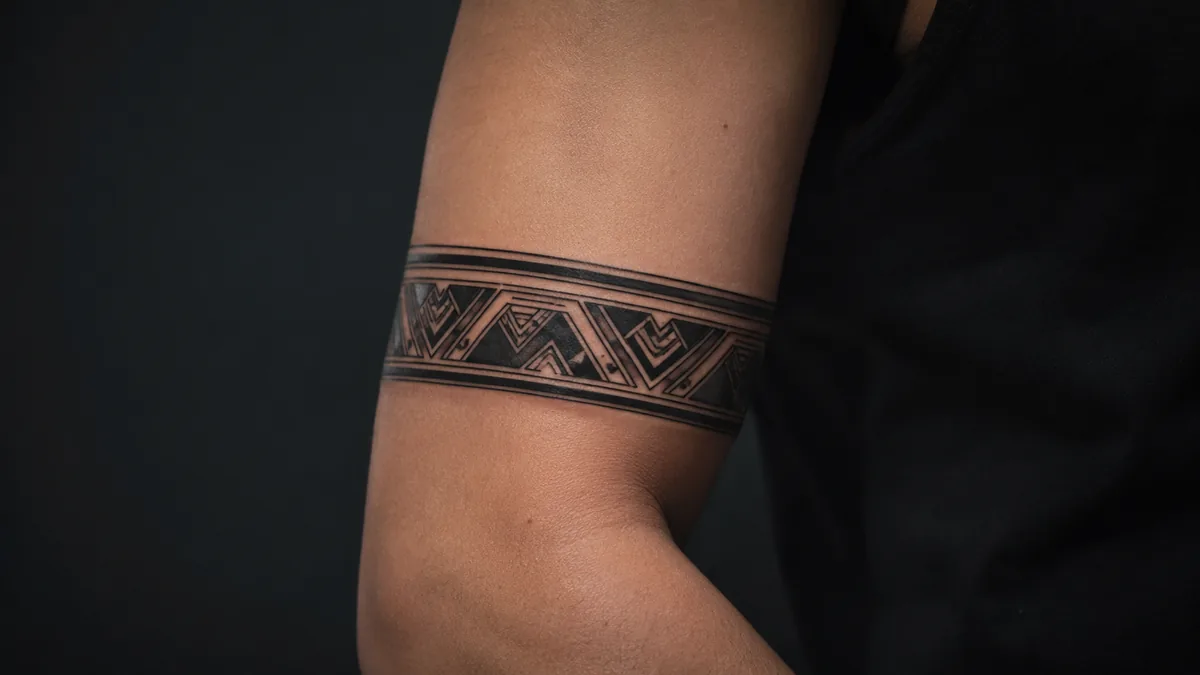
An arm band tattoo is exactly what it sounds like: a solid or decorative band that wraps all the way around the arm. Simple premise, but the meaning behind it runs deep. People get these for loss, for love, for identity, for culture. Some get one because it looks clean and bold. Most get one because it means something they don’t want to forget.
The armband sits in a category of tattoos that look strong from across the room and carry real personal weight up close. Whether it’s a solid black band, a tribal wrap, or a thin memorial line, the meaning depends on who’s wearing it and why. Let’s break it down honestly.
What an Arm Band Tattoo Actually Means
The most common meaning tied to a solid black arm band is grief and remembrance. In Western tattoo culture, people get a thick black band to honor someone who died. The idea is that you carry them with you everywhere you go, literally wrapped around you. It’s a quiet, permanent mark of loss that doesn’t need explanation. You see it and you know.
Beyond mourning, arm bands represent strength, endurance, and commitment. The full wrap around the arm symbolizes a boundary or a vow, something that holds and doesn’t break. Some people wear them as markers of a life chapter, a milestone, or a promise they made to themselves. The circle has no beginning and no end, which is a big part of why it reads as permanence.
Cultural and Historical Roots
A band that circles the arm never ends, that's the whole point.
Polynesian tattoo traditions are where arm band designs carry the oldest and most documented meaning. In Samoan, Hawaiian, and Maori cultures, bands and geometric wraps on the arm mark identity, rank, family lineage, and spiritual protection. Each pattern element means something specific. A solid row of triangles, a band of shark teeth, a twisted cord pattern: all of these carry cultural weight that has been passed down for generations.
Celtic knotwork arm bands have a long history in Irish, Scottish, and Welsh traditions. The interlocking lines with no visible start or finish represent eternity, continuity, and the interconnection of life and spirit. In military and warrior cultures across multiple continents, arm bands marked rank and valor. Know the roots of what you’re putting on your skin before you commit.
Solid Black Band vs. Decorative Designs
A solid, thick black band is the most direct version of this tattoo. Clean, bold, reads from across the room. No question what it is. This style suits anyone who wants a low-maintenance design that heals well and holds over time. Bold will hold. A thick saturated band keeps its definition for decades if the artist packs the black properly with no fading into a muddy gray blob ten years from now.
Decorative arm bands open up a massive range of styles: Polynesian geometric patterns, Celtic knotwork, fine line botanical wraps, dotwork mandalas, blackwork waves, or custom tribal designs. These take more session time and more healing care, but they give you something visually complex. Some clients mix both, running a solid black band with decorative breaks or negative space cut-outs. Make sure the design wraps clean with no awkward gap where the ends meet at the back of the arm.
Color vs. Black and Grey
Most arm bands are done in black and grey or solid black. There’s a reason for that. The arm is a high-wear zone. Sun exposure, friction from sleeves, constant movement. Color on the outer forearm and upper arm fades faster than you’d like. Bold color in an arm band can look incredible fresh, but without consistent SPF and touch-ups, it softens into something washed out within a few years.
If you want color in your arm band, go for it, but keep your expectations grounded. Saturated blacks and deep greens hold longer than pastels or whites. Black and grey with whip shade technique gives the band depth without sacrificing longevity. For memorial bands specifically, most people choose solid black because the gravity of what it represents calls for something permanent-looking and serious. Color can feel decorative. Black reads as intentional.
Placement and How It Ages
Upper arm bands sit on the bicep and tricep, which is a solid spot. The skin there is thicker, less sun-exposed than the forearm, and experiences less daily flexion stress. These heal nicely and age well. Factor in muscle growth if you’re actively training. A band that fits perfectly now may stretch and distort if you add significant size in that area over time.
Forearm bands are more visible and get more compliments day-to-day, but they take more sun and friction from watch straps, sleeve cuffs, and gym equipment. Fine line bands on the forearm will need touch-ups as they soften. Thick blackwork bands on the forearm hold the best. Wrist-level bands are the most painful of the group and sit in a high-traffic zone that can blur over time if the lines are too fine to hold their structure.
Pain Level and What to Expect in the Chair
Pain on the outer upper arm is manageable for most people, a solid four out of ten. The inner bicep is where things get spicy. Soft skin, close to nerves, and your artist has to work around your arm to complete the full wrap. The ditch, which is the inner elbow, is one of the more intense spots in tattooing. If your band crosses it, brace yourself. Most clients are surprised by how much more that section bites compared to the rest of the arm.
Forearm bands vary. The outer forearm is moderate. The inner forearm near the wrist gets more intense. The band has to wrap all the way around, so your artist will rotate your arm multiple times during the session. A solid thick band on the full upper arm can run one to three hours depending on width and detail. Decorative wraps with fine geometric patterns can push into multiple sessions. That full wrap is physically demanding to execute. Tip your artist well.
Who Gets Arm Band Tattoos and How to Make It Yours
Memorial arm bands are overwhelmingly common. People who’ve lost a parent, a sibling, a partner, or a close friend. Some add the person’s name or a date inside or beside the band. Others keep it clean and private, just the band, nothing else needed. Military and law enforcement communities wear arm bands frequently, often with symbols tied to their branch or unit. Athletes get them as markers of achievement or team identity.
To make an arm band personal, bring your artist something specific. A pattern that connects to your heritage, a width that reflects the gravity of what you’re marking, a design element that means something only to you. Talk to your artist about what it represents and build the design around that conversation. A good artist takes that story and turns it into something that holds. That’s what separates a tattoo from a generic design you grabbed off a reference sheet.









