
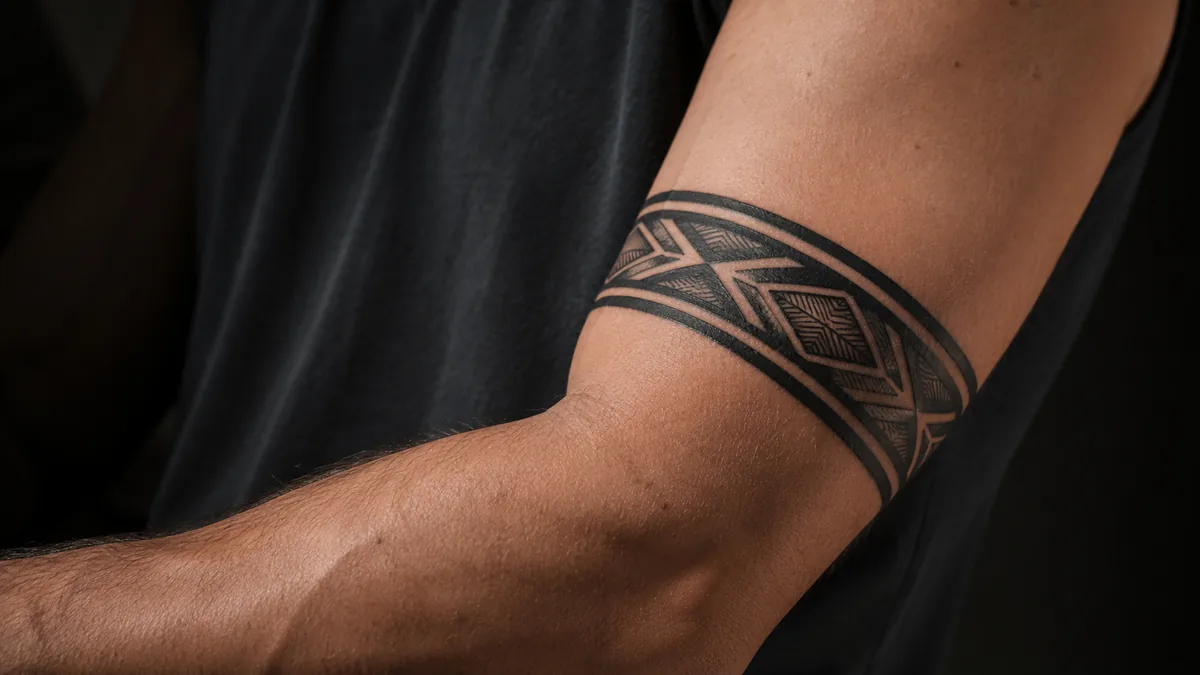
A band tattoo is exactly what it sounds like: a solid or patterned line that wraps all the way around a limb. Usually the arm, sometimes the wrist, the ankle, or the thigh. Simple concept, heavy meaning. These aren’t decorative filler. People get them for real reasons.
The symbolism depends on the design and the person, but a few core readings dominate. Grief, commitment, milestones, identity. Band tattoos are one of the oldest forms of body marking on the planet, and they still carry serious weight in a modern shop.
Core Meaning: What a Band Tattoo Actually Represents
The most common reason someone gets a solid black band is grief. Black armbands have signaled mourning across dozens of cultures for centuries. One band usually means one loss. Some people stack them, one for each person they’ve lost. It’s understated, it’s permanent, and it communicates without needing any explanation from across the room.
Beyond mourning, bands represent cycles, continuity, and commitment. A ring with no beginning and no end. Some people use them to mark the close of a chapter, a sobriety date, a survival milestone, or a relationship. The circle reads as wholeness or eternity depending on what the person puts into it.
Historical and Cultural Background
A band around your arm says everything without a single word.
Polynesian cultures, particularly Samoan and Maori traditions, have used circumferential banding patterns for thousands of years. Their geometric band tattoos carried rank, lineage, and spiritual protection. These weren’t random designs. Every element had function. Borrowing these patterns without understanding them is a conversation worth having with your artist before you commit.
In Western culture, black armbands as a mourning symbol go back at least to the Victorian era, when fabric armbands were worn publicly after a death. Soldiers wore them. Royalty wore them. The tattoo version carries the same signal, made permanent. Ancient Egyptian and Bronze Age mummies have also been found with banded tattoo markings on their limbs, so this is genuinely one of humanity’s oldest tattoo instincts.
Design Variations: From Solid Black to Intricate Patterns
Solid black is the most popular and the most readable. One crisp band, maybe 5 to 15mm wide, wraps clean around the arm. That’s it. No filler, no frills, and it hits hard. The simpler the concept, the more the execution has to be flawless. Blowout on a solid band is brutal because there’s nowhere to hide it.
From there, the range opens up. Dotwork bands, geometric patterns, Celtic knotwork, tribal linework, floral wraps, fine-line botanical wreaths, watercolor gradients. Ornamental bands pull heavily from mandalas and lace tattooing. Whip-shaded bands give you a softer fade rather than a hard edge. Each style changes the tone. Tribal reads strong and ancestral. Fine line reads delicate and personal.
Color vs. Black and Grey
Most band tattoos go black and grey or solid black, and for good reason. High-contrast, saturated black holds for decades on most skin tones. A bold black band that’s properly packed will still read clean 20 years out. It’s one of the best long-term investments in tattooing because the design has zero complexity to degrade.
Color bands are less common but they work. Red, deep blue, or forest green can hold if the pigment is quality and the placement is smart. Avoid high-wear zones for color. Pastel or light color on a band fades fast and gets muddy. If you want something that heals nice and stays sharp, black is the honest answer. Your artist will tell you the same.
Placement and How It Ages
Upper arm and forearm are the most popular placements. The skin is relatively stable, the shape of the limb is consistent, and the band wraps cleanly. Bicep bands land in a spot that’s lower wear, so they age well. Forearm bands get more sun and friction but still hold solid if the lines are packed correctly from the start.
Wrist bands are spicy and they fade faster. High wear, lots of movement, thinner skin. They need touch-ups more often. Ankle bands face similar challenges. Thigh bands are underrated: stable skin, easy to wrap, lower wear, and they heal nice. Wherever you go, the band needs to be a true circle or it will look off. Your artist should measure and wrap the placement before committing the stencil.
Stacking and Making It Personal
One band is a statement. Multiple bands are a system. When people stack them, spacing matters as much as the bands themselves. Tight clusters read differently than evenly spaced sets. Some people leave deliberate gaps for bands they plan to add later. Think about the finished look before you commit to the placement of band one.
Personalization comes through pattern, width, texture, and negative space. A single thin fine-line band reads fragile and intimate. A wide solid black band reads like armor. Adding a small break in the band, a gap with a word, a date, or a symbol, creates a focal point without cluttering the design. Talk to your artist about what you want the band to communicate and build from there.
Who Gets Band Tattoos and Why
Grieving people get them most often. The loss of a parent, a partner, a sibling, a best friend. A band is a way to carry that person without making it a portrait or a scene. It’s quiet. It’s daily. Survivors of addiction, serious illness, or trauma use them as a marker for the life before and the life after.
Athletes get them for team milestones or personal records. Veterans get them for service, sacrifice, or fallen brothers. Couples get matching bands instead of or alongside traditional ring tattoos. First-timers pick them because the concept is clean and the commitment feels right. There’s no one demographic. The band tattoo is universal because the idea of a circle, a cycle, a permanent mark of something that mattered, is universal.









