
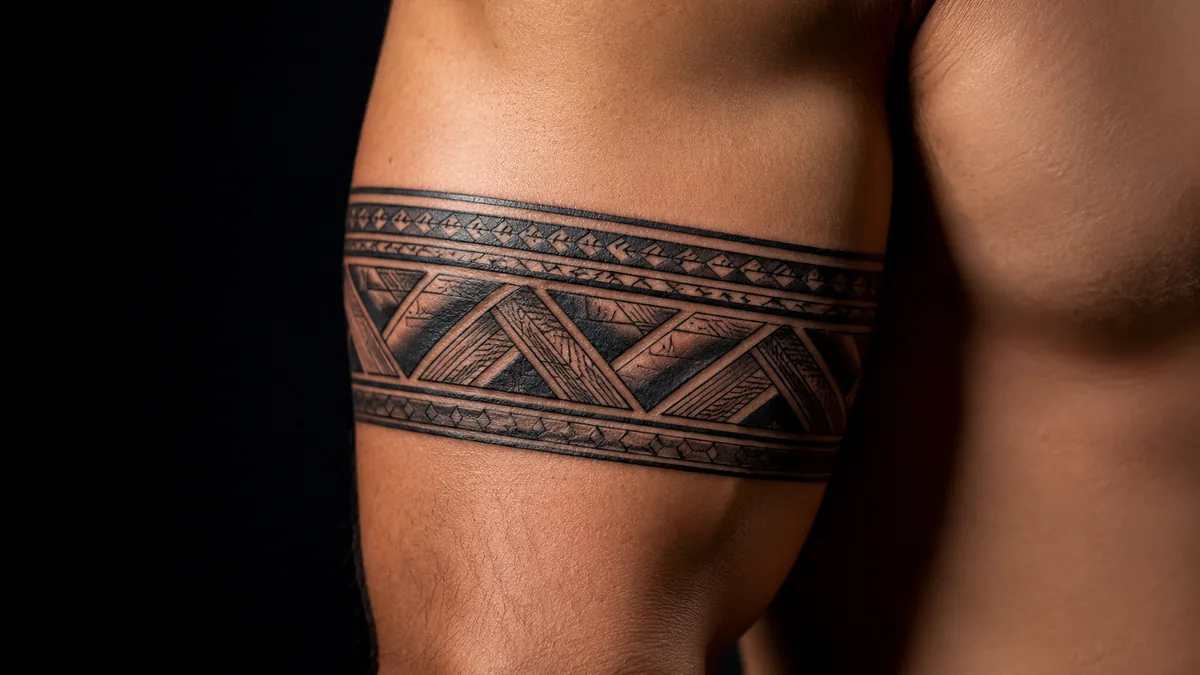
An armband tattoo is exactly what it sounds like: a band of ink that wraps all the way around your arm. No gaps, no breaks. That continuous loop is the whole point, and it’s loaded with meaning before you even pick a design.
People get armbands for a lot of different reasons, from marking grief to celebrating identity to just loving the look of a clean, bold wrap. The symbolism depends heavily on the style, color, and why you sat in that chair. Let’s break it down honestly.
The Core Symbolism: Continuity and Commitment
The loop that never ends is the armband’s most fundamental statement. It represents continuity, something without a beginning or a finish. People lean on that symbolism when they want to mark something permanent: a bond, a vow, a person they refuse to forget. The unbroken circle is one of the oldest human symbols for eternity, and wrapping it around your body makes it literal.
Strength and protection are the other big reads. A band around the arm echoes the look of armor, a warrior’s cuff, a shield. That resonance is real and it goes back a long way. A lot of people getting armbands describe the feeling of wearing something that holds them together, even if they couldn’t put that into words before they sat down.
Mourning Tattoos: The Black Armband Tradition
A line that never breaks means something. Make sure you know what.
A solid black armband, or a pair of them, is one of the most recognized mourning symbols in Western tattoo culture. It borrows directly from the tradition of wearing a black armband on the sleeve of a jacket to signal that you’re in grief. When someone translates that into permanent ink, they’re saying the loss doesn’t go away. It stays on the body because it stays in the life.
Some people get one band per person they’ve lost. Others get a thick single band that represents a specific death that changed everything. This meaning is widely understood in shops across the US. If you walk in asking for a solid black armband, most artists will ask who it’s for. It’s one of the most emotionally charged pieces you can book.
Cultural and Historical Roots Worth Knowing
Polynesian tattoo traditions, particularly Samoan pe’a and Hawaiian kakau, have used banded patterns around limbs for centuries. Those bands weren’t decorative choices. They marked rank, lineage, life milestones, and spiritual protection. The patterns inside the bands, solid fills, geometric shapes, spearhead rows, all carried specific meaning tied to the wearer’s identity and community.
Celtic knotwork armbands pull from a separate tradition. The interlocking, unbroken knotwork designs from Iron Age Celtic art were associated with interconnection and the eternal. Modern Celtic armbands are largely decorative interpretations, but the symbolism is genuine if you dig into the source material. Know what tradition you’re drawing from before you commit. It matters to do it with intention.
Design Variations: From Solid Bands to Detailed Wraps
The simplest form is a solid black band, one to three inches wide, sharp edges, no interior detail. It reads clean from across the room and heals nice because there’s no fine detail to blow out. Then you’ve got tribal patterns, geometric bands, barbed wire, floral wraps, vines, Celtic knotwork, and memorial designs that incorporate portraits or text inside the band. The range is enormous.
Fine line armbands have blown up recently. Single-needle or tight 3RL work can produce incredibly detailed patterns, but they require a skilled hand and realistic expectations about longevity. Fine line on the inner arm fades faster than bold work on the outer bicep. Whip shading inside a band can add depth without adding heavy saturation. Whatever you pick, the design has to wrap cleanly or the whole thing looks off.
Black and Grey vs. Color: What Actually Holds
Black and grey armbands age the best, full stop. Saturated black fills stay bold for years. Black and grey shading softens slightly but keeps its read. On a high-wear zone like the wrist or inner forearm, that matters. Color armbands can look stunning fresh out of the shop, but lighter colors, especially whites, yellows, and pastels, break down faster in areas that see constant sun and friction.
If you want color, go saturated. Deep reds, forest greens, navy blues, rich purples. They hold their structure significantly longer than soft tones. Your artist should be honest with you about how a specific color will perform on your specific skin tone. Don’t let anyone talk you into a white ink armband as a standalone piece. It looks great for about six months and then it’s a guess.
Placement, Pain, and How It Ages
Upper arm and bicep armbands are the most forgiving. The skin is thicker, the surface is relatively flat, and the band sits in a low-wear zone. It heals predictably and holds color well. The forearm is solid too, though the inner forearm is spicier on pain and sees more UV exposure, which accelerates fading. Wrist armbands are the most requested and the most high-maintenance placement on this list.
The wrist bends constantly, gets sun, and rubs against everything. Lines can blow out on the inner wrist if the artist goes too deep, and fine detail there is a gamble long-term. Bold will hold in this zone better than anything delicate. The upper arm near the elbow ditch is a spicy spot and the skin moves a lot, so keep designs simple there. Go into any armband consultation asking your artist how a specific design will age in the spot you want.
Making It Personal: What to Bring to Your Consult
The people getting armbands right now span every demographic, but the intent usually falls into one of a few camps: memorial, identity, spiritual protection, or pure aesthetic. None of those is more valid than the others. What makes an armband personal is intention and specificity. A generic tribal wrap means something different than one drawn from your actual ancestry, and your artist can tell the difference.
Bring reference, but also bring context. Tell your artist who you lost, what culture you’re connecting to, what the piece needs to feel like when it’s done. A good artist will shape the design around that information. The armband lives on you every day. It shows at the gym, at work, at the dinner table. Make sure the meaning behind it is something you’re ready to carry that publicly, because people will ask.









