Polynesian tattoos carry real weight. These aren’t flash designs you pick off a wall. Every element, every line, every shape in a traditional Polynesian piece ties back to identity, status, ancestry, and spiritual protection. When someone walks into my shop asking for Polynesian work, the first thing I tell them is: this style has a language, and you should know what you’re saying.
The core idea across all Polynesian tattooing is that the design is a living record. It tells who you are, where you come from, what you’ve survived, and what protects you. That concept hasn’t changed in over two thousand years. The tools have. The meaning hasn’t.
What Polynesian Tattoos Actually Mean
Polynesian tattoo symbolism centers on a few core ideas: protection, strength, status, and connection to ancestry. The ocean plays a massive role. Waves, turtles, sharks, and enata (human figures) all carry specific meanings. Waves represent change and the continuous journey of life. The turtle symbolizes longevity, fertility, and navigation. Shark teeth, called niho mano, are one of the most recognizable motifs and stand for protection, adaptability, and a warrior’s strength.
The sun is another constant. It represents leadership, brilliance, and eternity across nearly every Polynesian sub-culture. Spearheads signal courage and fighting spirit. Tiki figures, the stylized human face, are guardians that ward off evil. None of these meanings are arbitrary. They were chosen deliberately by the person being tattooed and often by the artist performing the ritual.
The Cultural Roots: Polynesia Is Not One Culture
A Polynesian tattoo is a biography in ink, every line is a word.
People say ‘Polynesian tattoo’ like it’s one thing. It’s not. Polynesia covers a massive stretch of the Pacific: Hawaii, Samoa, Tonga, Tahiti, the Marquesas, New Zealand. Each culture has its own tradition. Samoan tatau is one of the oldest continuous tattooing traditions on earth, with the pe’a (the male body suit from waist to knee) and the malu (the female equivalent) carrying strict cultural protocols. Marquesan tattooing from the Marquesas Islands is known for its dense geometric fills and bold black work.
Maori ta moko from New Zealand uses curved lines and spirals called koru, and traditionally each ta moko was unique to the individual, functioning like a fingerprint of identity. Hawaiian kakau used black geometric patterns tied to spiritual protection and tribal affiliation. Tahitian tattooing, suppressed by missionaries in the 19th century, has undergone a modern revival. Understanding which tradition your design draws from matters, both for accuracy and respect.
Core Symbols and Their Specific Readings
Breaking it down further: the hammerhead shark represents tenacity and sociability in Marquesan tradition. The manta ray means freedom and gracefulness. Stingrays can symbolize agility and the ability to hide from danger. Coconut trees represent life and prosperity. Ocean waves, depending on their form, can mean the afterlife or the sea as the origin of all things. Lizards (mo’o) are considered sacred in Hawaiian tradition and are seen as protectors against evil spirits.
The enata figure, a stylized human shape common across Marquesan and Tahitian work, represents people, ancestors, or enemies depending on its orientation. An upside-down enata traditionally meant a defeated enemy. Rows of enata can represent community or family lineage. The tiki’s wide eyes mean it sees all threats before they arrive. These readings are specific and documented. They’re not invented for Western tattoo clients, they come from the cultures themselves.
Design Styles and How They Look on Skin
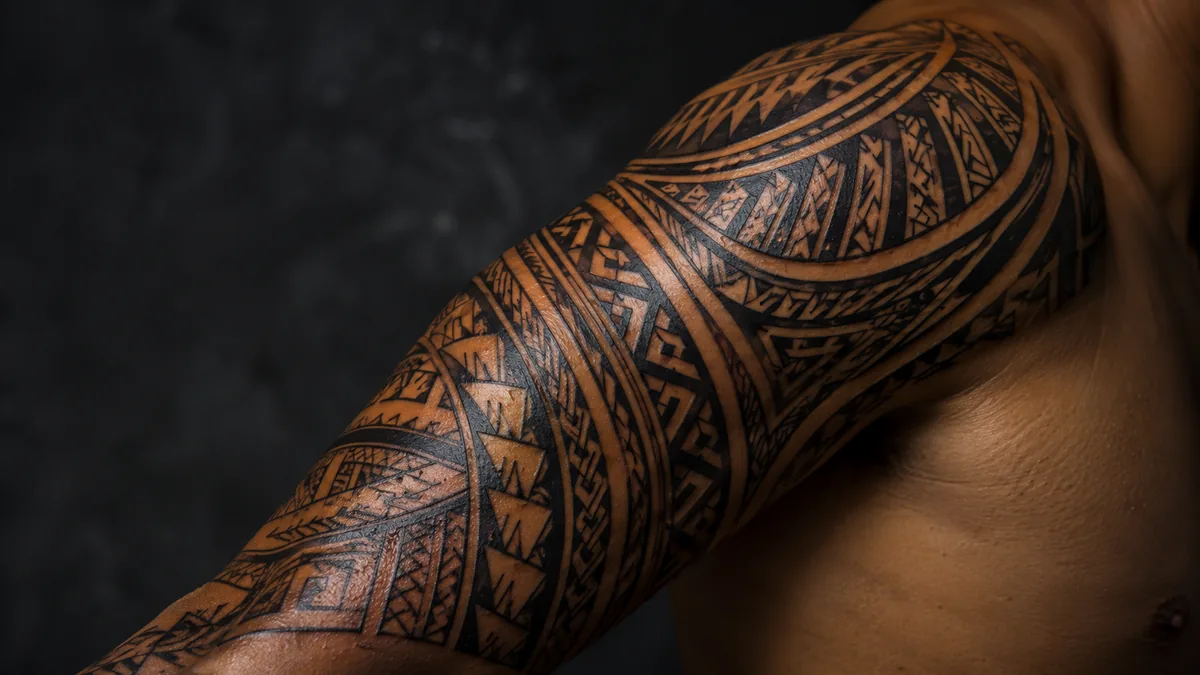
Traditional Polynesian work is almost exclusively black. Solid, saturated black fills. Crispy clean lines. Bold geometric shapes that read from across the room. The designs rely on contrast between filled black sections and negative space to create depth and pattern. This is not a style where you can go fine line and expect it to hold. Fine line Polynesian fades fast. The traditional approach, thick outlines and dense black fill, is what survives decades and still looks intentional.
Contemporary artists blend Polynesian motifs with other black work traditions, dotwork shading, or even realistic elements. Some clients request single Polynesian symbols as standalone pieces rather than full body compositions. A well-placed shark tooth band around a forearm or a turtle centered on a shoulder blade can be just as impactful as a full sleeve. The key is cohesion. Random Polynesian symbols mixed without composition logic look scattered. A good artist builds the piece around a visual anchor and a story.
Color vs. Black and Grey in Polynesian Work
Traditional Polynesian tattooing used black exclusively, made from soot and water pressed into the skin with bone or tusk combs. Color is a modern adaptation. Some contemporary shops do Polynesian-inspired sleeves with blue-grey washes or even full color backgrounds, but that’s a fusion style, not traditional. If you want something that reads as culturally grounded, black is the answer.
Black and grey Polynesian work is common in Western studios and holds extremely well. Whip shading can soften the transition between geometric fills and negative space. The contrast of saturated black against skin gives these designs their visual power. If you’re set on color, keep the Polynesian linework in solid black and use color selectively in background elements. Mixing pastel watercolor with traditional Polynesian motifs tends to undercut the boldness of the forms. Bold will hold. Soft pastels won’t.
Placement and How These Tattoos Age
Polynesian work was traditionally placed with purpose. The pe’a covers the body from waist to knee. Arm sleeves and chest pieces are common. Shoulder and upper arm placements are extremely popular in Western studios because the surface is flat and the skin ages relatively well there. A full back piece or a thigh piece gives the artist enough real estate to build a proper composition with distinct zones and visual flow.
High-wear areas like the inner forearm, hands, and feet will chew through fine details over time, but solid black Polynesian fills hold up much better in those spots than fine line work would. Knee and elbow ditches are spicy spots and the skin moves a lot, which can distort geometric patterns. The outer upper arm, chest, shoulder, and back are your best bets for longevity and visual impact. These pieces are meant to be read as a whole, so give the design room to breathe.
Pain Levels by Placement
Polynesian pieces often cover large areas, so pain tolerance and session length are real conversations to have. The upper arm and outer shoulder are manageable for most people, roughly a 4 to 6 out of 10. The chest, especially near the sternum and collarbone, gets spicier, 6 to 8. The ribcage is brutal for extended sessions. The thigh and back are workhorses for long sessions because the skin is thick and the area is large enough to move around, giving you mental breaks from any one spot.
Full sleeve or leg work in this style requires multiple sessions. Breaking it into 4 to 6 hour sessions with proper healing time between them is standard. Trying to rush a Polynesian sleeve into one marathon session is how you get blown-out lines from swelling skin. Give it time. The design rewards patience. A healed, fully settled Polynesian piece with good contrast is one of the most striking things you can wear.
Making a Polynesian Tattoo Personal and Doing It Right
If you’re not Polynesian, you can still get this work done respectfully. The key is being intentional. Research which tradition speaks to you. Choose symbols that genuinely connect to something in your life, your values, your history, your family. Work with an artist who specializes in the style and understands the grammar of the motifs, not just someone who googles a pattern and traces it. Bring references, have a real conversation about what you want the piece to say.
Avoid slapping random symbols together because they look cool. That’s how you end up with a piece that has no internal logic and reads as costume. The meaning of Polynesian tattooing is that it is specific to the person wearing it. Honor that. If an artist pushes back on a combination that doesn’t make sense culturally, listen. A great Polynesian piece takes time to design, time to tattoo, and heals into something that genuinely tells your story. That’s the whole point.