The rooster is one of those tattoos that hits hard without trying to be clever. It stands for courage, pride, watchfulness, and a refusal to back down. People have kept roosters close for thousands of years as a symbol of the dawn and the fight, and that carries straight onto skin.
You’ll see rooster tattoos across a wide range of collectors, from guys celebrating their Chinese zodiac year to women reclaiming the cock-of-the-walk confidence the image naturally projects. The meaning is old and it’s real. This one earns its place on your body.
Core Symbolism: What a Rooster Tattoo Actually Means
The rooster’s main readings are courage, vigilance, and masculine energy. He announces the day, holds his ground, and fights without hesitation. That combination makes him a natural pick for anyone who identifies with showing up first, standing their ground, and leading without apology. He is not subtle and he does not hide.
Secondary meanings include pride, fertility, and resurrection. Because the rooster crows at first light and signals the end of darkness, many traditions read him as a symbol of renewal and hope. A rooster tattoo can honestly carry all of these at once, or you can lean hard into just one thread depending on how you design it.
Cultural and Historical Background
The rooster doesn't ask for quiet, it announces the day whether you're ready or not.
In ancient Greece and Rome, roosters were sacred to Ares and Athena, the war deities, and to Asclepius, the god of healing. Socrates famously asked that a rooster be sacrificed to Asclepius at his death, linking the bird to gratitude and a debt paid. In Norse mythology, roosters crowed to warn the gods of approaching enemies. That warrior-watchman combination is consistent across continents.
In France the Gallic rooster has been a national symbol since antiquity, representing the French people’s fighting spirit. In West African and Afro-Caribbean traditions, the rooster is tied to spiritual protection and offerings. Japanese imagery pairs the rooster with the rising sun, Shinto shrines, and samurai virtues. Every angle is legitimate, so knowing your reference sharpens the design.
Chinese Zodiac and the Year of the Rooster
If you were born in 1957, 1969, 1981, 1993, 2005, or 2017, you are a Rooster in the Chinese zodiac. Rooster people are described as observant, hardworking, confident, and sometimes blunt. The zodiac angle is one of the most common motivations for this tattoo in Western studios right now, especially paired with traditional Chinese or Japanese aesthetics.
A zodiac rooster tattoo usually goes bold. Think Irezumi-influenced feathers, chrysanthemum backgrounds, or a clean five-color palette. The symbolism here is personal identity first. It says this is who I am by birth, not just what I admire. That distinction gives the piece a biographical weight that purely decorative animal tattoos do not always carry.
Popular Design Styles and Variations
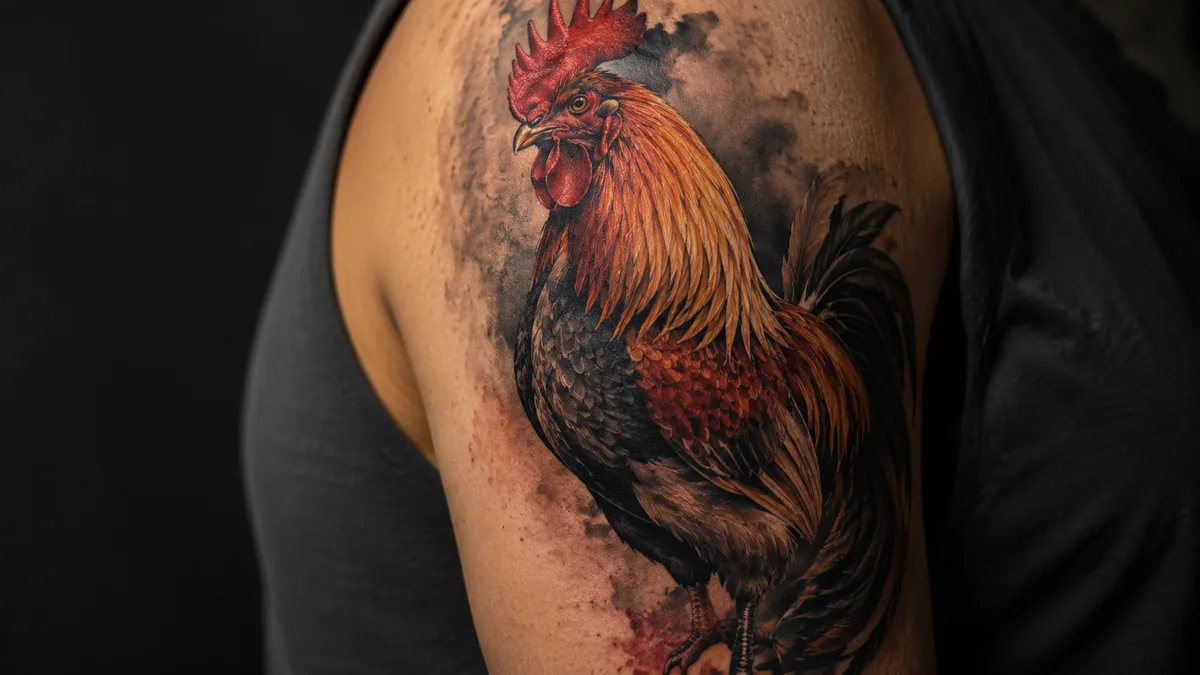
Traditional American rooster tattoos are among the strongest in the genre. Bold outlines, solid red combs, clean color fills, simple backgrounds. They read from across the room, age well, and stay crispy for years when placed right. Neo-traditional adds more illustrative detail to the feathers without losing the saturated palette. Both styles give you a tattoo that holds its shape through a decade of sun.
Japanese-style roosters lean into dramatic composition: flowing tail feathers, peonies or waves in the background, heavy black ink anchoring the image. Fine line roosters are trending but require careful placement and a skilled hand because thin lines on high-wear zones will blur. Blackwork and black and grey roosters drop the color entirely and focus on texture and shading, using whip shade or stipple to render the feathers with real depth.
Color vs. Black and Grey
Color wins on a rooster. The bird is built for it. Rich reds on the comb and wattles, deep greens and blues in the tail feathers, warm golds in the body. A fully saturated traditional or neo-traditional rooster is one of the most visually complete tattoos you can get. The color tells the story at a glance and commands attention in a way that monochrome sometimes cannot.
That said, black and grey done right is a different kind of statement. It forces the design to live or die on shape and shadow alone. A solid black and grey rooster with skilled shading looks painterly and serious. It tends to pair better with sleeves that use a muted palette. If you are going black and grey, push for maximum contrast between the highlights and deep shadows or the feather detail gets lost as it heals.
Placement, Pain, and How It Ages
The rooster has real visual mass. It needs room to breathe. The thigh, upper arm, calf, chest, and back all work well. These are lower to mid-pain zones depending on your build, and they give the artist space to render those tail feathers properly. A rooster crammed into a small patch becomes unreadable. Give it at least a four-by-four footprint, more if you are going detailed.
Avoid putting fine line roosters on hands, fingers, or feet. Those are high-wear zones and the ink breaks down faster. A bold traditional rooster on the forearm or outer calf will still look solid after ten years if you moisturize, stay out of the sun when it is fresh, and keep sessions out of peak summer heat. Placement on the ribcage and sternum is spicy. Worth it, but know what you are signing up for.
Who Gets Rooster Tattoos and How to Make It Personal
Rooster collectors are a wide group. Chinese zodiac Roosters are a strong segment. So are fighters, trainers, and athletes who connect with the never-back-down energy. People with French or Gallic heritage use it as a cultural marker. Farmers and people with deep roots in agricultural or rural life use it as a nod to that world without being sentimental about it.
Making it personal comes down to context and detail. Add a banner with a date, a name, or a word that anchors the meaning to your life. Choose a background that references your culture or your aesthetic. A rooster crowing at a rising sun reads differently than one with spurs up in a fighting stance. Talk to your artist about posture and expression before you commit to a sketch. That conversation is where a generic flash piece becomes yours.