
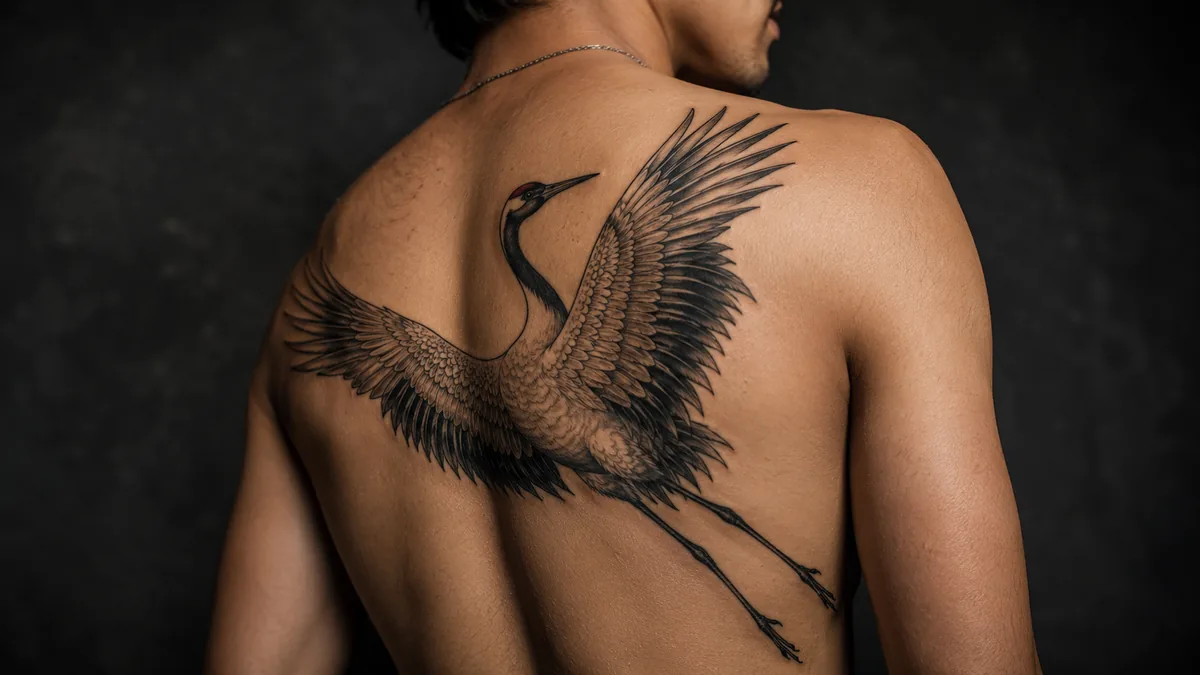
The crane is one of those tattoos that carries real weight without being loud about it. It reads clean from across the room and means something deeper the closer you look. People get cranes for longevity, good fortune, love, and transformation, and every one of those meanings has roots in actual cultural history, not some made-up internet lore.
Whether you want a delicate fine-line piece on your forearm or a bold Japanese-style crane covering your whole back, understanding what this bird stands for helps you make the tattoo yours. Here is the honest breakdown of crane tattoo meaning, style, and placement.
Core Symbolism: What a Crane Tattoo Actually Means
The crane represents longevity, wisdom, and good fortune across most of the cultures that have used it as a symbol. It is a bird associated with high ideals, specifically the idea that you live long, stay graceful under pressure, and carry yourself with dignity. That reads true in real life too. Cranes mate for life in many species, which makes them a natural symbol for loyalty and lasting love.
Beyond that, cranes are connected to transformation and freedom. They migrate, they soar at serious altitude, and they move with a precision that looks effortless. A lot of people get a crane tattoo to mark a major life change, a hard chapter they survived, or a commitment to living with more intention. The symbolism is flexible enough to be personal without being vague.
Japanese Crane Tattoo: The Origami Crane and Senbazuru
A crane carries a thousand years of meaning in every feather.
In Japanese culture, the crane, called tsuru, is one of the most sacred animals. It symbolizes longevity, luck, and fidelity. The red-crowned crane appears in Japanese art going back centuries, often paired with pine trees or the sun to reinforce themes of endurance and vitality. Japanese irezumi tattooing has used the crane as a central motif for generations, and the imagery is deeply tied to traditional tebori work and bold woodblock-print aesthetics.
Then there is the paper crane, the origami crane tied to the legend of senbazuru. The belief holds that folding one thousand paper cranes grants a wish, most often health or long life. Sadako Sasaki, the young girl who became a symbol of Hiroshima’s aftermath, brought that legend worldwide. Origami crane tattoos carry that specific meaning: hope through persistence, healing, and the refusal to give up. That is serious subject matter and the tattoo wears it honestly.
Chinese and Other Asian Symbolism
In Chinese tradition, the crane is associated with immortality and is often depicted carrying souls to heaven. Taoist imagery frequently shows sages riding cranes as a symbol of transcendence and spiritual elevation. The crane also represents high official rank in imperial China, where civil officials of the first rank wore the crane on their robes. That is real historical context, not decoration.
Korean culture similarly honors the crane as a symbol of longevity and purity. The red-crowned crane appears in Korean art, ceramics, and embroidery with consistent meaning: long life, noble character, and grace. For anyone with roots in these cultures, a crane tattoo can be an explicit nod to heritage. For people outside these traditions, the symbolism still holds up on its own merits, just be aware of what you are referencing and wear it with respect.
Popular Design Styles: From Traditional Japanese to Fine Line
Japanese traditional and neo-traditional are the most common styles for crane tattoos. Big bold outlines, saturated reds and blacks, dynamic wing positions. A crane mid-flight with wings fully spread reads strong and dramatic. Pair it with cherry blossoms, waves, or clouds and you have a composition that fills a sleeve or a chest piece with real visual impact. These designs are built to last. Bold will hold, and the solid fills and thick lines age predictably.
Fine line cranes are the other dominant style right now. Single-needle work, minimal shading, sometimes just the silhouette of a crane in flight. These look incredible fresh. The trade-off is honest: fine line work fades faster, especially on high-wear zones like hands or wrists. On the ribcage, inner arm, or thigh, a fine line crane can age beautifully if the artist executes it with the right needle depth. Blowout is a real risk with fine line on loose skin, so placement matters a lot.
Color vs. Black and Grey
Color cranes hit different depending on the palette. The red-crowned crane is the most iconic, and a well-executed red cap on a black and white bird is a composition that is hard to beat. It is graphic, it reads from a distance, and the contrast is clean. A full-color Japanese crane with turquoise, gold, and red in the feathers can be stunning, but it demands an artist who saturates color properly and understands how those pigments age together.
Black and grey cranes have a quieter elegance. Whip shading on the feathers can give the wings incredible texture and movement. A black and grey crane in flight, done in a realism or illustrative style, can look photographic when the artist nails the gradients. These age more predictably than saturated color work, and they hold up across most skin tones. If you are torn, look at the artist’s healed work, not just fresh photos. Healed is the real test.
Placement: Where a Crane Tattoo Works Best
Cranes with spread wings need room. A back piece, a thigh, a chest, or a full sleeve are the natural homes for a large crane composition. The bird’s wingspan translates directly into design real estate, and cramming it into a small space collapses the detail. A back piece crane is a statement piece that gives the artist full range to work the negative space and show the bird in motion.
Smaller cranes work on the forearm, upper arm, behind the ear, or on the ankle. A single flying crane on the inner forearm is a popular placement because it stays visible to the wearer and reads clearly to others. The ribcage and sternum are less common but work well for fine line cranes, though the ribcage is legitimately spicy for pain. The foot and hand placements fade fast and are high-wear zones, so be realistic about touch-up needs if you go that route.
Who Gets Crane Tattoos and How to Make It Personal
Crane tattoos attract people who want symbolism with substance. Survivors of serious illness who connect with the senbazuru legend. People celebrating long partnerships or marriage. Anyone with Japanese, Korean, or Chinese heritage who wants to wear that lineage visibly. Artists and creatives who connect with the crane’s association with beauty and precision. The symbolism is broad enough that it fits a lot of life experiences without feeling generic.
To make a crane tattoo yours, bring context to the consultation. Tell your artist what the crane means to you specifically. That shapes whether you go traditional Japanese with bold color or quiet fine line. It shapes what you add around it, cherry blossoms for impermanence, pine for endurance, waves for resilience. A crane without any thought behind it is just a pretty bird. A crane with intention is a piece you will explain to people for the rest of your life, and mean every word of it.









