
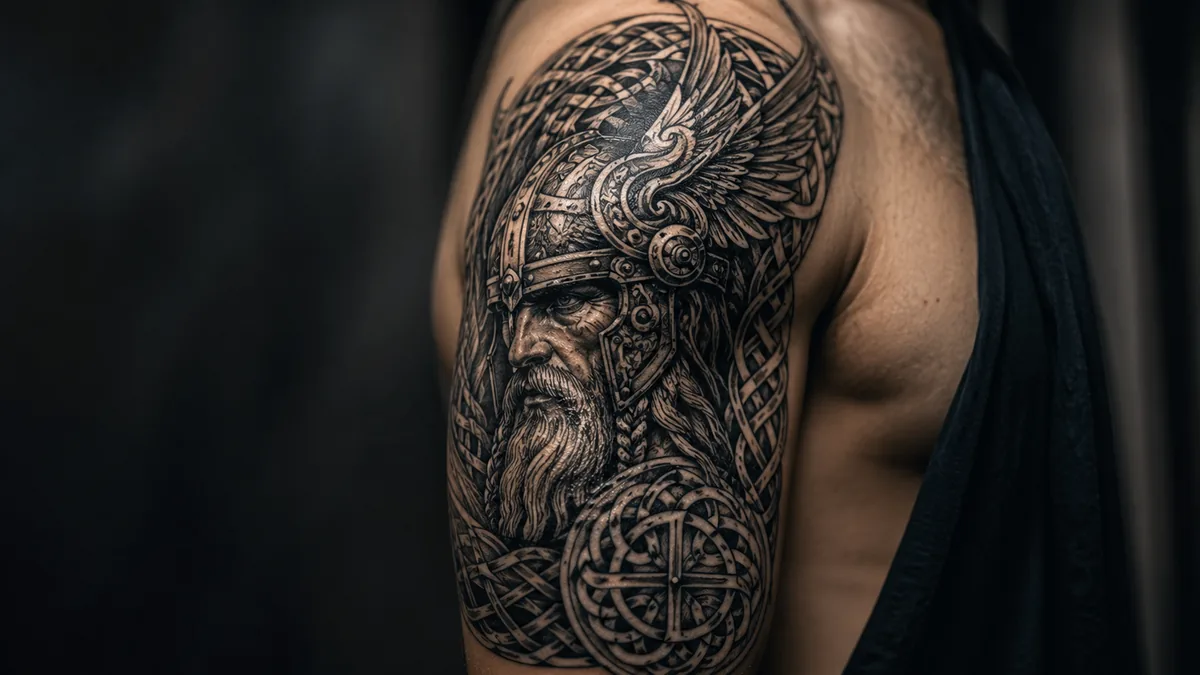
Viking tattoos are one of the most loaded categories in the shop. You’ve got people walking in wanting Thor’s hammer, others want a full Norse compass, and some just know they want something that feels ancient and powerful. The symbolism is real, it goes back over a thousand years, and it holds up under skin.
What makes Viking tattoos stand out is that the imagery isn’t decorative for decoration’s sake. Ravens, axes, serpents, runes, all of it carried specific meaning for Norse people. Understanding what you’re putting on your body makes the piece hit different, for you and for everyone who reads it.
Core Symbolism: What Viking Tattoos Actually Mean
Viking tattoos represent strength, courage, protection, and a connection to fate. Norse culture was built around warriors who believed their destiny was woven by the Norns and that dying in battle earned them a place in Valhalla. That mindset is baked into almost every symbol. An axe means readiness and resolve. A longship means journeys taken, risks accepted. Runes mean something specific based on which one you choose.
The overarching theme across Viking imagery is that life is a fight and you face it head-on. That resonates if you’re a veteran, an athlete, or someone who’s come through serious hardship. People get these pieces as declarations. They’re not just cool aesthetics. They’re statements about how you move through the world.
The Real Norse Symbols and What Each One Stands For
Every rune was a word before it was a tattoo.
The Vegvisir, often called the Norse compass, is one of the most tattooed symbols in this category. It appears in an Icelandic grimoire from the 1600s and was meant to guide the bearer through storms. Mjolnir, Thor’s hammer, represents protection and raw power. The Valknut, three interlocked triangles, is associated with Odin and the slain warriors he chose. Huginn and Muninn, the twin ravens, represent thought and memory.
Yggdrasil, the world tree, covers the nine worlds of Norse cosmology and works as a symbol of connection, roots, and the full scope of existence. The Helm of Awe, or Aegishjalmr, was believed to induce fear in enemies and protect the wearer in combat. Each of these has documented historical context. They’re not invented. That’s what separates them from generic tribal work.
Historical Background: Who Actually Had Tattoos in Norse Culture
Here’s where it gets honest. No hard archaeological evidence confirms that Norse Vikings themselves were heavily tattooed. Ibn Fadlan, an Arab traveler who encountered Rus Vikings in 922 AD, described them as covered in dark green patterns from fingernails to neck, likely describing tattoos or body paint. That’s one of the clearest historical references we have.
Modern Viking tattoos are largely a revival and reinterpretation. Tattoo artists and enthusiasts have taken documented Norse art, symbols from the Eddas, and runestone carvings and built a full visual language around them. That’s not a problem. Tattooing has always evolved across cultures. The symbols themselves are historically grounded even if the tattooing tradition as we practice it today is a modern interpretation.
Popular Design Variations and Styles
Blackwork and geometric renditions of the Vegvisir and Helm of Awe are the most requested. Clean linework, tight geometry, no filler fluff. They read crisp even at smaller sizes. Full Norse sleeves typically layer Yggdrasil as the central element with ravens, wolves, serpents, and rune scripts woven through. Dotwork adds texture and depth without needing heavy black fill. Fine line versions exist but require an experienced hand to stay solid over time.
Illustrative blackwork is the go-to for larger Viking pieces. Think Odin in a wide-brimmed hat, crows on his shoulders, spear in hand. Or a longship cresting a wave rendered with confident bold linework and whip shading in the water. Neo-traditional adds color and heavier outlines. Traditional American Viking pieces use that classic bold outline, limited palette, and solid color fills. All of these age well because the foundational shapes are strong.
Black and Grey vs. Color on Viking Pieces
Black and grey dominates this category for a reason. The imagery traces back to stone carvings and runestones, so a desaturated palette feels natural and historically adjacent. A black and grey Yggdrasil heals clean, reads from across the room, and ages with dignity. The contrast holds for decades when the artist uses proper black and a full grey wash spectrum.
Color works when it’s deliberate. Deep blues and greens on a longship at sea can look incredible. A saturated red Mjolnir pops against a black and grey background. The risk with heavy color on Viking pieces is that the imagery can start to read more fantasy-game than grounded Norse. If you want color, keep the line weight bold. Bold will hold. Fine saturated color on large complex pieces can blow out or blur into the surrounding blackwork as it heals.
Placement and How Viking Tattoos Age
The chest, upper arm, forearm, and back are the strongest placements for Viking tattoos. The Helm of Awe on the sternum is a classic. Full back pieces with Yggdrasil are ambitious and pay off when done right. Sleeves built around Norse themes work well because the imagery scales and flows naturally around the arm.
Avoid putting dense runic script or tight geometric compass work on the hands or fingers unless you’re ready to touch them up regularly. High-wear zones fade fast and those areas are spicy. Inner wrists hold fine line work reasonably well but go bold if you want it to survive five years without looking washed out. Neck placements on Viking imagery tend toward bold symbols like ravens or simple runes, nothing so detailed it turns to mud at that scale.
Who Gets Viking Tattoos and How to Make Yours Personal
Scandinavian heritage is a big motivator. People with Norwegian, Swedish, Danish, or Icelandic roots often choose Viking imagery to mark that lineage. But you don’t need ancestry to wear these symbols. The themes of resilience, protection, courage under pressure, and connection to something larger than yourself are universal. Veterans, first responders, athletes, people recovering from illness, all of them find something in Norse imagery that fits.
To make it personal, pick a symbol that matches your actual story. If you’ve navigated something disorienting and come through it, the Vegvisir makes sense. If you identify with the idea of sacrifice and wisdom, Odin is your guy. Work with your artist to integrate a rune or two that carry specific meaning for you. Keep the design grounded in real Norse visual language rather than mixing in generic tribal or fantasy elements. That’s what separates a strong Viking piece from a wall of noise.









