
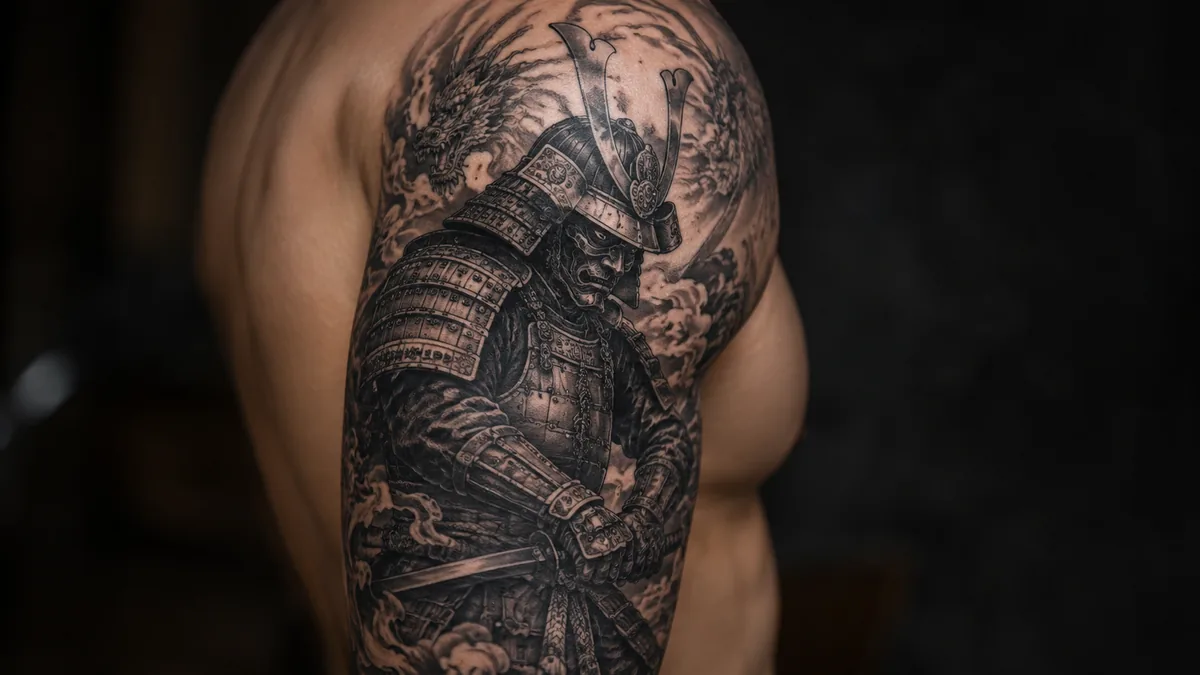
The samurai tattoo is one of the heaviest pieces you can wear. It’s not just a dope Japanese design, it carries real weight. Honor, loyalty, discipline, and a fearless relationship with death. That’s the core of what this tattoo means, and people feel that when they see it on skin.
It also hits different depending on how it’s built. A full armored warrior reads differently than just a Kendo mask or a lone ronin. The design choices you make shape the message. So before you sit in the chair, know exactly what you’re putting on your body for life.
Core Meaning: Honor, Discipline, and Loyalty
The samurai tattoo at its foundation represents the Bushido code. That’s the warrior’s way. Seven virtues: righteousness, courage, benevolence, respect, honesty, honor, and loyalty. People who get this tattoo are usually drawn to at least one of those values hard. It’s not a random aesthetic pick for most collectors. It means something personal.
Discipline is the one that comes up most often. The idea that you commit to a path and you don’t quit. Loyalty runs close behind, both to people and to your own principles. This is a tattoo for someone who takes their word seriously and lives by a personal code, not just someone who thinks samurai look cool.
Death Without Fear: The Deeper Symbolism
The samurai never fought for glory, the tattoo shouldn't either.
A samurai was trained to accept death as part of life. Not in a dark, nihilistic way. In a grounded, present way. You do your duty, you live with integrity, and when the time comes you face it clean. That philosophy is baked into samurai imagery. It’s why cherry blossoms show up constantly in samurai pieces.
Cherry blossoms fall at their peak. That’s the point. Beauty, impermanence, acceptance. When you combine that with a warrior figure, the tattoo becomes a meditation on living fully without clinging to outcome. Plenty of clients getting this piece have been through something. Loss, illness, a hard stretch. It lands differently after those moments.
Real Historical Background
Samurai were the military nobility of feudal Japan, roughly from the 12th century through the 19th. They weren’t mythological. They were real soldiers, administrators, and landowners who operated under a rigid social and ethical structure. The Meiji Restoration in 1868 formally abolished the samurai class, which is partly why the imagery carries this bittersweet weight. They’re a closed chapter.
Japanese tattooing has its own long history, but samurai imagery in Western tattooing grew through cultural exchange, films like Akira Kurosawa’s classics, and the rise of Japanese traditional and neo-traditional styles in American shops. The symbolism transplanted cleanly because the values, courage, integrity, mastery, are universal. That’s why it works on anyone’s skin.
Popular Design Variations and Styles
Full armored samurai in Japanese traditional style is the classic. Bold outlines, saturated colors, flowing waves or cherry blossoms as background filler. Reads from across the room, ages like a tank if the linework is solid. Neo-traditional gives you more dimension and painterly shading while keeping strong structure. Both styles are built for longevity.
A ronin, the masterless samurai, has its own edge. It signals independence and self-determination rather than loyalty to a master. Some clients go for just the kabuto helmet, the mask, or a katana with minimal surrounding detail. Fine line samurai pieces are popular right now but require a skilled hand. Fine line on texture-heavy areas fades fast. Bold will hold. Know which version matches your skin and the zone you’re working with.
Color vs. Black and Grey
Color Japanese traditional samurai pieces are stunning, full stop. Deep reds, golds, blacks, and whites with strong outlines. They pop on lighter skin tones and hold color well if kept out of direct sun. The tradeoff is you’re committing to touch-ups over the years to keep that saturation crispy. A well-done color piece is a legacy tattoo done right.
Black and grey samurai work beautifully and heals cleaner on a wider range of skin tones. Whip shading and fine gradients give the armor incredible depth. It also ages more predictably. For darker skin tones, high-contrast black and grey with heavy ink saturation in the darks is the move. The armor detail really pops when the blacks are packed solid and the highlights are strategic.
Best Placement and How It Ages
The thigh, upper arm, and back are the classic zones for samurai pieces and for good reason. Enough real estate to include armor detail, background elements, and negative space without cramming everything together. The back is the ultimate canvas for a full samurai, easily one of the most impressive large-scale Japanese pieces you can wear. Upper arm to shoulder to chest makes a strong sleeve foundation.
Avoid heavy detail work on hands, fingers, and feet for anything you want to still read in ten years. High-wear zones blur and blow out faster than people expect. The ribs are spicy but give you a long panel that works well for a standing warrior figure. Inner bicep fades faster than outer. A good artist will orient the piece so it faces the viewer when your arm hangs at your side.
Who Gets This Tattoo and How to Make It Personal
This tattoo attracts people who have fought for something. Veterans, martial artists, people rebuilding after serious setbacks, and collectors who take Japanese style seriously as an art form. It’s also popular with people who grew up on anime, manga, or samurai cinema and developed genuine appreciation for the culture and aesthetic. All of those are valid entry points.
To make it personal, talk to your artist about specifics. A ronin signals something different than a loyal warrior. Adding your family mon, the Japanese family crest, roots it in identity. Incorporating a specific weapon, a naginata vs a katana, changes the visual language. A strong concept combined with a skilled Japanese-style artist who respects the tradition will give you a tattoo that earns its place on your skin.









