
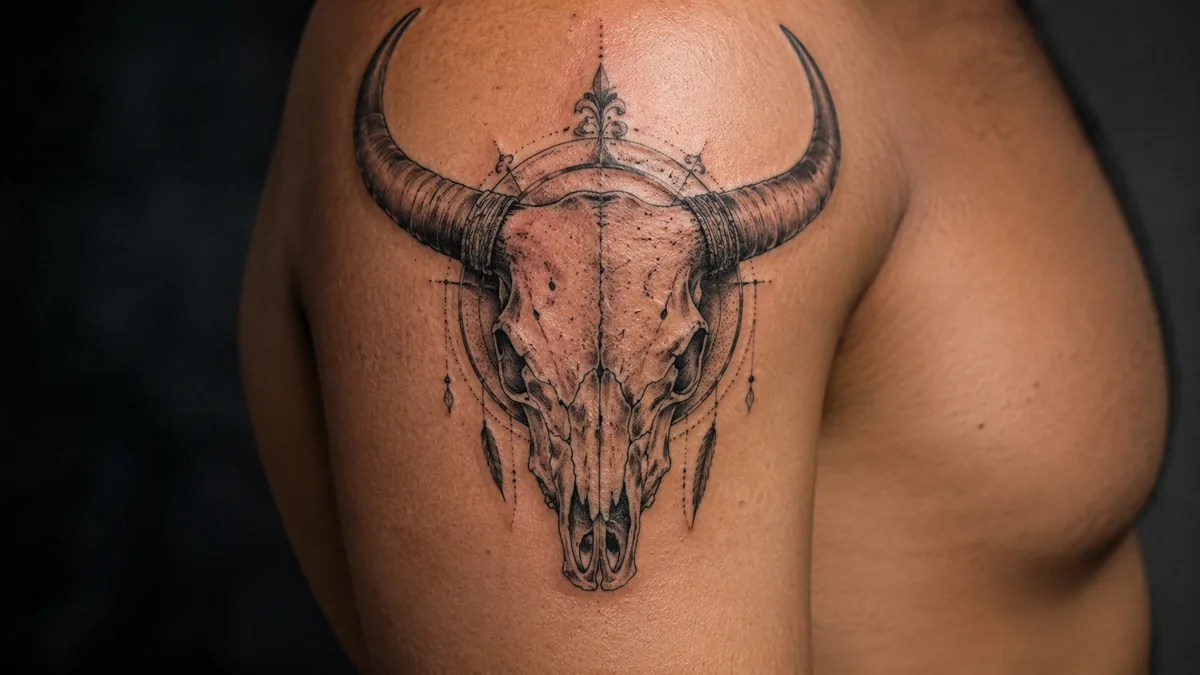
The bull skull tattoo is one of those images that hits you immediately. It’s bold, it’s stark, and it carries weight. this symbol is about facing mortality without flinching. The skull part acknowledges death; the bull part brings power into that conversation. Together, they say something most people spend their whole lives trying to avoid thinking about.
People get this tattoo for real reasons. It’s not just a cool-looking piece of flash. It ties into strength, survival, the American Southwest, spiritual protection, and the stubborn refusal to be broken by hard times. Here’s the full breakdown of what a bull skull tattoo actually means.
Core Symbolism: What a Bull Skull Really Says
The bull itself stands for raw power, courage, and an unstoppable force. Bulls don’t negotiate. They charge. So when you take that animal’s skull, you’re combining that brute strength with the universal language of death. What you get is something that says: I am powerful even in death, or, death has power but so do I. That tension is what makes the image so compelling.
Most people who wear this tattoo are drawn to themes of resilience and mortality awareness. It’s not morbid in a dark, hopeless way. It’s more stoic. You know life is finite, you know hardship is real, and you’re not running from that. You’re wearing it. That’s the emotional core most collectors are working with when they sit down for this piece.
American Southwest and Cultural Roots
The skull of a bull doesn't whisper, it commands the space it's given.
The bull skull, specifically as a bleached desert skull with horns, is deeply tied to the American Southwest. Think Georgia O’Keeffe paintings in New Mexico galleries. The imagery of sun-bleached cattle skulls scattered across desert landscapes became visual shorthand for that region’s harsh, beautiful, unforgiving terrain. It signals the frontier, survival, and a connection to that specific landscape and its history.
Some Native American cultures use animal skulls ceremonially as offerings or protective symbols, but the tattoo version is more broadly Western American in its popular reading than tied to any single tribe’s tradition. The imagery as a tattoo trend grew largely out of Western Americana aesthetics and ranch culture. Wear it for what it honestly means to you, and if you want to incorporate specific cultural references, talk to your artist about doing that respectfully.
Strength, Death, and the Space Between
The skull alone means death. The bull alone means strength. Put them together and you’re working in the overlap between the two. A lot of veterans, first responders, and people who’ve been through serious physical or emotional trauma gravitate toward this piece. It speaks without needing explanation. You survived something heavy. You’re still standing. This tattoo says that.
It also connects to themes of protection. In several folk traditions across the Americas and Europe, animal skulls were placed at property lines or above doorways as wards against evil. Wearing the skull on your body carries similar logic: a protective talisman, something fierce that guards you. Whether you read it spiritually or purely symbolically, that protective quality is one of the most common reasons people choose this image.
Design Variations and Style Choices
Traditional and neo-traditional styles are popular here. Think bold outlines, limited palette, strong shading, and clean separation between elements. Horns are usually exaggerated for visual impact. Floral fills, roses, peonies, or desert wildflowers like cacti blooms, are common additions that soften the skull and add a life-and-death duality. Dreamcatchers, feathers, and geometric line work also appear frequently with this subject.
Blackwork and ornamental styles suit the bull skull well because the image has strong silhouette geometry: thick curves on the horns, a wide cranium, deep eye sockets. It reads from across the room in a clean blackwork execution. Fine line bull skulls work too, especially smaller with delicate dot shading, but understand that finer lines need more maintenance over time as the skin shifts and the ink spreads slightly.
Color vs. Black and Grey
Black and grey is the go-to for most bull skull tattoos. The bleached-bone quality of the image translates naturally into grey wash and smooth whip shading. A skilled artist can give the skull real texture and dimension using nothing but black ink. It heals clean, ages predictably, and stays crisp at every scale. If you want something timeless that still reads solid in twenty years, black and grey is a dependable call.
Color opens up different territory. Southwestern palettes, dusty reds, turquoise, burnt orange, and sandy yellows, connect the piece strongly to its desert heritage. Full saturated color in a traditional style makes the tattoo pop hard, especially with a bold black outline holding everything in. Whatever you choose, make sure your artist is skilled in that specific execution. A blown-out fine-line color piece ages faster and worse than a solid traditional piece with proper ink saturation.
Placement and How It Ages
The upper back, chest, and thigh are premium placements for a bull skull. These areas give the image room, have relatively stable skin over the years, and sit lower on the pain scale compared to the ribs or the ditch. A large bull skull centered on the back is a statement that ages beautifully because the skin there doesn’t experience the same stretch and fold as high-wear zones like the elbow or knee.
For mid-size placements, the upper arm and forearm are solid. The outer forearm especially heals nice and stays visible. Avoid cramming a detailed bull skull into a small space on the wrist or ankle. Bold will hold, and a bull skull with fine horn tips and delicate floral fill packed into two inches of skin will muddy up within a few years. Give your artist the canvas the design deserves. Ribs and sternum placements are popular but spicy, you earn that placement.
Who Gets This Tattoo and How to Make It Personal
Ranchers, rodeo people, hunters, veterans, Southwestern natives and transplants, and people who’ve come through grief or illness are heavily represented among bull skull collectors. But this tattoo also pulls in a broad crowd: anyone drawn to memento mori themes, anyone with a strong connection to American Western aesthetics, and anyone who responds to the raw visual power of the image. The symbolism is accessible without being generic.
To make yours personal, think about what specifically draws you to it. Lost someone? Add their birth flower in the eye socket or work a significant date into the design. Tied to a place? Let your artist incorporate regional flora or state-specific plants. Survived something? You can layer that narrative into the composition through symbols that mean something only to you. The best tattoos have a private layer underneath the public read. A bull skull gives you plenty of room for both.









