
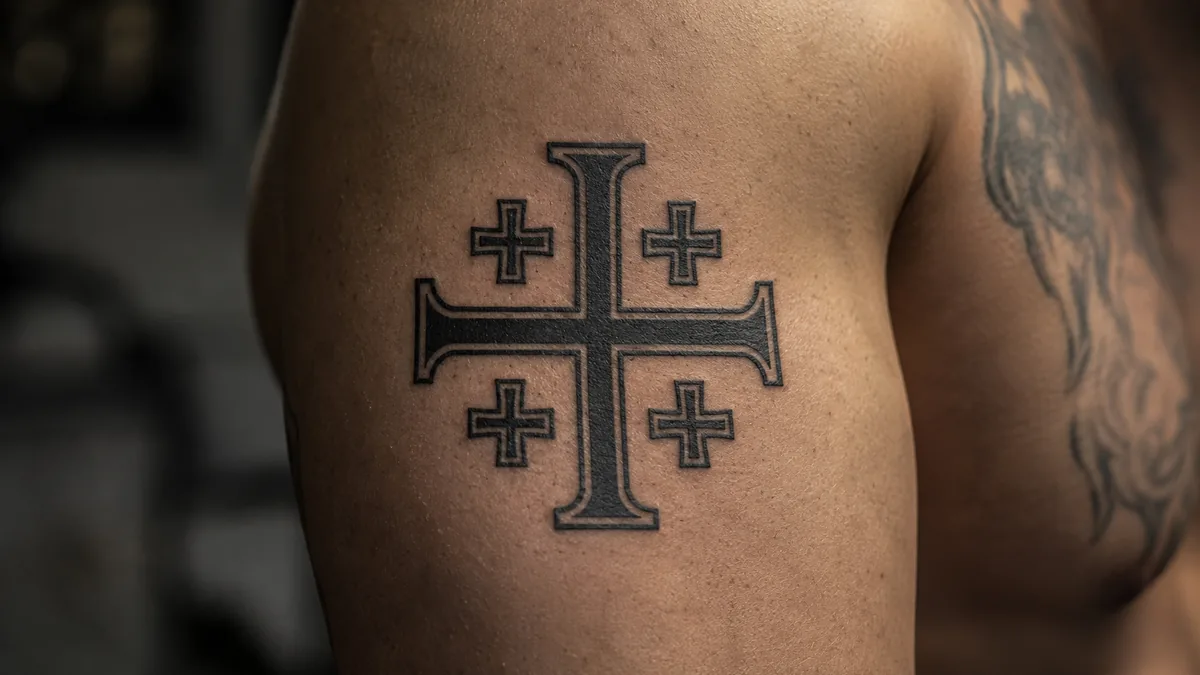
The Jerusalem cross is five crosses arranged in a specific pattern: one large cross at the center, four smaller crosses in each quadrant. That’s it. Simple geometry with a lot of weight behind it. People don’t get this tattoo by accident. They know what they’re putting on their body, and that intention shows.
The symbolism runs deep, from Crusader history to modern Christian faith to personal ideas about the four corners of the earth. This piece breaks down what the Jerusalem cross actually means, how it looks in different styles, and how to wear it well.
The Core Symbolism of the Jerusalem Cross
The Jerusalem cross, also called the Crusader’s cross or the Five-Wound cross, carries a layered meaning most people settle on one reading that fits their life. The most common interpretation: the large center cross represents Christ, and the four smaller crosses represent the four corners of the earth, symbolizing the spread of Christianity to every direction. It’s a missionary symbol at its root, representing the Gospel going out into the world.
A second strong reading connects the five crosses to the five wounds of Christ during the crucifixion: both hands, both feet, and the spear wound in his side. This gives the design a much more personal, devotional weight. Both readings are legitimate and historically grounded. Most people carrying this tattoo hold both at once without needing to choose.
Real Historical Background
Five crosses, one body, every line carries a thousand years of history.
The Jerusalem cross has documented roots going back to the First Crusade in 1099. When Godfrey of Bouillon became the first ruler of the Kingdom of Jerusalem, the cross appeared on his coat of arms and became associated with the Crusader state. It was stamped on coins, carved into church walls, and worn as a badge by pilgrims who made the journey to the Holy Land. That history is real, not invented.
Over the following centuries, the cross became a broader symbol of the Christian faith rather than a specifically military or political one. The Order of the Holy Sepulchre, a Catholic chivalric order that still exists today, uses the Jerusalem cross as its central emblem. That direct line from medieval Jerusalem to the present day is part of what gives the symbol its gravity for people who wear it.
Design Variations You’ll Actually See
The classic version uses a Greek cross, where all four arms are equal length, with four smaller Greek crosses in the quadrants. That symmetry is the foundation. From there, artists take it in different directions: some go ornate with filigree fills inside the quadrants, others keep it stripped down to clean outlines only. You’ll also see versions built on a Latin cross, where the bottom arm extends longer, giving it a more traditional crucifix proportion.
Dotwork is popular for this design, using stippling to build shading and texture without solid fills, which gives it an aged, almost engraved look. Geometric line variations treat each element as a strict shape with no organic softness. On the other end, illustrative styles add depth, shadow, and sometimes background elements like halos, stonework, or banners with text. The symbol is flexible enough to hold any approach without losing its identity.
Black and Grey vs. Color
Black and grey is the dominant choice for Jerusalem cross tattoos and for good reason. The geometric structure reads sharp and clean in pure black ink, and fine-line black and grey work lets an artist add depth through whip shading or stippling without muddying the lines. It heals predictably, ages well especially in low-wear zones, and photographs cleanly. Bold black outlines with no fill is the most readable version from across the room.
Color builds a different vibe entirely. Gold and deep red are the most historically resonant choices, echoing stained glass and medieval heraldry. A saturated gold fill inside the quadrants against black outlines creates strong contrast and reads as intentionally regal. White ink highlights can make the cross feel luminous on fair skin but won’t hold long-term the way solid black does. If you go color, keep it simple, one or two tones max, or the fine geometry gets lost.
Placement and How It Ages
The Jerusalem cross is a geometric design, so it needs flat, relatively stable skin to stay crisp. The sternum, upper back, chest plate, outer forearm, and upper arm are all solid choices. These areas have lower skin movement, decent thickness, and won’t distort the symmetry as the years add up. The design is also compact enough to scale well from a two-inch piece to a full chest plate centerpiece.
High-wear zones will soften the fine details first. Fingers, hands, and the inside of the wrist are spicy both during the session and over time. Blowout risk goes up anywhere the skin is thin or frequently folded. Placement on the ribcage or sternum is moderately spicy but rewards you with a protected spot where the ink stays saturated longer. For a design this geometric, protecting the line quality over time should drive the placement decision.
Who Gets This Tattoo and Why
Most clients getting a Jerusalem cross are practicing Christians who want a symbol with more visual complexity than a plain Latin cross. It signals a specific depth of faith or knowledge, not just general belief. You also see it on people with a strong connection to the Holy Land, whether through pilgrimage, heritage, or family history tied to the Middle East or to Catholic chivalric traditions. Veterans with ties to military chaplaincy sometimes choose it too.
The personal angle matters here more than with most religious symbols. A client who lost a parent and identifies with the five wounds is carrying something completely different from someone who sees it as a call to spread their faith outward. Ask your artist to leave space for that meaning in how the piece is built. A small inscription in Latin or a meaningful date tucked into the composition can make it specific to one person’s story without cluttering the core symbol.









