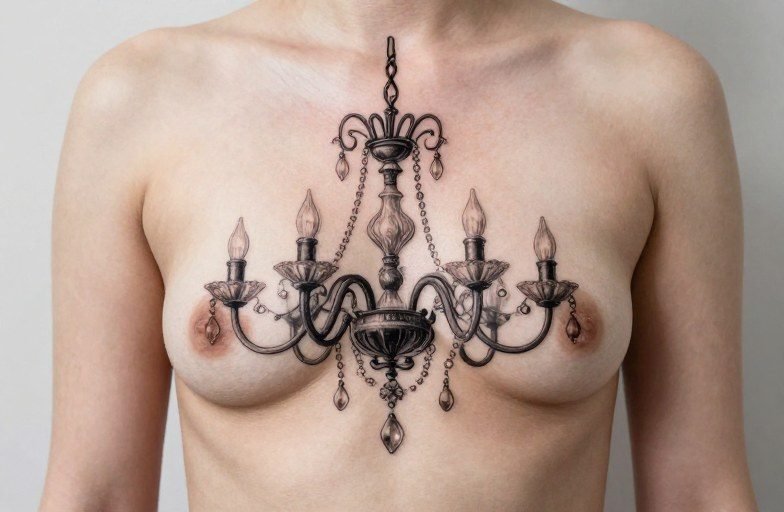
A chandelier tattoo placed under the breast, often called a sternum or underboob chandelier, typically symbolizes illumination from within, light that exists not for public spectacle but for personal space. The placement itself shapes the meaning: hidden beneath clothing, revealed selectively, the chandelier becomes a private source of radiance rather than a room’s centerpiece. The underboob placement curves with the body’s natural architecture, the chandelier’s arms and crystals following the rib cage’s slope, creating a symbiotic relationship between symbol and anatomy.
Symbolism & Core Meaning
Light as Internal, Not External
Unlike a chandelier hung for guests, this placement inverts the symbol. The light faces inward, toward the heart and lungs, suggesting self-illumination rather than performance. Many who choose this design speak of periods of finding their own clarity, decision-making, leaving relationships, recovering from grief, where the light needed to come from within rather than from external validation. The rib cage, protecting vital organs, becomes the “room” this chandelier lights.
Feminine Architecture and Power
Chandeliers themselves carry gendered history: ornate fixtures in ballrooms, boudoirs, spaces of gathering and intimacy. Placing this symbol under the breast reclaims decorative tradition as personal armor. The sternum placement specifically draws vertical lines that emphasize the body’s center line, creating a pendant-like effect that feels owned rather than worn. Some trace the chandelier’s appeal to Art Nouveau aesthetics, others to Victorian mourning jewelry, crystal drops resembling teardrops, light refracted through grief.
Common Variations & Styles
Line-Work vs. Ornamental Shading
Thin single-needle linework produces a delicate, sketch-like quality that ages softly but risks blurring if lines are too fine. Ornamental blackwork with dotwork shading creates stronger contrast against the skin’s natural tone, holding readability longer but reading heavier visually. Crystal elements present a specific challenge: facets rendered as tiny geometric shapes blur faster than simplified teardrop forms. Most experienced artists simplify chandelier crystals to elongated ovals or diamond shapes rather than attempting hyper-realistic refraction.
Color vs. Black and Grey
- Black and grey: Dominant choice for this placement; reads as shadow and silhouette, emphasizing the “lit from within” concept through negative space
- Metallic gold or bronze accents: Applied sparingly to suggest actual illumination without becoming literal
- Soft color washes: Pale blue or amber behind crystal elements can suggest light temperature, though color in this placement fades noticeably due to friction from bras and clothing
- Jewel tones: Deep ruby or sapphire crystal drops, though these require more frequent touch-ups than blackwork equivalents
How It Ages on Skin
The Underboob Reality
This placement sits at a skin tension point where the breast meets the rib cage. Movement, gravity, and bra bands create consistent friction. Fine lines spread faster here than on the outer ribs or upper chest. A chandelier with arms extending wide across the sternum will experience more distortion over five to ten years than a compact, vertically oriented design. Artists often recommend keeping central elements within a palm’s width of the sternum line to minimize drift.
Ink Behavior Specifics
Black ink in this area tends toward blue-grey undertones as it settles, especially on lighter skin. Shaded backgrounds often “fall out” partially, leaving a mottled effect that some find atmospheric, others aged poorly. The warm, thin skin under the breast means ink can appear more saturated initially than it will at three months healed. White highlight dots, popular for suggesting crystal sparkle, frequently disappear entirely within two to four years in this placement. Experienced artists plan for this by making white optional rather than structurally necessary.
Personal & Modern Meanings
Beyond traditional symbolism, contemporary wearers layer individual significance. The chandelier as “central fixture” translates to self as anchor, particularly for those who’ve relocated frequently, changed careers, or rebuilt identity after major life shifts. The underboob placement’s intimacy means the tattoo often becomes known to partners before public circles, creating a narrative of selective revelation that mirrors how people actually share vulnerability.
Some connect the chandelier to specific memory: a grandmother’s dining room fixture, a theater’s ceiling during a formative performance, a hotel lobby where a pivotal conversation occurred. The symbol’s domestic familiarity allows personal anchoring without requiring universal legibility. Unlike obviously symbolic imagery (lotus, phoenix), the chandelier permits ambiguity, decorative enough to read as aesthetic choice, structured enough to carry private weight.
Design Tips & Pairings
Complementary Elements
- Chain or cord extensions: Running vertically down the center of the stomach, connecting the chandelier to a lower abdominal piece; creates narrative flow but commits to a larger overall composition
- Moth or butterfly: Positioned near the light source, playing on attraction-to-flame symbolism; best placed asymmetrically to avoid visual clutter
- Ornamental frames: Art Nouveau borders or mandala sections extending to the sides of the ribs, containing the chandelier within architectural structure
- Script integration: Brief words or dates worked into the chain or base; requires careful font choice to maintain readability at small sizes
Scale and Flow Considerations
The sternum’s natural shape favors vertical or slightly flared compositions. A chandelier too narrow looks isolated; too wide extends into areas where skin movement distorts faster. Most successful designs use the underboob curve as a natural ceiling or floor for the fixture, either hanging from the breast’s lower curve or sitting as if on a surface with arms extending upward. The body’s midline provides natural symmetry, though perfectly mirrored designs can feel static; slight variation in crystal drops or arm ornamentation adds organic quality.
Similar & Related Symbols
Lanterns share the illumination theme but read more rustic, less ornate, better suited to narrative or travel-oriented symbolism. Candelabras offer similar vertical elegance but lack the chandelier’s architectural specificity and crystal refraction possibilities. Suncatchers or prisms capture light-play without the fixture’s historical weight, reading more contemporary and less formal. For those drawn to the underboob placement but seeking different symbolism, ornamental mandalas offer similar structural satisfaction with more universal spiritual associations; snake or serpent designs follow the same central vertical axis but carry transformation or danger connotations rather than illumination.
The chandelier’s particular strength is its combination of human-made structure with natural light phenomenon, suggesting that radiance requires craft, support, intention. Related body placements for similar themes include the throat (voice as light), inner bicep (strength as illumination), and upper back between shoulder blades (carrying light forward).
Final Thoughts
A chandelier under the breast works when the wearer connects to both halves of its paradox: the public fixture made private, the decorative object given functional weight. The placement demands commitment, the healing process involves significant friction from clothing, the aging requires acceptance of softening detail, the visibility remains controlled by the wearer alone. This last element may be the truest meaning: light that you choose when to reveal, how brightly, and to whom. The tattoo becomes less about the chandelier itself and more about the architecture of decision surrounding it, what it means to contain your own source rather than hang it for general view.
Frequently Asked Questions
Does a chandelier under breast tattoo hurt more than other placements?
The sternum and underboob area has thin skin over bone and nerve clusters, making it among the more sensitive placements. Most people describe it as sharp and intense rather than dull, with the center line directly over the sternum being the most challenging section.
How long does an underboob chandelier take to heal?
Surface healing typically takes two to three weeks, but the area remains vulnerable to friction from bras and clothing for six to eight weeks. Many artists recommend going braless or using soft, wireless options during early healing to prevent irritation and ink loss.
Can the design be easily covered or modified later?
Chandeliers with heavy blackwork and ornamental elements can be challenging to cover completely due to the dense ink and central placement. However, the vertical structure allows for extension upward or downward more easily than horizontal expansion.
What should I bring to my consultation for this specific design?
Bring reference images of chandelier styles you prefer, crystal shapes, arm configurations, era-specific details, but also photos of your own body angle to show how the breast shape affects the canvas. Artists need to design around your specific anatomy rather than applying a generic template.
Related Tattoo Meanings
- Clock with Roses Tattoo Meaning: Time, Love Mortality
- Con Safos Tattoo Meaning: Origins, Symbolism Style
- Cooper Dejean Tattoo Meaning: Symbolism Design Guide
- Explore more