
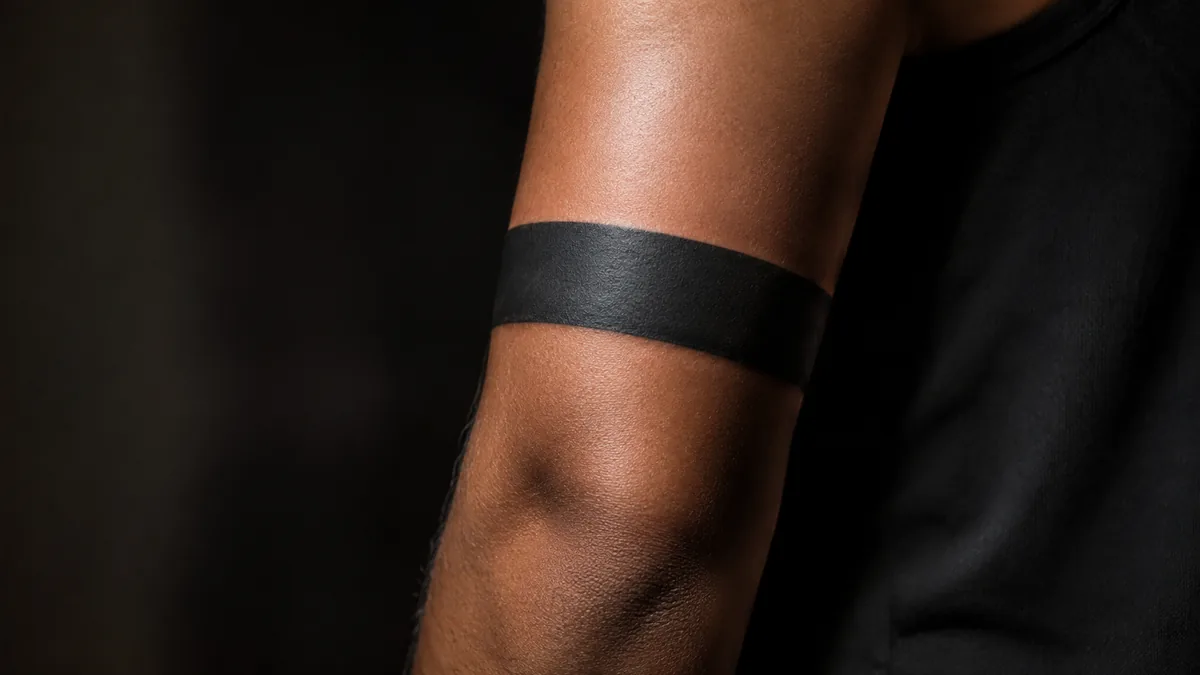
A black band tattoo is one of the most loaded pieces you can put on your body. Clean, bold, no filler. But that simplicity carries real weight, and the meaning shifts depending on who’s wearing it and why.
Most people associate black bands with grief and loss, a permanent mark of mourning. Others wear them as symbols of strength, transition, or personal commitment. The honest answer is it can mean several things, and context does the heavy lifting.
What Black Band Tattoos Actually Mean
The most widespread meaning is mourning. A single solid black band around the arm signals that the person is grieving someone they lost. It functions like a permanent armband, the kind people used to wear at funerals. That tradition goes back centuries in Western culture, where black cloth around the arm was a public sign of bereavement. The tattoo version makes it lifelong.
Beyond grief, black bands carry meanings of resilience and strength. The band doesn’t break, it circles all the way around, so some people read it as endurance, a closed loop that holds. Others choose it to mark a hard chapter they survived, a divorce, illness, addiction, or military service. The meaning is what you load into it.
Cultural and Historical Roots
A black band says everything about who you lost without saying a word.
In many Polynesian traditions, specifically Samoan and Hawaiian tattooing, solid black banding has been part of the visual language for generations. Bands marked rank, tribal affiliation, and rites of passage. The placement on the arm or leg communicated specific status within a community. That context is real and worth respecting if you’re drawing from it.
In Western culture, the black armband as a mourning symbol dates to at least the 19th century. Athletes, soldiers, and public figures wore black armbands to honor the dead. Turning that into a tattoo is a natural extension. It’s permanent where the cloth was temporary. Know which tradition you’re pulling from, or be honest that you’re not pulling from any, just making it personal.
Common Design Variations
The simplest version is a single solid band, fully saturated black, wrapped clean around the upper arm or forearm. Width varies from a thin half-inch stripe to a thick two-inch block. Some people stack two or three bands, one per person lost. Each band is a separate memorial. The spacing and width stay consistent for a cleaner read.
Beyond the basic band, artists add texture through whip shading inside the band, geometric line breaks, dotwork edges, or integration with larger sleeve work. Fine line banding looks sharp fresh but needs to be wide enough to hold over time. Tribal-influenced bands often feature thicker fills with organic tapered edges. Solid and saturated will always outlast delicate linework on a high-wear zone like the forearm.
Full Black vs. Shaded Approaches
Full black saturation is the traditional call for band tattoos. Packed in solid with multiple passes, it reads from across the room and holds its shape as the skin ages. The downside is that fully saturated black on certain skin tones can spread slightly over the years, so sharp edges matter more than anything. A tight, clean edge is what separates a great band from a blurry blob a decade out.
Some artists approach bands in black and grey, adding a fade or gradient from dense black to a lighter wash toward one edge. It softens the graphic impact but gives the piece more dimension. Fine line banding with no fill is an option, but bold will hold and thin lines on high-movement areas like the wrist or elbow will blur faster. Talk to your artist about your skin tone and the long game before you decide on weight.
Placement and How It Ages
Upper arm is the most popular placement, specifically the bicep area. It’s a moderate pain zone, the skin is thick, and the band reads clearly if you’re in a t-shirt or not. Forearm bands are also common and very visible, but the inner forearm is a spicy spot and the skin moves a lot, which can affect edge sharpness over time. Calf bands are another strong choice, with good surface area and solid aging.
Avoid placing bands directly over joints. The ditch of the elbow and the back of the knee are high-wear zones where ink migrates and lines blow out faster. Wrist bands look clean but thin skin over bone means more pain and faster fading. Wherever you place it, keep the line work consistent all the way around. A band that isn’t perfectly level looks sloppy immediately, so check the placement standing, sitting, and with your arm at rest before the needle touches skin.
Who Gets Black Band Tattoos and Why
Grieving parents, siblings, and partners get them more than anyone else. One band for a parent lost, two bands for two losses, the math is personal. Veterans get them to honor fallen brothers and sisters. Athletes wear them as a nod to a coach or teammate. The demographic is broad because loss is universal. It’s one of the few tattoo concepts that crosses age, gender, and style.
That said, plenty of people choose black bands with zero memorial intent. Minimalists who want a clean, graphic piece with visual weight. People adding a foundational element to a future sleeve. Someone who just likes how it looks and feels like the meaning of strength fits their story. None of those reasons are wrong. The tattoo doesn’t come with rules. Just know what yours means to you before it’s permanent.
Making a Black Band Tattoo Your Own
The most personal black band pieces layer other elements around the core band. A date tattooed inside the band in a clean font. A small symbol breaking the band on one side, a cross, a star, initials, a tiny portrait. Some clients have their artist leave a gap in the band deliberately, representing something unfinished or a loss that doesn’t have closure yet. That detail is subtle but hits hard when you know the story.
If you’re stacking multiple bands, talk through the sizing and spacing with your artist before booking. Equal width, equal spacing looks intentional. Bands that vary in width without a reason look like a mistake. Keep the design simple enough that it reads clean from a distance but personal enough that it means something up close. That balance is what makes a black band tattoo last, not just on your skin, but in how you feel about it twenty years from now.









