The Playboy Bunny is one of the most recognized symbols in the world, and on skin it carries a whole spectrum of meaning. Some people get it as a pure confidence flex. Others tie it to sexuality, freedom, or nostalgia for an era when that logo was everywhere.
It reads clean from across the room, it holds up over time, and it works in any style from fine line to bold traditional. Here’s what it actually means and how to wear it right.
What the Playboy Bunny Actually Symbolizes
the Playboy Bunny tattoo signals confidence, sensuality, and a certain unapologetic attitude. For a lot of people it’s a statement about owning their sexuality without shame. It says you’re comfortable in your skin and not too worried about what the neighbors think. That energy is the whole point.
Some wearers lean into the luxury angle. The Playboy brand built itself on aspiration, exclusivity, and a glamorized version of the good life. Getting the Bunny tattooed can be a nod to that lifestyle fantasy, or just a bold declaration that you’re fun, free, and not playing small.
The Real History Behind the Logo
It's not a brand, it's a statement about exactly how unbothered you are.
Hugh Hefner launched Playboy magazine in 1953, and art director Art Paul designed the Bunny logo for the second issue. It became one of the most reproduced logos of the 20th century. By the 1960s and 70s the Bunny was a genuine cultural icon, tied to Playboy Clubs, Bunnies as cocktail servers, and a whole aesthetic that blended glamour with rebellion.
By the time tattoo culture exploded in the 90s and early 2000s, the Bunny had decades of loaded meaning behind it. It showed up on skin as a badge of sex positivity, counterculture attitude, and pop nostalgia all at once. That layered history is part of why it still lands hard today.
Who Gets It and What They’re Saying
Women get this tattoo a lot, and the meaning is often reclaimed ownership over their own sexuality. It’s not about the magazine, it’s about not letting anyone else define what’s proper or modest for them. That’s a strong statement and it reads clearly. Men get it too, usually as a shorthand for a playboy lifestyle, confidence with women, or just genuine love for the aesthetic.
You also see it on people who grew up with the brand and connect it to 80s and 90s nostalgia, to a specific era of pop culture. Paris Hilton, Pamela Anderson, the whole Y2K revival brought the Bunny back hard. For younger clients it can be ironic, retro, or completely sincere. All three are valid.
Popular Design Variations
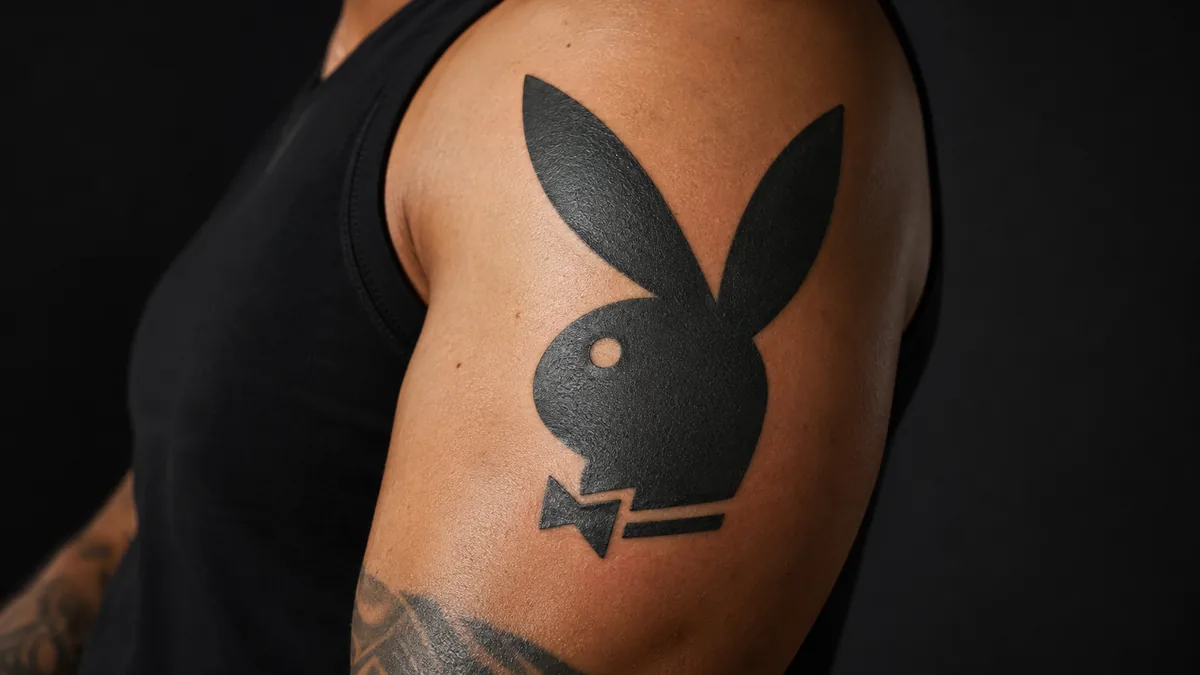
The classic silhouette, that clean bowtied profile, is the most tattooed version by far. It’s simple, graphic, and scales beautifully from a tiny wrist piece to a larger chest or thigh placement. Some artists add diamonds, crowns, stars, or flames around it. Others flip it into a skull Bunny for a darker, more punk read. Feminine versions often get florals, bows, or lashes worked in.
Fine line versions are huge right now, especially for rib, collarbone, and inner arm placements. Traditional bold outline with a black fill is the workhorse option, crispy lines, ages solid, reads from across the room. Ornamental styles wrap the Bunny in geometric or jewel patterns. Watercolor versions exist but the logo’s graphic nature honestly fights the style. Bold and clean is almost always the better call.
Black and Grey vs Color
Black and grey is the go-to for this design and for good reason. The Bunny logo is inherently a high-contrast silhouette, so a solid black fill with clean linework is all it needs. It heals nice, it holds over years, and it photographs well. Add some whip shade in the background or drop shadow and you’ve got a polished piece without overcomplicating it.
Color opens things up but you need a clear reason for it. Hot pink or red fill gives a bold, retro pin-up energy. White highlights can add dimension on darker skin tones. Some artists use a two-tone palette, black outline with a color fill, referencing the brand’s actual logo history. Whatever direction you go, make sure the linework is solid first. The color is just support.
Best Placements and How It Ages
The Bunny logo is versatile. Small versions work well on the wrist, ankle, behind the ear, collarbone, or inner bicep. Medium placements hit great on the forearm, thigh, hip, or shoulder. The shape is compact so it doesn’t need a lot of real estate to read clearly. That’s one of its strongest points as a tattoo design.
Aging comes down to placement and line quality. High-wear zones like the finger, foot, or inner wrist will fade and blur faster, so expect touch-ups if you go small there. Thigh, upper arm, and rib placements age much better. Fine line versions need tight linework from a skilled artist or they get muddy in five years. Bold linework with solid black fill is the most durable option long-term. Bold will hold.