
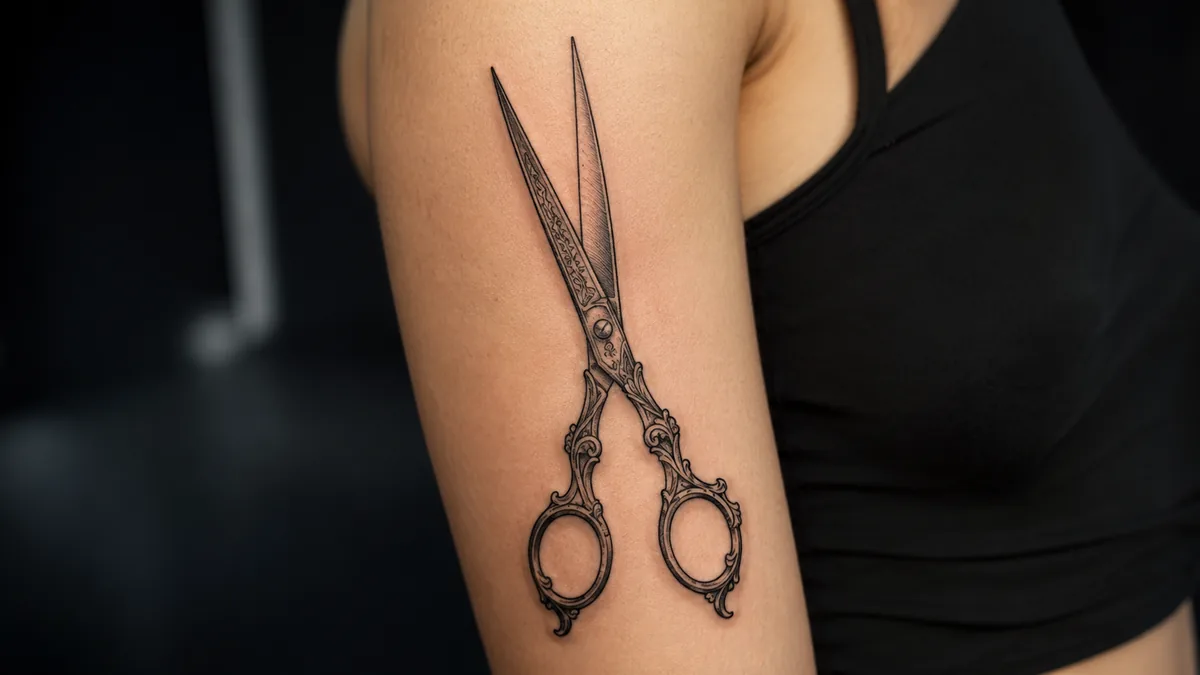
Scissors show up on skin more than you’d think, and they mean something. This isn’t a random object tattoo. Scissors carry real weight: cutting away what no longer serves you, taking control of your own story, or straight-up repping a craft you’ve dedicated your life to.
The meanings range from deeply personal to professionally proud. Hairdressers, tailors, surgeons, barbers. Plenty of people in trades get scissors tattooed as a badge. But plenty of others get them for the symbolic edge: severing toxic relationships, ending a chapter, choosing what stays and what gets cut.
Core Meaning: Cutting and Control
At the heart of it, scissors represent the act of cutting. That translates to endings, decisions, and control. You’re the one holding the blades. You decide what gets severed and what stays intact. For a lot of people, that’s a powerful image to carry permanently. It says: I make the call.
That sense of agency is why scissors tattoos land differently than most sharp-object ink. A knife or sword reads aggressive. Scissors read deliberate. Precise. There’s intention behind every cut. People who’ve walked away from bad situations, bad relationships, or bad versions of themselves often connect hard with that idea.
Severing Ties: The Moving On Read
Two blades, one cut, some things need to be let go permanently.
One of the most common reasons people get scissors tattooed is to mark a break. A divorce. Cutting off a toxic family member. Leaving a destructive friendship or addiction behind. The scissors become a visual record of that decision, something permanent to honor what took real courage to do.
Some folks add visual reinforcement: scissors cutting a rope, a string, a chain, or even a name. That imagery removes all ambiguity. The meaning is loud and clear without a single word of explanation. It reads from across the room and tells a story anyone can understand.
Duality and the Two Blades
Open scissors form an X shape. That X carries its own symbolism, opposition, balance, two forces meeting. Some people read the two blades as representing duality: masculine and feminine, past and future, logic and emotion. The pivot point holding them together becomes the symbol of balance between opposites.
This angle appeals to people drawn to deeper symbolic layers in their ink. A pair of scissors in the open position can represent two sides of one self, or two people whose lives intersect and work together. It’s a clean visual metaphor that doesn’t need explanation if you know what you’re looking at.
Trade Pride: Hairdressers, Barbers, and Tailors
Occupation tattoos are their own category, and scissors are the go-to for anyone in the craft of cutting. Hairdressers, barbers, seamstresses, tailors, even surgeons. Wearing your tool on your skin is a statement of identity. It says this is what I do, and I’m proud of it. It’s not a job, it’s a calling.
These tattoos often get personalized to the specific trade. Barber scissors look different from fabric shears. Some people incorporate a comb, thread, a measuring tape, or a razor to make the read specific. Done right with crispy lines and solid black, a barber scissors tattoo holds up for years and never loses its meaning.
Style Variations: Fine Line, Traditional, and Neo-Trad
Scissors are versatile in terms of style. Fine line scissors look sleek and modern, capturing the delicate detail of the blades with thin, precise linework. They suit placements like the inner wrist or behind the ear, and carry a subtle, refined energy. The downside: fine line in high-wear spots can fade faster, so placement matters.
Traditional and neo-traditional scissors go bolder. Think thick outlines, saturated color, and a design that reads clean from ten feet away. Bold will hold. A neo-trad pair of scissors with a banner, a floral wrap, or color fills is a classic setup that ages well on most skin. Black and grey with whip shading gives scissors a dramatic, sharp look that suits sleeves and thigh pieces nicely.
Placement and How It Ages
Scissors are a naturally elongated shape, which makes them easy to orient vertically or diagonally along limbs. The forearm, thigh, calf, and ribcage all work well. The forearm is a popular choice because you see it yourself every day, which matters if the meaning is personal. The calf is lower wear and holds ink reliably over time.
Avoid placing fine-line scissors on the fingers, palms, or inner wrist if longevity matters to you. Those are high-wear, high-friction zones and the ink breaks down faster. Behind the knee and inner elbow are spicy for pain and notorious for blowout if the artist isn’t careful. Stick to flatter, lower-wear skin for small detailed work.
Color or Black and Grey
Most scissors tattoos go black and grey. The metallic quality of scissor blades translates naturally to grey tones with white highlights. A skilled artist can make scissors look like actual steel using nothing but black ink and smart shading. That reflective illusion is one of the satisfying parts of tattooing a metal object.
Color works too, especially for trade pride pieces or neo-traditional designs. Gold handles, a splash of red for a barber aesthetic, or floral color wrapping around the blades all pop well. Saturated color on scissors reads bold and holds its visual impact for years on well-cared-for skin. Both approaches are solid choices, it comes down to your aesthetic and what the rest of your collection looks like.
Who Gets Scissors Tattoos and How to Make It Yours
The people who get scissors tattoos tend to fall into a few camps. Craft professionals who want to wear their work identity. People marking a significant ending or life transition. Individuals drawn to duality symbolism. And collectors who love the clean geometric elegance of the object. All of those are legitimate reasons to sit in the chair.
To make it personal, think about context. Add a date, a name being cut, a specific type of scissors tied to your craft, or surround the blades with imagery that deepens the meaning. A small floral, a specific thread color, a banner with a word. Your artist can help you build something that communicates exactly what you need it to without over-explaining. That’s the craft.









