
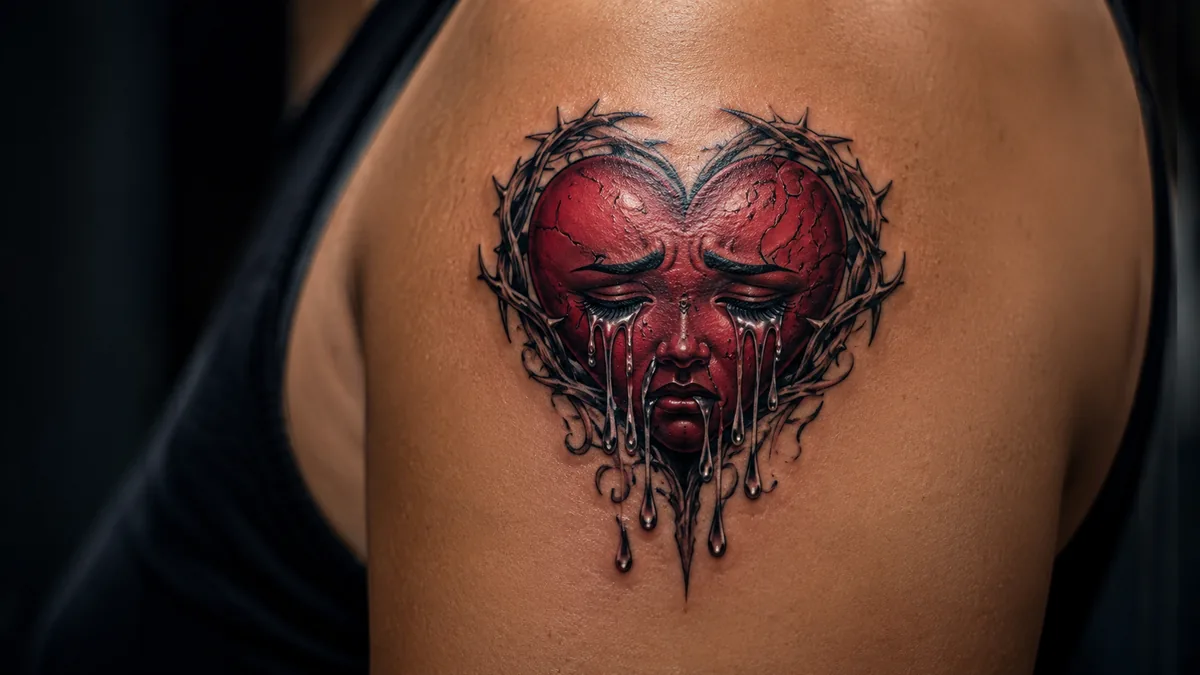
A crying heart tattoo does exactly what it says on the tin. It’s a heart with tears falling from it, and what it means is pretty universal: you’ve loved something deeply, and that love has cost you something. Pain and emotion are baked into this design at the concept level.
That’s not a bad thing. Some of the most powerful tattoos are the honest ones. The crying heart doesn’t pretend love is easy. It sits on your skin and says, yeah, I’ve been through it, and I’m still here. That’s a lot to carry in a two-inch piece of flash.
Core Meaning: Love, Loss, and Grief
The crying heart is primarily a symbol of emotional pain tied to love. That covers heartbreak from a relationship ending, grieving someone you’ve lost, or carrying the weight of unrequited love. The tears aren’t weakness. They’re proof that whatever you felt was real. A lot of people get this tattoo specifically because they want a permanent acknowledgment of something that hurt them in a way that changed them.
It can also represent empathy and sensitivity, the ability to feel things deeply. Some people aren’t memorializing a single event. They’re saying, this is who I am. I feel a lot, I love hard, and I don’t apologize for it. Both readings are valid. The design holds both without contradiction.
Historical and Cultural Background
Some hearts cry because they felt something real.
The crying heart as a tattoo image has roots in traditional American flash from the early-to-mid 20th century. Sailors and soldiers wore heart motifs to represent loved ones back home, and the emotional register of those hearts varied, sometimes proud and bold, sometimes clearly mourning. The weeping heart became shorthand for missing someone, often paired with a banner or a name.
Mexican folk art and Dia de los Muertos iconography also carry a crying heart tradition, where the sacred heart of Catholic devotion is depicted bleeding and tearful. That influence fed into Chicano tattooing in the American Southwest, giving the design a religious and cultural depth that still echoes in a lot of crying heart work you see today.
Sacred Heart vs. Crying Heart
It’s worth knowing the difference between a sacred heart and a crying heart, because clients sometimes ask for one and show reference for the other. The sacred heart is a specific Catholic image: a flaming heart, often crowned with thorns and topped with a cross, representing the suffering and love of Christ. The crying heart borrows from that visual language but strips away the explicitly religious elements.
What you’re left with is a secular symbol that still carries spiritual weight for a lot of people. If your client wants tears and thorns and flame together, you’re building something that’s half sacred heart, half raw grief, and that combination reads strong. Know what they’re bringing to the table emotionally before you finalize the design.
Popular Style Variations
Traditional American is the most common execution: bold outlines, solid fills, a clean teardrop or two falling from the bottom of the heart. It reads from across the room, heals predictably, and holds up for decades. Neo-traditional gives you more line weight variation, decorative fills, and more elaborate tear shapes without losing legibility. Both styles suit the iconography perfectly.
Fine line crying hearts are trending hard right now, especially on wrists and inner arms. They look delicate and precise fresh out of the machine, but be honest with clients: fine line in a high-movement or high-wear zone fades and blurs faster than bold work. If someone wants a fine line crying heart on their hand or inner wrist, talk placement and realistic longevity before you book them.
Color vs. Black and Grey
A red heart with black tears is the classic color read. The contrast is immediate, the symbolism obvious, and saturated red heals well when the artist packs it solid. Some clients go full color, adding pink gradients or blue tears for a softer, more melancholic feel. Color work shows the emotional temperature of the piece. Red is hot grief, blue is a slower sadness.
Black and grey crying hearts hit different. Whip shading on the heart body, smooth gradients on the tears, and the whole thing lives in a quieter emotional register. It tends to feel more introspective, less raw. Neither approach is better. They’re just different emotional frequencies. Ask the client what they want the piece to feel like, not just look like, and let that guide the palette.
Placement and How It Ages
The chest is a classic spot, directly over the literal heart. It’s a low-wear zone, protected from sun and friction, and it ages well. Upper arm and shoulder placements are also solid choices, good canvas size, the skin moves predictably, and bold linework stays crispy for years. These are your safest bets for longevity with minimal touch-up needs.
Inner wrist, hand, and finger placements are spicy on the pain scale and harder on the tattoo long-term. The skin there flexes constantly, regenerates faster, and takes more daily abuse. Blowout risk is higher on thin-skinned areas. If a client insists on a small crying heart on the hand, go bolder than you think you need to. Bold will hold where fine line won’t survive the year.
Who Gets This Tattoo and How to Make It Personal
A wide range of people get crying heart tattoos: people marking the end of a relationship, people memorializing someone who died, people who want a symbol for depression or mental health struggles they’ve survived, and people who just connect with the idea of loving deeply at personal cost. It’s not a tattoo that belongs to one group or one experience.
Making it personal comes down to the details. A name banner, a specific date, a particular flower worked into the design, a style that matches the person’s existing work. Some clients want tears that look like roses, or a heart that’s cracked but not fully broken. Ask them what the difference between broken and healing looks like to them. That conversation usually leads to a better tattoo than any reference image they bring in.









