
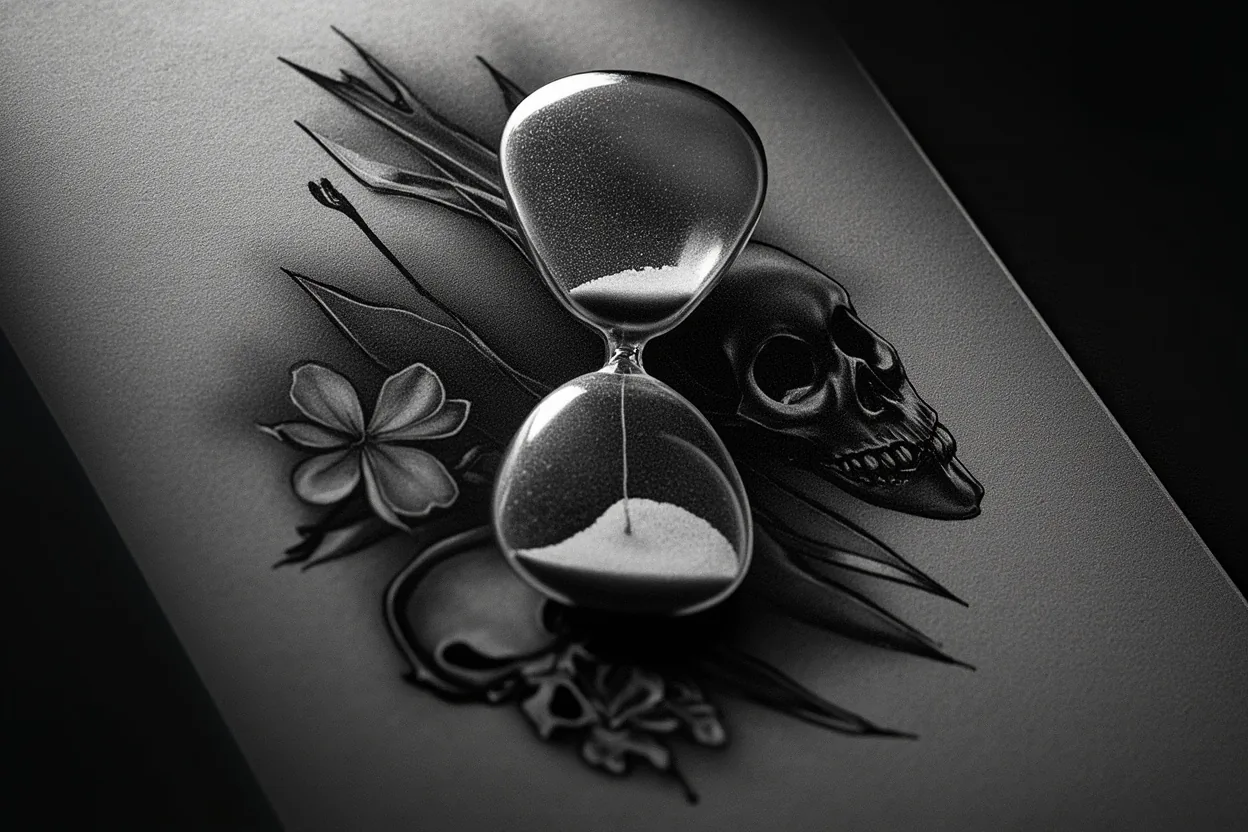
What the Hourglass Actually Communicates
An hourglass is one of the few tattoo symbols that reads instantly across almost any culture. No one asks what it is. They ask why you chose it. That directness is the point, and it is also the risk. Without personal detail, the hourglass can flatten into a generic “time tattoo” that says little more than a wristwatch.
The core meanings cluster around a few ideas. Mortality is the oldest and most common, stretching back to European memento mori art where hourglasses appeared beside skulls and extinguished candles. Patience sits at the opposite pole, the slow fall of sand as something endured rather than feared. Change, pressure, balance, and the sense of a season ending all layer in depending on what you surround the glass with. The symbol itself is a container. You fill it.
How sand position changes the message
Where the sand sits matters more than most people realize. A full top chamber with sand just beginning to fall reads as time running out but not yet gone. This is the version people often choose after a close call, a diagnosis, or the loss of someone sudden. The feeling is urgent but not finished.
An empty top with sand collected below flips the meaning entirely. Time has passed, experience is banked, the heavy part is behind. This version tends to appeal to people marking survival, recovery, or the end of a long chapter. Split evenly, the chambers balanced, the meaning shifts to equilibrium, the halfway point, the attempt to hold two states at once. It is a quieter read than the others, less dramatic, and for that reason often more honest.
Some designs replace sand entirely. A skull inside the glass removes all ambiguity. Birds rising from spilled sand suggest release and transformation. These substitutions work only if they are technically clean enough to read at a distance. A skull the size of a fingernail, or birds with wingspans of a few millimeters, will blur into grey smudges within a few years.
Broken Glass and Its Variations
A broken hourglass is not simply a damaged version of the same symbol. It is a different statement entirely. Where the intact glass suggests time passing within accepted limits, the broken one signals rupture, a timeline that was interrupted rather than completed. The meanings people attach to this are specific and often heavy: grief, survival, divorce, sobriety, the refusal to live by a clock that no longer applies to them.
Technical considerations for shattered designs
Broken glass needs more space than people usually allocate. Shards, cracks, and spilled sand become visual noise if the tattoo is under three inches in its longest dimension. The forearm and upper arm give an artist room to scatter fragments naturally, to make the break feel like an event rather than a decoration. Wrists and ankles compress the design, and the shards tend to muddy together during healing.
Linework matters enormously here. Sharp, clean shards with solid outlines and crisp tips age far better than delicate fine-line fragments. Whip shading on the glass edges can suggest dimension without adding detail that will not hold. If the meaning is loss, the surrounding symbols need restraint. A broken hourglass plus skull, rose, banner, and date can become a crowded memorial piece unless the artist edits ruthlessly. One strong symbol carries more weight than five competing ones.
The spilled sand itself can be handled several ways. Pooling at the base suggests time stopped, final. Scattering upward, against gravity, suggests something unnatural, a life derailed. Turning into smoke or birds as it falls is a common illustrative choice, but it requires a skilled artist to avoid looking like clip art. Ask to see healed photos of similar transformations, not just fresh work.
Cracked versus shattered
There is a meaningful distinction between a cracked frame and fully shattered glass. A crack running through the frame, with sand still falling through it, reads as time under pressure, not yet broken, the feeling of holding on. Fully shattered glass with sand spilled out is past tense, irreversible, no going back. Know which tense you are living in before you commit to the design. Your artist cannot choose this for you.
Placement and Longevity
The hourglass is naturally vertical, which makes certain placements read better than others. The forearm remains the most popular choice because the shape maps cleanly onto that long, flat canvas, sits upright without distortion, and heals well on skin that is neither too thin nor too mobile. Upper arm and thigh offer more room for detailed versions with wings, roses, or broken elements. The ribcage works for people who want the piece private, but the skin there moves with breathing and can distort the silhouette over time.
Size and detail limits
Small hourglass tattoos can work on the wrist or ankle if the shape stays simple. The moment you add tiny sand grains, detailed wood grain on the frame, or small text, you are asking for trouble. These elements blur and clump within two to three years on high-wear areas. If you want a broken glass design, the minimum workable size is larger than most people expect. Discuss this explicitly with your artist. A good one will tell you when your requested detail exceeds the available space.
For a sleeve, an hourglass can sit between other symbols: skull, rose, compass, snake, eye, clock. Each needs enough breathing room or the arm becomes a pile of disconnected meanings. The hourglass works best as an anchor point, something the eye rests on between busier pieces. Its simple geometry provides relief from more complex surrounding work.
Color choices and their effects
Black and grey keeps the symbol timeless and serious. A single color pop, deep red sand or a blue flame beneath the glass, adds drama without losing the core meaning. Full color with soft background elements can shift the piece into illustrative territory, which reads younger and more playful. This is not a value judgment, but it is a real difference in how the tattoo will be perceived. The same hourglass in black and grey and in full color tells two different stories about the same person. Choose consciously.
What to Remember
The hourglass offers clarity, which is its strength and its trap. Because the symbol is so immediately readable, people often assume it needs no supporting detail. The opposite is true. The hourglass is a frame. The sand, the glass condition, the surrounding elements, and the placement all supply the actual content. Without them, you have a stock image.
Before you sit down, know which version of time you are marking: running out, survived, balanced, broken, or refused. Know whether you want the piece to read from across a room or reward close inspection. Bring reference images of the specific sand position, the specific crack pattern, the specific flower or skull style you have in mind. The hourglass has been tattooed for centuries. The difference between a meaningful one and a forgettable one is the specificity you bring to it.
Frequently Asked Questions
Does an hourglass tattoo always mean death?
No. While mortality is one common reading, hourglass tattoos also mark patience, survival, balance, major life changes, and the refusal to live by external timelines. The surrounding details determine which meaning dominates.
How big should a broken hourglass tattoo be?
Larger than most people initially expect. Broken glass with scattered shards and spilled sand needs at least three inches in the longest dimension to read clearly and age well. Smaller versions on wrists or ankles tend to blur together during healing.
What does split sand, half in each chamber, mean?
It usually signals balance, the midpoint, or holding two states simultaneously. This is a quieter, less dramatic read than full top or full bottom sand, and it tends to appeal to people marking a period of equilibrium rather than crisis or completion.
Do hourglass tattoos work in color?
They do, but color changes the tone significantly. Black and grey reads timeless and serious. A single accent color adds drama. Full color with soft backgrounds shifts toward illustrative and playful. Choose based on the story you want told, not just aesthetic preference.









