
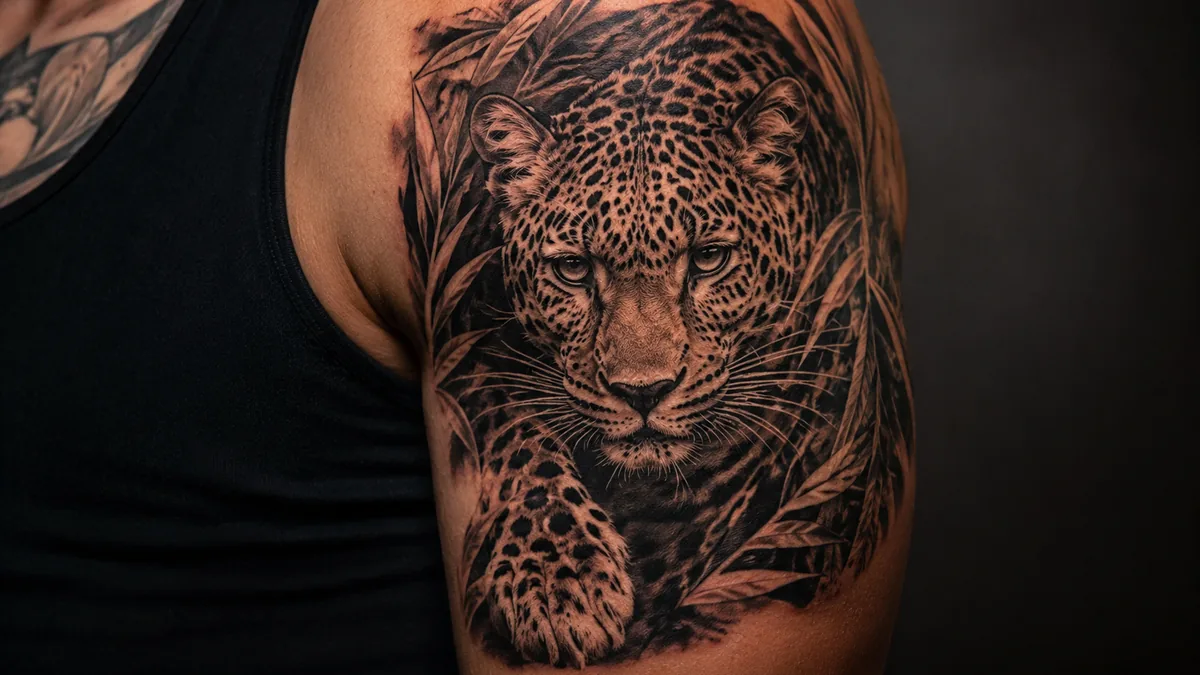
The leopard tattoo is one of the oldest predator symbols in body art. It reads as raw power, self-reliance, and the kind of confidence that doesn’t need an audience. People aren’t getting it because it looks cool on a mood board. They’re getting it because the leopard means something that lands deep.
the leopard represents strength operating quietly. Not the lion’s loud dominance, not the tiger’s brute force. The leopard moves alone, hunts alone, and doesn’t answer to anyone. That energy is exactly what draws people to the chair.
Core Symbolism: What the Leopard Actually Means
The leopard carries a tight cluster of meanings that have stayed consistent across cultures for centuries. Power, stealth, independence, courage, and primal instinct are the big ones. It also represents ferocity balanced with grace, which is a rare combination. The leopard doesn’t just overpower. It outsmarts, waits, and strikes precisely. That duality is what makes the symbol resonate.
A lot of clients bring in the leopard specifically because it reads as self-sufficient. This isn’t a pack animal. It doesn’t need a crew to survive. For people who identify as loners, independent thinkers, or someone who’s built their life on their own terms, that hits differently than any other big cat tattoo.
Cultural and Historical Roots
The leopard does not announce itself, and neither should your tattoo.
In ancient Egypt, the leopard skin was worn by priests during burial rites, connecting the animal to death, transformation, and passage into the afterlife. The pharaohs associated it with the god Osiris. In West African traditions, the leopard symbolizes royalty and warrior status. Leopard societies, actual warrior fraternities in several West African cultures, used the leopard as their emblem. The Aztecs tied spotted cats to their jaguar warriors, and while jaguars and leopards are distinct animals, the symbolism overlaps heavily in modern tattoo culture.
In Chinese symbolism the leopard represents bravery and martial skill. European heraldry used the leopard as a symbol of a fierce but controlled warrior, distinct from the lion’s pure monarchy. The British coat of arms historically featured heraldic leopards. These threads are real and documented, which gives the leopard tattoo a genuine historical weight that a lot of designs just don’t have.
Popular Design Variations
The roaring leopard is the loudest version. Open mouth, teeth showing, done big. It reads as aggression and dominance, works best with enough real estate to show detail in the face. The stalking leopard, crouching low or mid-stride, emphasizes the stealth angle. It has movement and tension. The resting leopard, calm and observing, pulls toward the quiet power reading. All three are solid concepts, each one tells a different part of the story.
Leopard spots as a standalone pattern, sometimes called cheetah print in conversation but leopard in execution, are popular for wraps on thighs, forearms, and upper arms. The rosette pattern, which is the actual leopard spot with a darker center ring, is more accurate than a filled dot. Clients who’ve done their research ask for rosettes specifically. Skull combined with a leopard is another direction, leaning into the mortality and predator theme. Floral leopard portraits, where the animal is surrounded by or merged with flowers, soften the aggression and push toward the fierce beauty interpretation.
Black and Grey vs. Color: What Works on Skin
Black and grey leopard tattoos are the most versatile. A skilled artist using whip shading and pencil-work realism can build a leopard portrait that looks three-dimensional and heals exceptionally clean. The rosette pattern in black and grey reads strong from across the room because of the contrast between the open tawny areas and the dark spots. Bold will hold here, especially if the outlines are solid and the dark values are properly saturated.
Color opens up the palette toward that golden amber coat with black rosettes and a white muzzle. When the color is clean and fully packed, it pops hard. The challenge is that yellow and ochre tones can fade faster than black ink, especially on lighter skin tones in high-sun areas. If you’re going color, talk to your artist about touch-up expectations in year two or three. A neo-traditional interpretation with heavy outlines and flat, bold color holds the best long term of any color approach.
Placement and How It Ages
The thigh is the number one spot for a leopard. Enough flat space for a full portrait or a large stalking composition, relatively low on the pain scale, and it heals well. The upper arm and shoulder are close seconds. A full side piece or rib cage leopard looks incredible but that placement is spicy and the torso can be uneven skin territory. Ribs age fine if the work is done solid, but expect more color refresh needed there compared to the thigh.
Avoid the hands, fingers, and feet for detailed leopard work. Fine line detail in those high-wear zones blows out fast and the delicate spots become blobs within a few years. The neck and sternum are popular for smaller leopard pieces, usually just the face or a compact stalking pose. Those areas are sharp on pain. If someone wants spots as a pattern wrap, the forearm is a great choice, easy to tattoo, heals nice, and the cylindrical surface shows off a wrap design better than almost anywhere else.
Color Meaning: Spots, Snow Leopards, and Black Panthers
A traditional spotted leopard in gold and black reads as primal energy, natural ferocity. The snow leopard, white or silver with grey spots, shifts the meaning toward mystery, isolation, and spiritual strength. Snow leopards are rare and elusive in real life, and that rarity translates into the tattoo as something set apart, singular. It’s a less common choice, which makes it a stronger personal statement for the right client.
The black panther is technically a melanistic leopard, a leopard with a gene mutation causing excess dark pigmentation. The rosette spots are still there, visible under certain light. In tattoo culture, the black panther has its own deep symbolism rooted in rebellion, protection, and reclaiming power. It became a symbol of resistance through the Black Panther Party and has meant defiance and community protection in that context since the 1960s. Many clients get a black panther specifically for that political and cultural meaning, not just the animal.
Who Gets Leopard Tattoos and How to Make It Personal
Leopard tattoos pull a specific type of person. Independent, self-directed, not interested in fitting in. Athletes, especially combat sports people, lean toward the roaring or stalking version for the aggression read. Women who want strength without the masculine connotations of a skull or eagle gravitate toward the leopard portrait or the flower-leopard hybrid. It balances fierce and beautiful in a way that’s authentically powerful, not softened down.
To make it personal, think about what angle of the symbolism actually fits your life. If it’s about moving through hard times quietly and surviving on your own, go stalking pose, low, patient energy. If it’s about arriving fully and owning your space, the roaring portrait says that loud and clear. Add a birth flower in the surround, change the eye color to something meaningful, or request a specific background landscape if you have a geographic connection to the region where leopards live. Your artist can build in those details without muddying the composition.









