
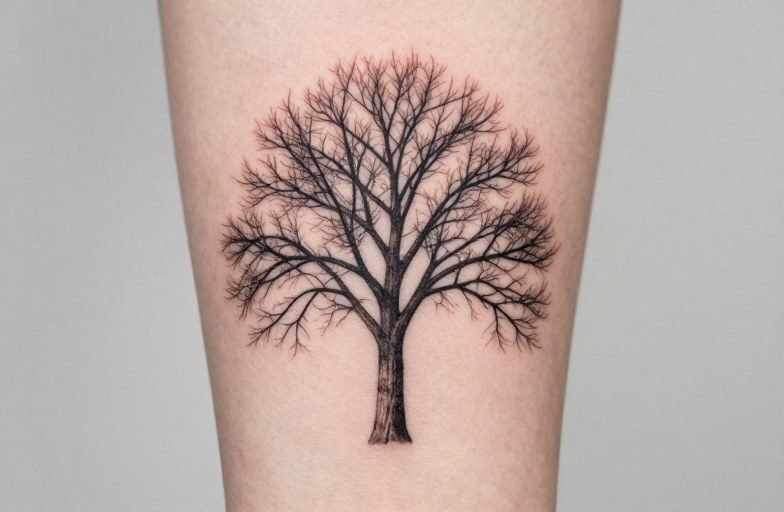
A leafless tree tattoo most commonly represents survival through hardship, the beauty of stripped-down essence, and the quiet promise of return. Without foliage, the tree becomes its structure alone, branches, trunk, roots, making it a symbol of enduring core identity when everything decorative has fallen away. The meaning shifts with season, species, and how the piece is rendered.
Symbolism & Core Meaning
Seasonal Truth and Resilience
Deciduous trees drop leaves as strategy, not failure. The bare form speaks to a specific kind of strength: the capacity to survive exposed. In tattoo form, this resonates with people who’ve passed through depletion, grief, or major transition and recognize themselves in the winter phase. The roots remain active underground even when the crown looks dead. That biological reality underpins much of the tattoo’s emotional weight.
Death, Rebirth, and the In-Between
Some wearers connect the motif to ancestors or mortality, the skeletal branch structure resembles lung tissue, nervous systems, river deltas. Others read it as pre-spring, the held breath before return. The ambiguity is structural to the symbol. A leafless oak reads differently than a leafless birch: oak as stubborn endurance, birch as paper-white vulnerability and regeneration.
- Single tree: isolation, personal survival, singular focus
- Stand or forest of bare trees: community through shared hardship, collective winter
- Roots visible: foundational identity, family, what sustains beneath surface
- Birds departing or perched: transition, watchfulness, temporary rest
Common Variations & Styles
Species-Specific Choices
The tree type matters more than most clients initially realize. Willow without leaves carries mourning associations, weeping without the green softness. A bare cherry references Japanese mono no aware, the pathos of impermanence, often linked to samurai culture and brief beauty. Dead oak or elm can signal stubbornness, refusal to fall, or regional identity (New Englanders, Midwesterners). Tattooers who know their botany will adjust branch angles, bark texture, and root spread to match the actual species rather than generic “tree” iconography.
Linework vs. Shading Approaches
Line-only bare trees age with particular grace. The high contrast between black ink and skin tone mimics the natural contrast of winter branches against sky. Heavy blackfill in the trunk with delicate branch lines creates depth that holds up over years. Watercolor splashes behind or through the branches, purples, rust oranges, cold blues, can suggest sunset, dawn, or memory without literal leaves. Dotwork shading on bark texture adds tactile quality but requires a specialist; poorly executed stippling can blur to gray mush within five years.
Placement shapes the reading. A bare tree wrapping a forearm reads as armor, endurance carried forward. Across ribs or side, it’s more private, more breath. Small behind the ear: a whispered reminder, easily hidden. Large back pieces allow for root systems that wrap toward the spine, literalizing the “rooted” metaphor in body geography.
Color vs Black and Grey
Color in leafless tree tattoos usually functions as atmosphere, not foliage replacement. A single red leaf clinging to a branch, sometimes interpreted as holding on, sometimes as the last thing to fall before renewal. Blood-red sunset behind bare branches. Fog rendered in muted blue-gray wash. These touches of color against the dead palette create focal points that draw the eye and add narrative specificity.
Black and grey dominates for good reason. The subject matter is inherently tonal: winter light, shadow, the absence of green life. Greywash allows for bark texture, atmospheric perspective in branch layering, and the soft gradation of distant twigs dissolving into skin. A well-executed black and grey bare tree can look striking ten years later because the subject’s natural palette matches the ink’s limitations. Color sunsets behind the branches tend to fade faster, requiring touchup or accepting the muted version as its own aesthetic.
Religious & Spiritual Angles
Norse and Celtic Resonance
Yggdrasil, the world tree of Norse cosmology, is often depicted as ash with knowledge-bearing roots and branches spanning worlds. Leafless renderings connect to Ragnarök narratives, the tree’s endurance through cosmic winter. Celtic sacred groves and the concept of the crann bethadh (life tree) sometimes appear in bare form, though this is more commonly associated with Irish-American tattoo tradition than documented ancient practice. Some trace it to 19th-century Celtic revival aesthetics rather than pre-Christian sources.
Christian and Buddhist Readings
The Jesse Tree, depicting Christ’s genealogy as branches from the root of Jesse, sometimes appears bare in Advent imagery, waiting, preparation, the time before fulfillment. Bodhi tree representations occasionally show bare branches to signify the moment before enlightenment, though this is less common than full-canopy depictions. More frequently, Buddhist-adjacent wearers choose the bare tree as a meditation on impermanence (anicca), the stripped form revealing what persists through change.
Personal & Modern Meanings
Contemporary wearers often arrive with specific autobiographical readings: recovery from addiction, the period after divorce, surviving a parent’s death, living with chronic illness that has no visible marker. The leafless tree externalizes an internal state that lacks social recognition. “I look fine but I’m not”, the bare branches make visible what others can’t see.
Some choose it as counter-aesthetic to the lush, oversaturated tattoo trends of the 2010s. Where everyone has roses and mandalas and full-color sleeves, the bare tree refuses decoration. It’s a minimalism of necessity, not style. This reading is particularly common among people in creative or design fields who recognize the visual power of restraint.
Environmental grief appears increasingly: trees killed by beetle infestation, drought, fire. The tattoo becomes memorial for specific lost landscapes, often with location coordinates or dates worked into root systems. This is distinct from general “nature lover” tattooing, it’s elegy with political edge.
Who Chooses This Tattoo
Age range skews slightly older than average tattoo clientele, late twenties upward, people who’ve actually experienced a significant winter phase rather than anticipating one. Gender distribution is fairly even, though men often choose larger, more isolated tree forms while women more frequently incorporate surrounding landscape or atmospheric elements. This is trend, not rule.
Professions cluster in healthcare, social work, education, and creative fields, jobs involving sustained emotional labor where the “still standing” aspect resonates. Veterans sometimes choose bare trees after PTSD diagnosis or transition to civilian life, though this is less common than military-specific imagery.
The choice often follows a delay: people who wanted tattoos for years but waited for a subject that felt weight-bearing enough. The leafless tree arrives as a first tattoo more often than as an addition to existing work, suggesting it’s chosen for personal significance rather than collection-building.
The Bottom Line
The leafless tree tattoo works because it refuses easy optimism. It doesn’t promise spring, only the structure that survives until spring might come. That honesty is what gives it staying power as both image and skin. Choose your species, know your season, and let the branches be exactly as bare as your own experience demands. The best ones look like they grew there, not like they were placed.
Healing considerations: fine branch tips are prone to blowout and fading. Go to someone who specializes in detailed blackwork, not just a shop that “does everything.” Expect touchups on outer branches at the five-year mark. The trunk holds; the twigs wander. That’s part of the meaning too.
Frequently Asked Questions
Does a leafless tree tattoo always mean something sad or depressing?
Not necessarily. While many wearers connect it to survival through difficulty, others choose it for the aesthetic honesty of stripped form, seasonal appreciation, or the specific biology of dormancy and return. The meaning depends on what the bare phase represents to you personally.
Which tree species works best for a leafless tattoo?
Oaks and birches are most common because their branch structures read clearly even without leaves. Willows work for mourning themes, aspens for quaking movement. Avoid generic “cartoon tree” branches, find reference photos of your actual species in winter.
How well do fine branch details hold up over time?
Outer twigs soften and fade faster than thick trunk lines. Expect some blurring by year five, especially on high-movement areas like wrists or ribs. A skilled artist can design with aging in mind, using slightly heavier lines on branches that must remain readable.
Can I add color later if I start with black and grey?
Yes, but plan for it. Leaving negative space or designing branch intersections with color potential in mind makes later additions easier. A sunset wash behind existing black branches is straightforward; adding colored leaves to previously bare branches requires more strategic planning.
Related Tattoo Meanings
- Lighter Tattoo Meaning: Flame, Rebellion Renewal
- Lion of Judah Tattoo Meaning: Roots, Symbolism Design
- Locust Symbolism Tattoo Meaning: Plague, Survival Rebirth
- Explore more









