
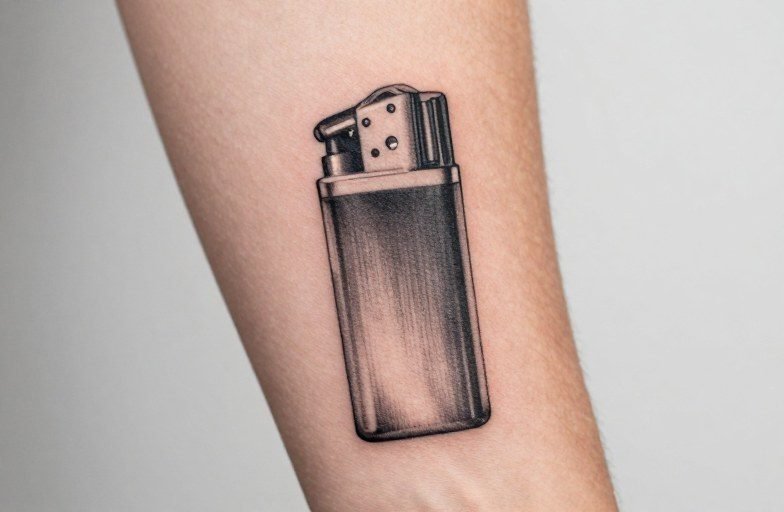
A lighter tattoo most commonly represents ignition, literal and metaphorical. It signals someone who starts things, who carries their own spark, or who’s survived by burning through obstacles. The meaning tightens or loosens depending on what’s paired with the lighter: a single flame suggests initiation and potential; a broken or empty lighter can mean burnout, addiction recovery, or the end of a destructive cycle. The object itself is ordinary, which is part of the point. It’s a pocket-sized tool for controlled fire, and that tension between mundane and dangerous gives the image its weight.
Common Variations & Styles
Not all lighter tattoos read the same. The style you choose steers the symbolism hard in one direction or another.
Classic Zippo and Vintage Metal
The hinged-lid Zippo shape is instantly recognizable and carries associations of military history, road culture, and working-class ritual. These designs often include engraved surface detail, flames, eagles, or custom text on the casing. Line work needs to be tight here; the hinge mechanism and lid seam are what sell the realism. Artists typically use a mix of bold outlines and fine single-needle work for the etched patterns. This style ages into a readable silhouette even if the interior detail softens.
Disposable Bic and Minimalist Forms
The translucent plastic Bic lighter, rendered in simple line work or color blocks, reads more contemporary and less nostalgic. It can suggest impermanence, disposability, or the cheap tools people actually use. Minimalist versions, a few clean lines suggesting the shape with a single flame, work well at smaller sizes and hold up better over time than photoreal plastic attempts. The lack of metal texture means less shading complexity and cleaner aging.
- Realistic metal lighters: heavy black and grey shading, reflective highlights, often 3-4 inches minimum
- Neo-traditional: bold outlines, limited color palette, flame as focal point with decorative casing
- Stick-and-poke aesthetic: intentionally rough, personal, often hand-sized or smaller
- Abstract/flame-forward: lighter as small element, flame dominating the composition
How It Ages on Skin
Lighter tattoos face specific aging challenges tied to their detail level and placement tendencies.
The thin lines of engraved casing patterns blur fastest. A Zippo with intricate scrollwork on the metal surface might look crisp at six months and muddy at five years. The solution is either sizing up, giving those details room to breathe, or simplifying the casing to a solid color block with minimal etching. Flame tips, rendered in yellow and orange, tend to fade lighter than surrounding blacks and greys, which can flatten the image over time. Darker flame bases (deep orange, red, or black soot marks) anchor the shape as the brighter tips soften.
Reflective highlights, the white spots that sell metal realism, are often negative space or very light grey. These can disappear entirely as surrounding ink settles or as skin tone changes with sun exposure. Some artists now use light grey ink instead of pure negative space for highlights, which ages more predictably.
Placement and Wear Patterns
Hands and fingers are popular for lighter tattoos, visible, personal, tied to the act of holding and using. These spots also fade fastest. Finger skin sheds and regenerates rapidly; fine lines can be unrecognizable within two to three years. Inner forearm and upper arm offer better longevity with similar visibility. Ribs and thighs hold ink well but hide the image, which works against the lighter’s usual role as a personal emblem or conversation piece.
Design Tips & Pairings
What you place near the lighter changes its meaning substantially. The object itself is neutral; context gives it direction.
Common Pairings and Their Weight
A lighter with a cigarette reads as addiction, coping, or social ritual, potentially dark, potentially nostalgic. A lighter with candles or lanterns shifts toward guidance, memory, or memorial. Paired with a burning house or bridge, it becomes destructive or powerful, depending on tone. The same flame that lights a cigarette can start a forest fire or ignite a molotov; the surrounding elements determine which.
Text pairings work when brief. A single word across the lighter body, “burn,” “light,” “survive”, can ground ambiguous imagery. Longer quotes tend to compete visually with the object itself. Dates, coordinates, or small numbers fit the casing’s rectangular form naturally.
- Chains or rope wrapped around the lighter: restraint, addiction, trapped energy
- Hands holding the lighter: agency, choice, the moment before action
- Multiple lighters in a row: collection, progression, or shared ritual among a group
- Extinguished or broken flame: burnout, recovery, end of a phase
Religious & Spiritual Angles
Fire carries spiritual weight across traditions, and the lighter as a fire-making tool taps into that lineage without requiring explicit religious imagery.
In some Buddhist contexts, lighting candles represents illumination of ignorance. A lighter tattoo can serve as a personal, portable version of that act, less temple-specific, more daily practice. Pentecostal Christianity emphasizes holy fire and spiritual ignition; a lighter rendered with dove or flame motifs can reference that without being doctrinally explicit. Some practitioners of ceremonial magic use specific lighters for ritual work, and a tattoo of that particular tool can mark dedication or identity within those communities.
The lighter’s mundane nature actually supports spiritual readings. It’s not a sacred object; it’s a gas station purchase. That accessibility can mean the divine or powerful is ordinary, close at hand, not requiring special equipment. The spiritual angle here tends toward immanence rather than transcendence, fire in the pocket, not on the mountain.
Color vs Black and Grey
This choice affects both immediate impact and long-term readability.
Color flames, yellow core, orange body, red base, blue at the hottest point, read instantly as fire. The gradient work requires a skilled artist; bad color flames look like cartoon explosions. Good ones glow against skin. Over time, yellow and light orange fade most noticeably, sometimes leaving a red-orange ghost that still reads as flame but loses the luminous quality. Touch-ups every few years can restore the brightness.
Black and grey flames rely on contrast and texture rather than hue. They read more somber, more permanent, less celebratory. The flame shape must be stronger because it can’t depend on color association to sell the concept. These age more gracefully; there’s no bright yellow to disappear. A black flame with white highlights can suggest ash, smoke, or extinguished fire, different meanings entirely.
Metal casing in black and grey uses heavy black for shadow, white or negative space for shine, and mid-tones for brushed texture. This is technically demanding but holds up well. Color casing, red Bic, translucent purple, branded yellow, needs the specific hue to read correctly, and color shifts over time can make a purple lighter read as blue or brown.
Best Placements
Where you put a lighter tattoo shapes how it’s seen and what it means to you.
The outer forearm, visible when arms are at rest, keeps the image in your own sightline, useful for a motivational or memorial piece. The inner forearm faces you more directly; others see it when you gesture or reach. This placement works for personal meaning you want to share selectively.
Hands and fingers carry the most cultural weight for a lighter. The hand holds it, flicks it, uses it. A lighter tattoo on the side of the index finger or across the knuckles references the physical habit directly. Expect faster fading and potential blowout in these spots. The skin is thin, the movement constant, the exposure to sun and friction high.
Ribs and chest allow larger compositions where the lighter is one element among many, flames spreading, objects burning, a scene of destruction or creation. Thigh and calf offer flat, stable skin that holds detail well, with easy concealment. These placements suit heavier designs with surrounding context rather than the lighter alone.
Behind the ear or on the neck is less common but effective for a small, simple lighter shape, more emblem than object. The visibility is high, the space limited, so the design must reduce cleanly to its essential silhouette.
The Takeaway
A lighter tattoo works because the object is familiar and the symbolism is flexible. It can mark survival, rebellion, ritual, or the simple human need to make fire. The specific meaning comes from your pairing choices, style, and placement, not from the lighter itself. Focus on clean flame shapes, realistic aging expectations, and context that tightens the image into something personal rather than generic. The best lighter tattoos look like they belong to someone particular, not like stock flash hanging on a shop wall.
Frequently Asked Questions
Does a lighter tattoo always mean smoking or addiction?
No. While it can reference those experiences, many people choose it for ignition, survival, or spiritual light. The surrounding design elements determine the specific meaning.
How small can a lighter tattoo be before it becomes unreadable?
Below two inches, the hinge details and flame gradients start to blur together. For finger placement, simplify to a basic silhouette with minimal interior detail.
Is it better to get a lighter tattoo in color or black and grey?
Color sells the flame immediately but fades faster. Black and grey ages more gracefully but requires stronger shape design to read clearly as fire rather than abstract smoke.
What should I avoid adding to a lighter tattoo design?
Avoid overly long text that competes with the object, excessive detail that will blur in small sizes, and photorealistic plastic textures that discolor unpredictably over time.
Related Tattoo Meanings
- Magpie Tattoo Meaning: Duality, Curiosity, and Thievery
- Matchstick Tattoo Meaning: Symbolism, Styles Placement
- MGK New Tattoo Meaning: Machine Gun Kelly s Ink Explained
- Explore more









