A broken chain tattoo is about one thing at its core: freedom earned the hard way. Not the kind you’re handed. The kind you had to rip loose yourself. Whether that’s escaping addiction, leaving a toxic relationship, cutting off an abusive family member, or surviving something that nearly owned you, this piece tells the world you got out.
It reads instantly from across the room. Two chain segments, a broken link in the middle, and a story behind it that’s completely yours. The symbolism is old and universal, but the reasons people sit for this one are deeply personal. Here’s what it actually means, how it looks best on skin, and where to put it.
Core Meaning: What a Broken Chain Actually Symbolizes
The broken chain is one of the clearest symbols humans have ever used for freedom. A chain restrains. A broken chain says the restraint is over. That’s the whole message, and it’s been that way for centuries. In tattoo culture it translates directly: the person wearing it has broken free from something that was holding them down, whether that’s a person, a substance, a situation, or a version of themselves they had to leave behind.
It also carries themes of defiance and survival. This isn’t a passive image. Breaking a chain takes force. So the tattoo signals strength alongside freedom. People who’ve come through serious struggles, addiction recovery, incarceration, grief, or trauma, often choose this design because it marks the exact moment they stopped being defined by whatever was holding them.
Historical and Cultural Background
The chain does not break by accident, it breaks by choice.
Broken chains have carried political weight for a long time. Abolitionists used the image to represent the end of slavery, and it appeared in revolutionary iconography across Europe and the Americas during the 18th and 19th centuries. Statues representing liberty, justice, and emancipation often feature broken chains at their feet. That historical weight doesn’t disappear when the image moves onto skin. It brings context even when the wearer isn’t thinking about it directly.
In modern tattoo culture the political layer is usually secondary to the personal one, but it’s there. Some people get this piece specifically to honor ancestors who were enslaved. Others wear it as a broader symbol of oppression overcome. Either way, this is not a design that showed up out of nowhere. It has roots, and those roots give it real gravity.
Popular Design Variations
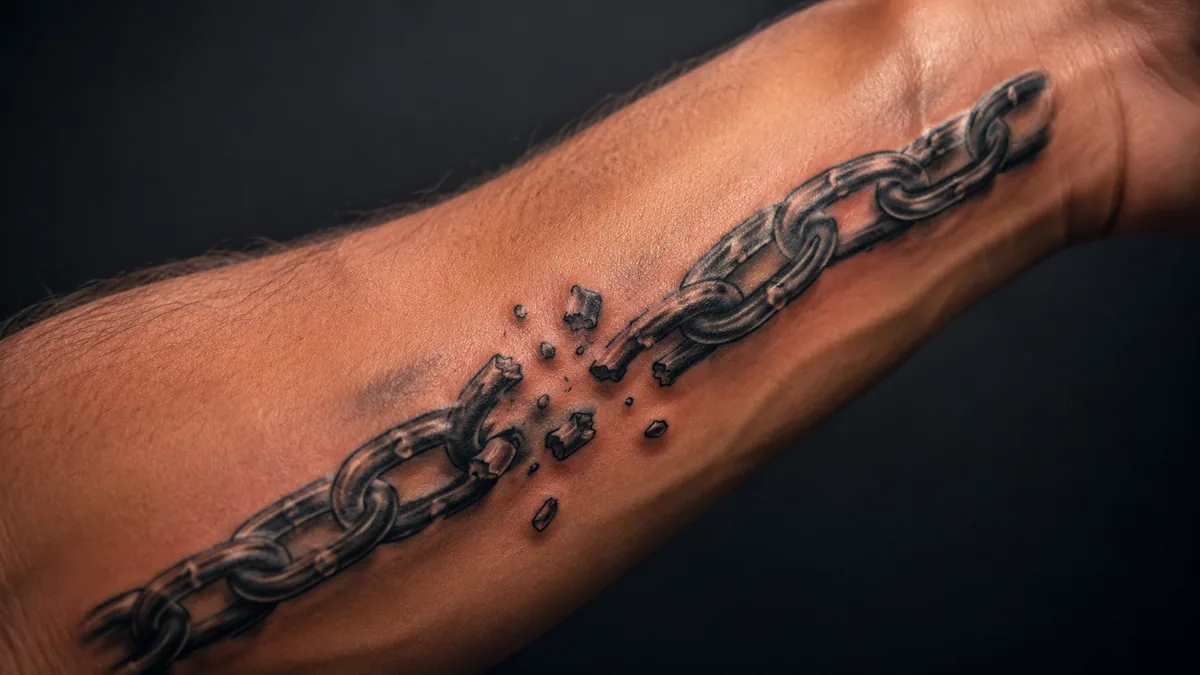
The classic version is a thick chain, nautical or rolo style, with one link snapped clean. You can show both ends falling apart, or have one end wrapped around the wrist or arm and the other hanging free. Some clients want the broken link to look like it exploded outward, with bent metal and a sense of sudden violent release. That energy reads strong and works well in bold traditional or neo-trad. Others want a single chain link, cracked open, simplified and minimal.
Fine line versions are popular right now. A delicate chain in single-needle black, with one link splitting apart. It’s subtle, readable up close, and works well on the wrist, collarbone, or ribcage. Realism takes it further: hyper-detailed metal with shadows, rust, wear, even light catching the edges. That style needs room to breathe, so the forearm or upper arm is your best canvas. Some artists add a bird flying through the broken link, or a small flame at the break point for added symbolism.
Color vs. Black and Grey
Most broken chain tattoos are done in black and grey or solid black, and for good reason. Metal reads best in monochrome. Black and grey lets an artist build up volume and shine through whip shading and contrast, making the chain look like actual steel. Crispy lines hold the structure, and a solid highlight down each link sells the illusion. This style heals nice and stays legible for decades if the linework is tight and the shading doesn’t get muddy.
Color can work, but it has to serve a purpose. Some people go for a golden chain to signal wealth or royalty being discarded. Others want a rusted orange-brown to suggest something old and corroded finally giving way. Saturated color in a traditional palette looks clean and bold on this subject. What you want to avoid is adding color just to add color. The design is already strong on its own. Color should add meaning, not decoration.
Best Placements and How It Ages
The wrist is the most popular placement, especially when the chain wraps around it. It looks like the restraint was literally on the body, which makes the symbolism physical and immediate. The forearm is another solid choice, giving the artist room to build detail and scale. The upper arm, chest, and ribcage all work depending on the size. If you want it small and personal, the inner wrist or behind the ear handles a simplified version fine.
Aging depends on where you put it and how it’s built. Bold traditional linework on the outer forearm or upper arm holds for a long time. Bold will hold. Fine line on a high-wear zone like the inner wrist or fingers will fade and spread faster, sometimes blurring within a few years. Inner wrist is moderate wear, better than fingers. Avoid overly thin lines on areas that see constant sun or friction. Black and grey with solid contrast ages best overall, and a touch-up down the road keeps it crisp.
Who Gets This Tattoo and How to Make It Personal
Recovery communities get this one a lot. People marking a sobriety date will sometimes incorporate the date into a broken link or put it beneath the chain in a simple script. Domestic violence survivors wear it. People who’ve walked away from high-control religious groups, cult situations, or generational trauma patterns wear it. It’s also common in circles that value personal liberty on principle, people who see freedom from authority or conformity as a core identity.
To make it yours, think about what the chain represents specifically. Was it a relationship? Incorporate a birthstone color or initials that only you’d recognize. Was it addiction? The sobriety date in the break point carries a lot of weight and keeps the meaning grounded. If it’s about ancestry or heritage, talk to your artist about working in cultural design elements from your background. The symbolism is already solid. The personalization is what turns a strong design into your design.