
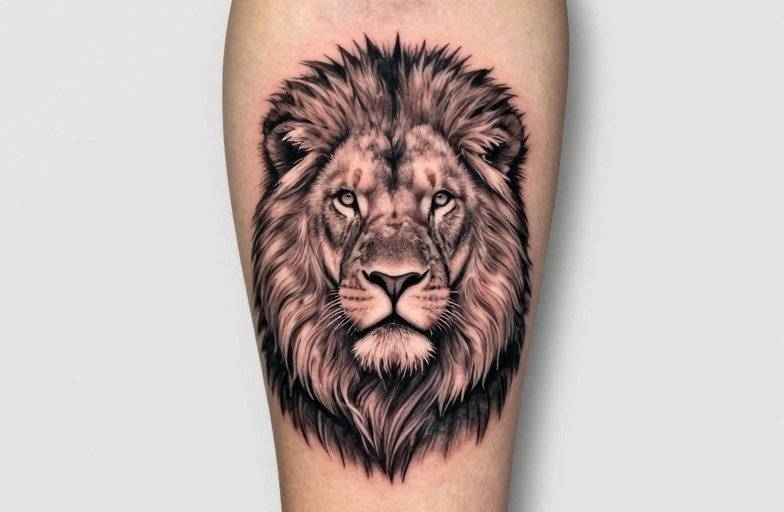
The Lion of Judah tattoo centers on a symbol with layered religious, cultural, and political weight: a lion, often crowned, representing Haile Selassie I, Ethiopian sovereignty, and for many, the spiritual strength of the Israelite tribe of Judah. On skin, it functions as a declaration of faith, heritage, or resistance, depending on who wears it and what tradition they speak from.
Symbolism & Core Meaning
The Biblical Root
In Genesis, Jacob blesses his son Judah by comparing him to a lion’s cub; Revelation later calls Jesus the “Lion of the tribe of Judah.” This biblical lineage gives the image its core religious resonance. For Christian wearers, the tattoo often signals Christ’s kingship, sacrifice, and promised return. The lion here is not merely fierce, it’s messianic, tied to a specific narrative of redemption through a particular bloodline.
Rastafari and Ethiopian Identity
Haile Selassie I, emperor of Ethiopia until 1974, claimed direct descent from King Solomon and the Queen of Sheba. Rastafarians identify him as the returned messiah, and the Lion of Judah became his emblem, literally stamped on Ethiopian currency and imperial seals. A tattoo in this tradition carries political weight: Pan-African solidarity, resistance to colonialism, and the spiritual repatriation of a diaspora. The colors green, yellow, and red often accompany the image, pulled from the Ethiopian flag.
- Crowned lion: Imperial authority, Selassie as divine king
- Uncrowned lion: Tribal strength, Judah’s biblical blessing
- With cross or scepter: Explicit Christian messianic claim
- With dreadlocks or cannabis leaf: Rastafari-specific identification
History & Cultural Roots
The symbol’s path onto skin runs through multiple channels. Ethiopian Orthodox Christianity used lion imagery in manuscripts and church paintings for centuries before it reached the West. Rastafari, emerging in 1930s Jamaica, adopted and transformed it. By the 1970s, reggae album art and concert posters broadcast the crowned lion globally, making it available to wearers with no direct Ethiopian or Jamaican heritage.
Some trace the tattoo’s popularity in Western shops to Bob Marley’s visibility and the broader reggae explosion. Others note its adoption by Christian athletes and musicians as a shorthand for “spiritual warrior.” This layered history means the same image can read very differently depending on context, sacred to one viewer, vaguely rebellious to another, culturally appropriative to a third.
Who Chooses This Tattoo
Faith Communities
Christian wearers often select the Lion of Judah to mark conversion, baptism, or a period of testing. The image appeals particularly to those who frame their faith in martial terms, “spiritual warfare,” overcoming addiction, surviving violence. It’s less common among liturgical traditions and more prevalent in charismatic, evangelical, and nondenominational circles where personal testimony carries weight.
Rastafari and Diaspora Wearers
For practicing Rastafarians, the tattoo can function as a sacred vow or Nazarite commitment. Among Caribbean and African diaspora communities, it may signal cultural pride or political consciousness without full religious adherence. The distinction matters: wearing the symbol without understanding Selassie’s role or Rastafari’s specific theology can flatten a complex living tradition into aesthetic.
How It Ages on Skin
Line Work and Detail Loss
The Lion of Judah demands fine detail, mane texture, facial structure, crown filigree, sometimes script. This is where aging hits hardest. Single-needle lines in the mane blur within 5-10 years into fuzzy texture. Small text (“Judah,” “Jah,” biblical verses) becomes illegible faster than you’d expect, especially on high-movement areas like ribs or shoulders. Bold, simplified mane shapes with thicker outlines hold their readable silhouette decades longer.
Placement Realities
Upper arms and outer thighs give the lion room to breathe and age more gracefully than compressed chest pieces or wrist wraps. The face needs scale, too small, and the eyes and nose merge into an unrecognizable blob. Black and grey ages more predictably than color, though the Rastafari palette of green, yellow, and red can be done with longevity in mind if the artist uses opaque, high-saturation pigments and avoids watercolor-style diffusion.
- Best aging: Bold outer lines, simplified mane geometry, 4+ inches minimum for face detail
- Risky: Inner bicep (sweat, friction), finger or hand (rapid fade, professional stigma)
- Color longevity: Red holds well; yellows fade fastest; greens vary by pigment base
Design Tips & Pairings
Traditional Elements
The classic crowned lion facing left or right, front paw raised, remains the most immediately readable composition. Adding the Ethiopian flag’s colors behind or below grounds it in Rastafari context. Script pairings work best when integrated into the design rather than floating nearby, “Conquering Lion of the Tribe of Judah” arched above, or “Jah Rastafari” below, sized to match the lion’s visual weight.
Modern Variations
Some artists split the lion’s face with geometric patterns or negative-space techniques. Others incorporate the Star of David, Ethiopian crosses, or the Ark of the Covenant silhouette. These work when the artist understands the symbol’s gravity; they fail when treated as mere “tribal fusion” decoration. A half-lion, half-human Selassie portrait exists in the tradition but requires extreme technical skill to avoid caricature.
Pairing with other imagery demands care. Lions with roses or clocks drift into generic tattoo vocabulary and dilute the specific meaning. Better companions: broken chains (liberation), open Bibles, Ethiopian landscape elements, or the specific colors that signal your intended tradition.
Personal & Modern Meanings
Contemporary wearers sometimes detach the Lion of Judah from its specific histories, using it as a generic emblem of personal strength or leadership. This happens with every loaded symbol, but the risk here is particular: the image remains actively sacred to living communities. A wearer outside those traditions should consider whether their personal meaning can coexist with the symbol’s public weight, or whether another lion variant, heraldic, astrological, purely naturalistic, would serve without appropriation.
That said, sincere adoption exists. Converts to Rastafari, Christians drawn to Ethiopian Christianity, and others engaging the symbol’s full context rather than its surface gravitas can wear it with integrity. The question is depth of engagement, not DNA.
The Bottom Line
The Lion of Judah tattoo carries genuine historical density, biblical prophecy, imperial Ethiopia, Rastafari theology, Pan-African resistance. It ages best when designed with bold simplicity rather than photographic detail. It communicates most clearly when the wearer understands which layer they’re speaking from and doesn’t pretend the symbol is infinitely plastic. Choose it for specific reasons rooted in actual tradition, or choose a different lion entirely.
Frequently Asked Questions
Does a Lion of Judah tattoo have to include a crown?
No. The crown specifically signals imperial or Rastafari context; an uncrowned lion draws more directly from the biblical Judah blessing. Both are valid but communicate differently.
Can someone who isn’t Black or Rastafari get this tattoo respectfully?
Possible, but requires genuine engagement with the tradition rather than aesthetic borrowing. Many artists and community members view casual adoption as appropriation, especially when paired with dreadlocks or cannabis imagery stripped of religious context.
What’s the best font for script paired with this design?
Avoid thin cursive or gothic blackletter that competes with the lion’s visual weight. Bold serif or clean sans-serif, integrated into the composition rather than floating nearby, ages better and reads more clearly.
How much should a detailed Lion of Judah tattoo cost?
Expect 4-8 hours for a solid medium-sized piece with proper detail, ranging from roughly $600 to $2,000+ depending on artist rate and location. Budget artists often rush the mane texture, which ages poorly.
Related Tattoo Meanings
- Locust Symbolism Tattoo Meaning: Plague, Survival Rebirth
- Lucifer Tattoo Meaning: Symbolism, Design, and What It Actually Says
- Mace Tattoo Meaning: Power, Protection, and Medieval Symbolism
- Explore more









