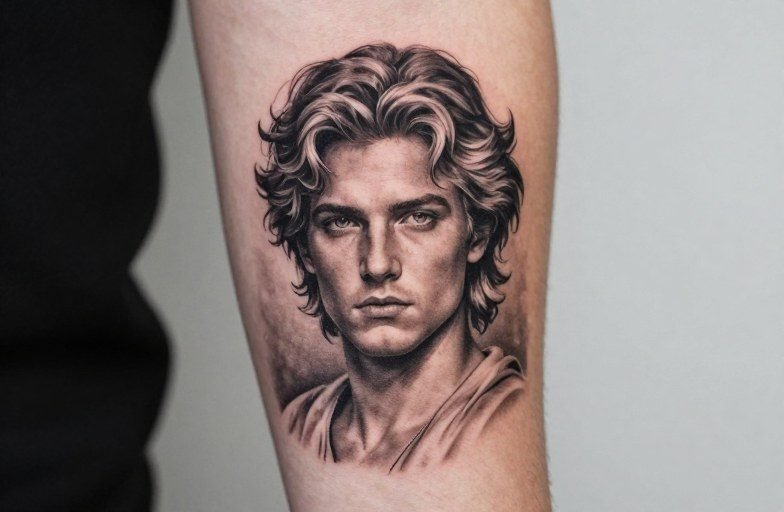
A Lucifer tattoo most commonly signals rebellion against authority, the pursuit of forbidden knowledge, or a complex relationship with duality, light and darkness, freedom and consequence. For some, it represents the archetype of the light-bringer who chose consciousness over obedience. For others, it’s a darker emblem of pride, isolation, or the beauty found in transgression. The meaning depends heavily on which Lucifer you’re referencing: the fallen angel of Milton, the romantic rebel of Blake, or the occult figure of modern esotericism.
Similar & Related Symbols
Lucifer doesn’t stand alone in tattoo iconography. Several related figures and symbols orbit the same thematic space, and understanding the distinctions helps clarify what you’re actually asking for.
Fallen Angels & Rebellious Archetypes
Prometheus, the Greek titan who stole fire for humanity, functions as a direct parallel, punished eternally for bringing enlightenment. Baphomet, with its goat-headed androgyny, shares Lucifer’s association with occult knowledge and rejected binaries. The serpent of Eden, particularly when depicted with an apple or the Tree of Knowledge, hits similar notes of curiosity and consequence. Each carries slightly different cultural weight: Prometheus reads more tragic, Baphomet more ceremonial, the serpent more primal.
Christian vs. Occult Depictions
A winged, beautiful Lucifer with intact angelic features differs sharply from the horned, bestial Satan of medieval tradition. The first draws from Milton and Romantic-era rehabilitation; the second from centuries of church propaganda. Tattoo collectors should know which lineage they’re entering. The beautiful fallen angel tends to attract those identifying with misunderstood brilliance or the cost of independence. The demonic version usually signals embrace of darkness, hedonism, or anti-Christian positioning.
Design Tips & Pairings
Lucifer imagery rewards specificity. Vague or generic execution turns a potentially nuanced piece into edgelord cliché.
Figurative Approaches
Portrait-style Lucifer tattoos work best with strong reference material, Gustave Doré’s illustrations, Romantic paintings, or carefully researched occult art. The face demands technical skill: subtle arrogance in the eyes, the particular tension of beauty marked by ruin. Single-needle or fine-line approaches can capture ethereal quality but age poorly on high-detail facial work; slightly bolder linework (3RL minimum for key features) holds up better over five to ten years. Wings, when included, should show damage, singed edges, missing feathers, asymmetry, to communicate the fall rather than intact angelic glory.
Symbolic & Text Pairings
- “Non serviam” (I will not serve): The classic declaration of autonomy, best rendered in clean serif or blackletter script
- Broken chains or shattered halos: Visual shorthand for liberation from imposed morality
- Flames that illuminate rather than destroy: References the “light-bringer” etymology (lux + ferre)
- Upward-pointing pentagrams or inverted crosses: Explicitly anti-Christian signaling; know your audience
- Books, scrolls, or burning libraries: Knowledge as both gift and catastrophe
Text integration needs spatial planning, Latin phrases wrap well around arm bands or collarbone pieces; larger symbolic tableaus suit backs, thighs, or full chest panels.
Best Placements
Where this goes on your body changes how it’s read, both by others and by you.
Visible rebellion: Hands, neck, and face make the statement unavoidable. These placements signal that the Lucifer identification is central to public identity, not private philosophy. Hand tattoos of sigils or the sigil of Lucifer specifically mark occult affiliation for those who recognize it. The commitment level is high, employment implications, social friction, the permanent nature of the declaration.
Concealed contemplation: Ribs, upper thighs, upper back, and chest under clothing allow personal significance without constant explanation. The rib cage, painful and private, suits the theme of hidden knowledge or internal struggle. Full back pieces provide canvas for narrative complexity, fall sequences, celestial warfare, the moment of choice.
Medium visibility: Forearms, calves, and shoulders offer balance. The forearm works well for vertical compositions (falling figure, descending light). The calf’s cylindrical shape suits coiled serpents or wrapped wings. Shoulder caps frame winged figures naturally, with the blade as potential halo or broken aureole.
One practical consideration: Lucifer imagery often involves extensive black fill. Large solid black areas heal with more variance, some patchiness, some lightening, touch-ups often needed at 6-12 months. Plan for that maintenance.
Mythology & Folklore
The name’s trajectory through cultures matters for tattoo meaning. Lucifer as a concept predates the Christian devil in some respects, and the layers accumulate.
Biblical & Apocryphal Sources
The single Isaiah reference to “Lucifer, son of the morning” originally described a Babylonian king, not a supernatural being. Later interpretation, particularly through the lens of the Book of Enoch and medieval glosses, constructed the narrative of angelic rebellion. Tattoo imagery drawing from this lineage often uses morning star imagery, Venus, the planet that precedes dawn, both light-bringer and something that falls. The visual paradox suits the theme: beauty that arrives before destruction, or illumination that costs everything.
Literary & Romantic Rehabilitation
Milton’s Paradise Lost famously made Lucifer the most compelling speaker in the poem. Blake’s assertion that Milton was “of the Devil’s party without knowing it” captures the Romantic reclamation. By the nineteenth century, Lucifer represented legitimate resistance to tyranny, artistic integrity, the refusal to kneel. Tattoos in this tradition emphasize eloquence, suffering, and tragic grandeur rather than menace. The figure might weep, might address empty heavens, might be shown in the moment before the fall still beautiful.
Modern occult traditions, Thelema, certain Luciferian currents, some Left-Hand Path practices, further complicate the figure, sometimes treating Lucifer as a Promethean intelligence to be engaged rather than a Christian adversary to be worshipped. Tattoo collectors in these spaces often use specific sigils (the Lucifer sigil, the eleven-pointed star) rather than figurative depiction.
Color vs Black and Grey
This choice fundamentally alters the tattoo’s emotional register.
Black and grey: Dominates Lucifer imagery for good reason. The chiaroscuro tradition, light emerging from darkness, or darkness consuming light, maps perfectly to the subject. Doré’s illustrations, the Romantic paintings, the occult aesthetics all lean monochrome. Black and grey ages reliably, allows subtle gradation in wings and facial modeling, and carries the gravitas most collectors want. The limitation is warmth: genuinely beautiful Lucifer needs some warmth, which skilled greywash can approximate through brown or olive undertones in the black mix.
Color: Riskier but potent when deliberate. Gold for the halo’s remnant, the morning star’s light. Deep crimson for the wound of the fall, or for the robes of kingship abandoned. Sickly green for the corruption of paradise. Full color Lucifer tattoos work best with strong illustrative or neo-traditional approaches, bold outlines holding saturated fills. The pitfall is garishness; without disciplined color theory, Lucifer becomes comic book villain rather than complex archetype. One effective compromise: black and grey figure with selective color accent, gold eyes, a single red tear, the flame’s heart.
One technical note: reds and yellows in flame work tend to fade fastest, requiring more frequent refresh. Plan touch-up budget accordingly.
History & Cultural Roots
Understanding where this imagery comes from prevents the most embarrassing tattoo mistake: claiming a meaning that contradicts your actual design.
The visual tradition of beautiful Lucifer is largely post-Renaissance. Medieval art universally depicted the devil as grotesque, animal, deformed, visually othered to confirm moral othering. The shift to tragic beauty required humanism, the recovery of classical forms, and eventually Romanticism’s valorization of the outcast. Your tattoo participates in this specific lineage whether you know it or not.
The sigil of Lucifer, an intricate geometric design sometimes called the “Lucifer seal”, emerged from nineteenth-century occultism, often linked to the Grimorium Verum and later popularized by groups like the Order of the Nine Angles and various Luciferian organizations. It’s a constructed symbol, not ancient, but that doesn’t diminish its accumulated meaning. Tattoo collectors using it should know its relatively recent origin rather than claiming Phoenician or Sumerian roots.
In contemporary tattoo culture, Lucifer imagery surged with the rise of black metal and occult blackwork in the 1990s and 2000s, then diversified as fine-line and illustrative styles absorbed darker themes. The current moment allows more nuance than the earlier association with purely antagonistic metal culture.
The Takeaway
A Lucifer tattoo communicates something specific about your relationship to authority, knowledge, and the costs of both. The key is alignment: know which Lucifer you’re invoking, place it where the statement matches your life, and execute with technical seriousness this figure demands. Whether Milton’s eloquent rebel, Blake’s romantic adversary, or the occult light-bringer, the image carries weight that outlasts trend. Get it right, and it ages with you, complex, unrepentant, still asking the forbidden questions.
Frequently Asked Questions
Does a Lucifer tattoo automatically mean I’m anti-Christian?
Not necessarily. Many people choose this imagery for its themes of rebellion, enlightenment, or personal autonomy without any religious statement. However, the symbol carries strong cultural associations with rejecting Christian authority, so be prepared for that interpretation from others regardless of your intent.
What’s the difference between a Lucifer tattoo and a Satan tattoo?
Lucifer typically refers to the pre-fall or fallen angel, beautiful, luminous, tragic, while Satan in tattoo imagery usually means the fully demonic, adversarial figure. The distinction matters: Lucifer draws from Milton and Romantic tradition; Satan from medieval diabology and horror aesthetics. They’re related but not identical symbols.
Will a Lucifer tattoo hurt more than other designs?
Pain depends on placement, not imagery. However, Lucifer designs often require extensive black fill or detailed linework that extends sessions longer than simpler tattoos. Rib placements, common for this theme, are among the most painful. Budget for multiple sessions if doing large-scale work.
Can I combine Lucifer imagery with other religious symbols?
You can, but understand the tension you’re creating. Pairing Lucifer with Christian crosses, saints, or angels creates explicit narrative conflict that some will read as blasphemous, others as theological commentary. Make sure the juxtaposition is intentional and coherent rather than accidentally contradictory.
Related Tattoo Meanings
- Archangel Michael Tattoo Meaning
- Angel Michael Tattoo Meaning
- Fallen Angel Tattoo Meaning
- Explore more