
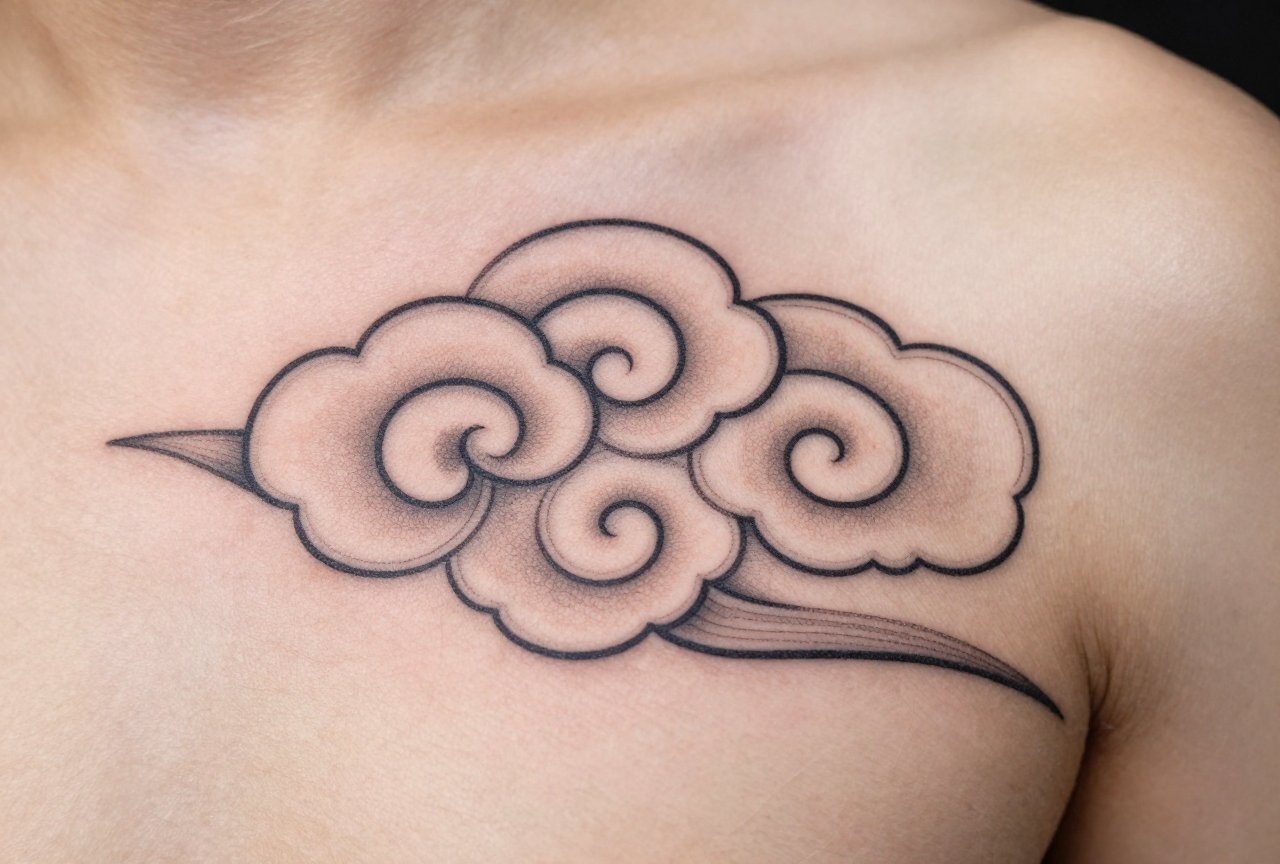
A traditional Japanese cloud tattoo represents the transient nature of life, the unstoppable force of change, and the boundary between earthly and spiritual realms. In Japanese tattoo art, known as Irezumi, clouds serve as both decorative background elements and powerful symbols of wind, movement, and impermanence. These flowing forms carry centuries of cultural weight, connecting the wearer to Buddhist philosophy, Shinto spirituality, and the aesthetic traditions of ukiyo-e woodblock prints.
Symbolism & History
Japanese cloud motifs, called kumon or un, trace their origins to Chinese artistic traditions that arrived in Japan during the Asuka period (538-710 CE). Over centuries, Japanese artists developed distinctly local styles, most notably the raimō (thundercloud) pattern and the softer, scrolling forms seen in temple paintings and screen art.
In Buddhist and Shinto contexts, clouds represent several interconnected concepts:
- Impermanence (mujō): Clouds form and dissolve without fixed shape, embodying the Buddhist teaching that all phenomena are temporary and ever-changing.
- Wind and movement: Clouds cannot exist without air currents, making them symbols of unseen forces that shape our lives.
- Divine presence: In religious art, clouds often surround deities, Buddhas, and spirits, marking the threshold between mortal and sacred spaces.
- Protection and transition: Storm clouds can signify both danger and the cleansing renewal that follows.
During the Edo period (1603-1868), ukiyo-e masters like Hokusai and Hiroshige popularized dramatic cloud formations in their prints. These images directly influenced the developing tattoo tradition, giving Irezumi artists a visual vocabulary that remains central to the style today.
Common Variations & Styles
Japanese cloud tattoos appear in several recognizable forms, each carrying slightly different connotations:
- Background filler clouds: Soft, swirling forms that frame primary subjects like dragons, tigers, or koi fish. These create atmospheric depth and movement across large compositions.
- Standalone cloud bands: Horizontal strips of clouds, often seen in munewari (chest-opening) or donburi (full back) designs, representing the sky itself as a subject.
- Thunderclouds (raimō): Dark, turbulent formations with jagged edges and spiral patterns, suggesting power, upheaval, or spiritual intensity.
- Gold-leaf inspired clouds: Borrowed from screen painting traditions, these use bold outlines and flat color areas for a more graphic, decorative effect.
- Wind-blown clouds: Elongated, streaked forms that emphasize motion and the invisible force of fūjin (the wind god).
Color choices also carry weight. Traditional Irezumi uses primarily black and grey shading for clouds, with occasional red accents. Modern interpretations may incorporate blue, purple, or even full color palettes while maintaining classical linework structures.
Best Placements
Cloud tattoos adapt remarkably well to body contours because their organic, flowing shapes can wrap around muscles and joints naturally. Common placements include:
- Full back or partial back: The classic canvas for Irezumi, where clouds can sweep across the shoulder blades and drift down toward the waist.
- Sleeves (kote): Clouds work exceptionally well as background elements that unify disparate images into a cohesive sleeve composition.
- Chest panels: Swirling clouds can frame the central chest area or flow outward from the sternum.
- Thighs and legs: The curved muscle structure accommodates cloud movement, particularly for designs that suggest upward or forward momentum.
- Neck and behind the ear: Smaller cloud formations suit these intimate placements, often chosen for their personal rather than public significance.
Who Chooses This Tattoo / Personal Meanings
People drawn to Japanese cloud tattoos often share certain sensibilities or life circumstances. The design appeals to those who have experienced significant transformation, whether through recovery, relocation, career change, or personal loss. The cloud’s meaning of impermanence resonates with individuals who have learned to embrace uncertainty rather than fear it.
Some wearers connect specifically to the wind association, seeing themselves as adaptable, free-moving, or resistant to being pinned down. Others appreciate the aesthetic tradition itself, drawn to Irezumi as a living art form with rigorous technical standards and cultural depth.
Cloud tattoos also attract people with Japanese heritage seeking to reconnect with ancestral visual culture, as well as non-Japanese enthusiasts who have studied and respect the tradition’s history. The key distinction lies in approach: thoughtful engagement with the symbolism versus superficial appropriation. Reputable artists help navigate this balance, ensuring designs honor rather than exploit their source material.
Similar Symbols
Japanese tattoo tradition offers several motifs that complement or parallel cloud symbolism:
- Wind bars (kaze-hauchi): Straight or curved lines representing wind movement, often paired with clouds in dynamic compositions.
- Waves (seigaiha or nami): Like clouds, water forms are ever-changing and share similar flowing visual grammar. The pairing of wind and waves appears throughout Japanese art.
- Smoke and fire: Often emanating from dragons or surrounding Buddhist figures, these elements share clouds’ quality of marking supernatural presence.
- Cherry blossoms: Another powerful symbol of transience, frequently scattered across cloud-filled backgrounds in spring-themed designs.
- Dragons: In Japanese tradition, dragons command weather and dwell in clouds, making these two motifs natural companions.
Final Thoughts
The traditional Japanese cloud tattoo offers far more than decorative filler. It carries a sophisticated philosophy of change, acceptance, and spiritual awareness rooted in centuries of artistic development. Whether chosen as a subtle accent or a dominant composition element, these flowing forms connect the wearer to a living tradition that values both technical mastery and meaningful symbolism. For those considering this design, working with an artist experienced in Irezumi principles ensures the cloud’s full expressive potential, honoring its history while making it personally relevant. The best cloud tattoos move with the body as real clouds move through sky, reminding us that permanence is neither possible nor desirable, and that beauty lives in the constant flux of becoming.
Related Tattoo Meanings
- Pentacle Tattoo Meaning: Symbolism, History Personal Significance
- Valkyrie Tattoo Meaning: Strength, Honor Divine Guidance
- Phoenix Tattoo Meaning: Rebirth, Resilience Rising Strong
- Explore more
Frequently Asked Questions
What do traditional Japanese cloud tattoos symbolize in relation to wind?
Japanese cloud tattoos, or kumo, often appear alongside wind bars and represent the invisible force of wind that shapes and moves clouds. This pairing symbolizes life’s unstoppable momentum and the idea that change is constant and natural.
Why do Japanese cloud tattoos represent change and transformation?
Clouds are ever-shifting and never permanent in Japanese art, making them a powerful metaphor for the Buddhist concept of impermanence called mujō. A cloud tattoo reminds the wearer that all circumstances, good or bad, will eventually pass and transform.
How do Japanese cloud tattoos connect to spirituality and religion?
In Japanese Buddhism and Shinto, clouds represent the boundary between the earthly and divine realms, often surrounding gods and sacred figures in traditional paintings. This spiritual association makes cloud tattoos a symbol of transcendence and connection to higher consciousness.
What is the difference between Japanese wind bars and cloud tattoos?
Wind bars are the straight, spiraling lines that indicate movement and direction, while cloud tattoos are the rounded, swirling shapes that fill space and soften transitions in a larger design. Together they create the classic Japanese sleeve background called gakubori, but clouds alone carry more spiritual weight regarding impermanence and the divine.









