
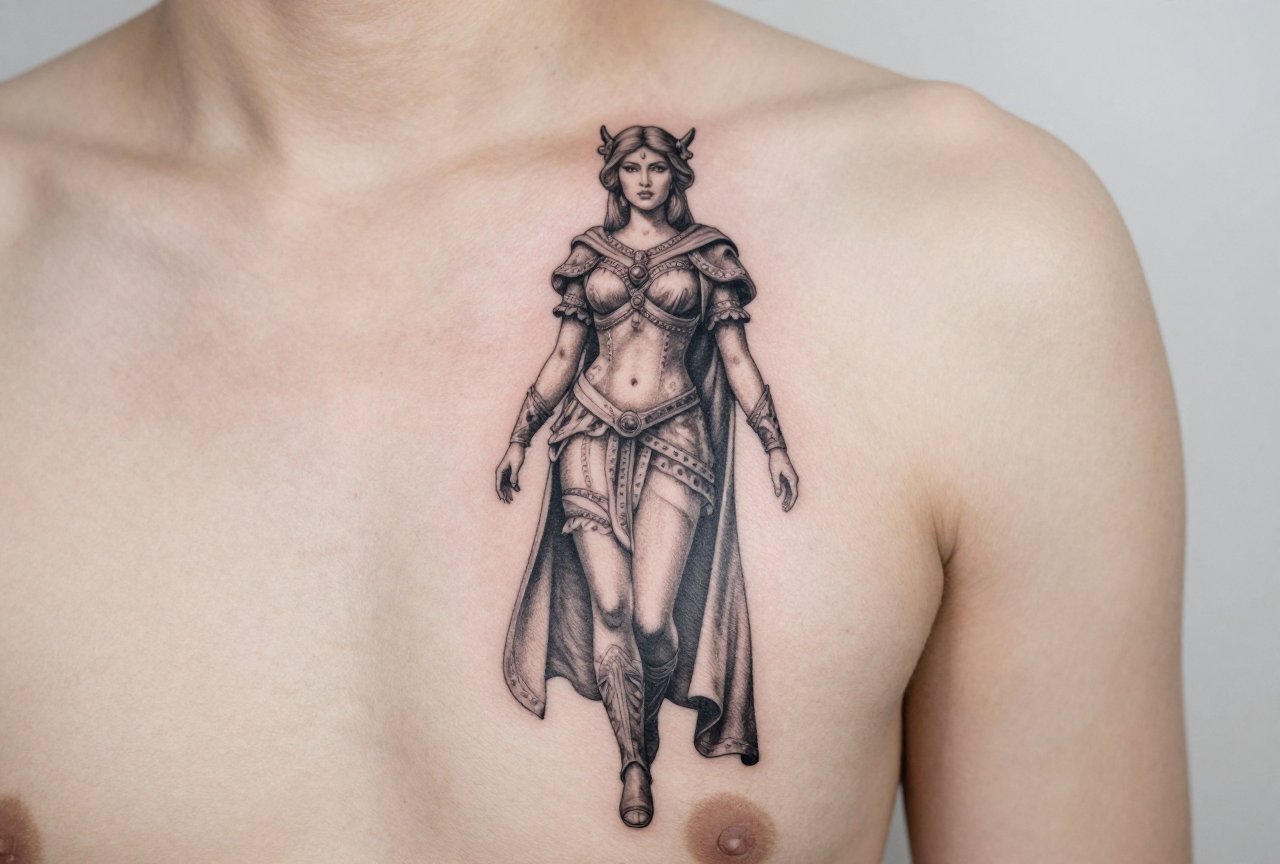
Valkyrie Tattoo Meaning: Strength, Honor & Divine Guidance
Valkyrie tattoos occupy a distinctive space in Norse-inspired body art. These figures from Old Norse tradition offer more than dramatic imagery; they carry layered associations with battle, fate, and the threshold between life and death. Whether drawn to their martial presence or their subtler role as psychopomps, you will find that Valkyrie iconography rewards careful consideration before needle meets skin.
Origins and Historical Context
The Valkyries emerge from Old Norse literature, primarily the Poetic Edda and Prose Edda, compiled in Iceland during the 13th century from earlier oral sources. These figures, whose name derives from Old Norse valkyrja (“chooser of the slain”), appear as servants of Odin who select warriors fallen in combat to inhabit Valhalla.
Literary Sources vs. Popular Imagination
Medieval texts present Valkyries with notable complexity. In Helgakviða Hjörvarðssonar, they appear as human women; elsewhere, they possess supernatural attributes. The famous image of winged maidens in armor owes more to 19th-century Romanticism and Wagnerian opera than to primary sources. For tattoo purposes, this distinction matters. You might choose historically grounded depiction or embrace the evolved visual tradition, but understanding the difference sharpens your artistic decisions.
Archaeological Evidence
Material culture offers limited but intriguing support. The Tjängvide image stone from Gotland (8th-9th century) depicts a rider welcomed by a female figure bearing a drinking horn, often interpreted as a Valkyrie offering mead to an arriving einherjar. The Rök stone references Valkyries in its inscription. Such artifacts suggest these figures held genuine religious significance rather than existing purely as literary invention.
Core Symbolic Dimensions
Valkyrie tattoos communicate through several interconnected symbolic channels. Your chosen emphasis will determine placement, style, and accompanying imagery.
Strength and Martial Prowess
The most immediate association connects Valkyries to combat and physical courage. Unlike passive feminine archetypes in other traditions, these figures actively participate in violence, wielding weapons and determining battle outcomes. This dimension resonates particularly with those who have served in military or emergency services, or who have faced significant personal battles requiring sustained endurance.
- Spear imagery references Odin’s weapon and the Valkyrie’s active role
- Shield motifs suggest protection alongside aggression
- Armor details emphasize preparedness and resilience
Honor and Ethical Choice
Less frequently discussed but equally potent, the Valkyrie embodies selection based on merit rather than birth or wealth. The fallen warrior enters Valhalla through demonstrated courage, not social standing. This egalitarian dimension often appeals to those who value earned respect over inherited privilege. The tattoo can mark personal commitment to integrity under pressure, to choosing difficult right action over convenient compromise.
Divine Guidance and Psychopomp Functions
Perhaps the most personally meaningful aspect involves the Valkyrie’s role as guide. Beyond battlefield selection, these figures conduct souls across boundaries. This resonates with those who have experienced profound loss, who work in hospice or death-care professions, or who have undergone powerful personal transitions. The Valkyrie becomes not merely a warrior but a companion through liminal spaces, offering presence during passages where familiar structures dissolve.
Design Approaches and Stylistic Considerations
Effective Valkyrie tattoos require thoughtful integration of figure, symbolism, and technical execution. Several established approaches offer starting points for your custom design.
Traditional Norse Art Styles
The Urnes style, with its slender, intertwined beasts, provides authentic period vocabulary. Valkyrie figures rendered in this manner appear on rune stones and metalwork. The Ringerike and Borre styles offer alternative ornamental frameworks. These approaches demand skilled specialists; the interlace requires mathematical precision, and figure recognition within stylized forms challenges even experienced artists.
Contemporary Realism and Neo-Traditional
Modern realistic rendering allows emotional expression through facial detail, fabric texture, and atmospheric effects. Neo-traditional approaches incorporate bold outlines and limited but saturated color palettes. Both permit dramatic winged compositions, dynamic poses, and integration with ravens, wolves, or runic inscriptions. Consider how your chosen style will age; fine detail in wings and faces may blur over decades, while bold structural elements maintain legibility.
Minimalist and Symbolic Alternatives
Not every Valkyrie tattoo requires full figural representation. A spear with distinctive binding, a drinking horn, or a stylized wing can invoke the figure while permitting placement flexibility. Single-needle work suits these approaches, creating subtle pieces that reveal their reference to informed viewers without demanding explanation. This path often suits professional environments where visible elaborate tattooing carries consequences.
Placement and Composition
Valkyrie imagery particularly suits certain body locations due to its vertical or spreading character.
- Back pieces accommodate full winged figures with surrounding narrative elements
- Thighs offer substantial flat planes for seated or standing compositions
- Upper arms and shoulders suit profile or three-quarter views with shield or spear
- Ribs and flanks work for ascending or descending figures, emphasizing movement
Consider how the composition interacts with your body’s natural lines. Wings can extend across shoulder blades or wrap around limbs. A descending Valkyrie composition along the outer thigh creates dramatic visual flow. Discuss these possibilities with artists experienced in large-scale figure work; poor placement can distort the figure or create unintentional comic effects as body position changes.
Scale and Detail Balance
Small Valkyrie tattoos rarely succeed. The figure’s identifying attributes, wings, weapons, often armor, require minimum scale for recognition. Below approximately palm-sized, the image dissolves into generic warrior-woman. Conversely, excessive scale without sufficient detail produces empty, disappointing results. Match your ambition to your artist’s demonstrated capabilities and your sessions budget.
Cultural Sensitivity and Personal Authenticity
Norse iconography circulates increasingly in contexts far removed from its origins. Thoughtful engagement with this heritage matters.
Separating Symbol from Misappropriation
Valkyrie imagery has appeared in nationalist and supremacist contexts, though less frequently than certain runic symbols or Thor’s hammer. Understanding this contamination helps you make informed choices. Emphasizing the figure’s feminine power, her role as guide and chooser rather than exclusive racial guardian, resists such appropriation. Some incorporate explicitly inclusive elements: mixed martial traditions, diverse physiognomy in the figure herself, or accompanying symbols from multiple cultural sources.
Personal Connection Beyond Ancestry
Meaningful tattooing requires no genealogical justification. You might resonate with Valkyrie symbolism through lived experience, aesthetic preference, or philosophical alignment. The question is not whether ancestors spoke Old Norse but whether the symbol genuinely articulates something you need expressed permanently. That said, superficial adoption, selecting imagery for perceived toughness without understanding its dimensions, produces hollow results you may later regret.
Aftercare and Long-term Maintenance
Valkyrie tattoos, particularly elaborate pieces with fine detail, demand rigorous aftercare. Follow your artist’s specific instructions, which typically include keeping the area clean, avoiding submersion during initial healing, and protecting from sun exposure during the extended settling period. Over years, sun protection remains essential; wing feathers and facial features blur disproportionately under UV exposure. Plan for periodic touch-ups to maintain the crisp definition that makes these compositions effective.
Final Thoughts
A Valkyrie tattoo offers remarkable range: warrior and guide, death-bringer and welcome-giver, fearsome and compassionate. The symbol’s complexity is its strength, permitting genuine personal interpretation without collapsing into empty genericism. Your task is to identify which dimensions resonate with your specific experience, then collaborate with an artist capable of translating that resonance into technically accomplished, visually powerful form. The result should feel inevitable, something that could only have been made for your particular body, carrying your particular history forward into the visible world.
Frequently Asked Questions
Do I need Scandinavian ancestry to get a Valkyrie tattoo?
No. Meaningful engagement with this symbolism depends on personal resonance and thoughtful understanding, not genetic connection. Many who choose Valkyrie tattoos connect through lived experience, philosophical alignment, or aesthetic appreciation rather than ancestry.
What is the most historically accurate way to depict a Valkyrie in tattoo form?
The winged maiden in armor derives largely from 19th-century Romanticism. For greater historical grounding, consider the drinking horn motif from image stones, or figures in earlier medieval dress without elaborate wings. Discuss specific artifacts with your artist to develop authentic approaches.
How large should a Valkyrie tattoo be to work effectively?
Below palm-sized, identifying attributes typically blur into generic warrior imagery. Successful Valkyrie tattoos generally require substantial scale to accommodate wings, weapons, or armor details. Match your ambition to your artist’s demonstrated skill with large-scale figure work.
How can I avoid associations with extremist appropriation of Norse symbols?
Emphasize dimensions resistant to such readings: the Valkyrie’s feminine power, her role as psychopomp and guide, her function as merit-based chooser. Consider inclusive design elements, diverse representation, and explicit contextual framing that foregrounds these universal aspects over exclusionary interpretations.









