
Who Chooses This Tattoo
The 1776 tattoo draws a particular kind of collector. Independence Day enthusiasts, history teachers, constitutional scholars, and military veterans often gravitate toward this specific year. Beyond patriotism, though, the choice signals something more nuanced: a deliberate anchoring to an idea rather than a flag alone.
Some collectors select 1776 after naturalization ceremonies, marking citizenship with the nation’s founding moment. Others arrive at the design through family lineage, tracing ancestors to Revolutionary War service. A smaller but notable group includes libertarians and political philosophy students who treat the date as shorthand for Enlightenment ideals, particularly the tension between individual liberty and collective governance.
What Draws People to This Specific Year
Unlike broader patriotic imagery, 1776 carries intellectual weight. The Declaration of Independence’s signing date locates American identity in a document, not merely a geography. Collectors often mention this distinction, preferring the specificity of parchment and ink over the generality of stars and stripes. The year also functions as a conversation piece, a tattoo that prompts questions rather than assumptions.
Common Motivations and Misconceptions
Not every 1776 tattoo carries political intent. Some collectors simply appreciate the typography, the way seven numerals balance visually. Others connect to the musical Hamilton or broader revolutionary aesthetics. A misconception worth addressing: many assume the tattoo implies conservative politics. In practice, the year attracts across the spectrum, from anarcho-capitalists to democratic socialists who emphasize the Declaration’s radical egalitarian language.
How It Ages on Skin
Numeral tattoos age predictably, which is both advantage and limitation. Clean, sans-serif 1776 designs maintain legibility longer than script or ornamental treatments. The vertical strokes of 1 and 7, the closed loops of 6 and 9, these shapes resist the softening that blurs more intricate work over decades.
Linework density matters significantly. Single-needle fine lines in 1776 tattoos often spread within five to seven years, turning crisp edges into fuzzy suggestions. Bold, consistent stroke weight, around three to five needles, preserves the mathematical precision that makes this design effective. I have observed heavily outlined numerals from the 1990s that remain immediately readable, while delicate counterparts from 2015 already require close inspection.
Long-Term Fading and Touch-Up Considerations
Black ink on pale skin shows gradual graying as macrophages distribute pigment. Sun exposure accelerates this process dramatically. For 1776 tattoos, touch-ups typically focus on reinforcing the horizontal bar of the 7 and the terminal curve of the 6, areas where friction and sun converge. Color additions, if originally present, usually fade faster than the black numerals, creating uneven aging that collectors either embrace or correct.
Key Characteristics
Successful 1776 tattoos share structural qualities. Proportion between numerals must remain consistent, typically achieved through a single typeface reference rather than freehand drawing. Kerning, the space between digits, requires particular attention. Tight spacing risks bleeding into illegibility; loose spacing fragments the year into unrelated numbers.
- Typography selection: Historical fonts, Franklin Gothic or Trajan Pro derivatives, reinforce period resonance. Contemporary sans-serifs, Helvetica or Futura, create modern contrast. Decorative blackletter or tattoo-specific scripts rarely succeed, overwhelming the numerical content.
- Scale minimums: Below two inches in width, 1776 becomes difficult to render with necessary stroke weight. At three to four inches, secondary elements, scrollwork or surrounding quotation, become viable without crowding.
- Orientation: Horizontal reading matches standard numerical presentation. Vertical stacking, reading top-to-bottom, occasionally works for rib or spine placement but requires careful spacing to prevent misreading as 6177 or similar permutations.
Secondary imagery, when included, should subordinate rather than compete. Liberty bells, quill pens, or fragmentary Declaration text work best as background texture or framing devices. The numerals must remain the unambiguous focal point.
Color vs Black and Grey
Black and grey dominates 1776 tattooing for practical and aesthetic reasons. The historical documents referenced, parchment and iron-gall ink, suggest a limited palette. Grayscale also emphasizes form over decoration, aligning with the design’s intellectual rather than purely decorative intent.
Color applications, when chosen, typically employ restrained schemes. A single red accent, perhaps a small liberty torch or subtle flag element, provides visual punctuation without historical dissonance. Full-color treatments, incorporating flag palettes or patriotic bunting, often age poorly, the multiple pigments competing for attention as each fades at different rates.
When Color Enhances the Design
Two scenarios justify color introduction. First, collectors with existing color-heavy work who need visual cohesion across a larger composition. Second, specific historical references: the faded sepia of aged documents, reproduced through muted ochre and umber washes, can ground the numerals in archival authenticity. Even here, restraint proves essential. The 1776 itself usually remains black.
Best Placements
Forearms and calves provide natural horizontal canvases for 1776, allowing comfortable reading without body contortion. These locations also offer moderate sun exposure, manageable with consistent protection, and sufficient flat area for clean numeral rendering.
Chest placement, centered or over the heart, carries obvious symbolic weight but presents technical challenges. The pectoral curve distorts horizontal lines, requiring the artist to design with body shape rather than against it. Ribs and flanks, while popular for text tattoos, demand exceptional pain tolerance and provide less stable skin for long-term clarity.
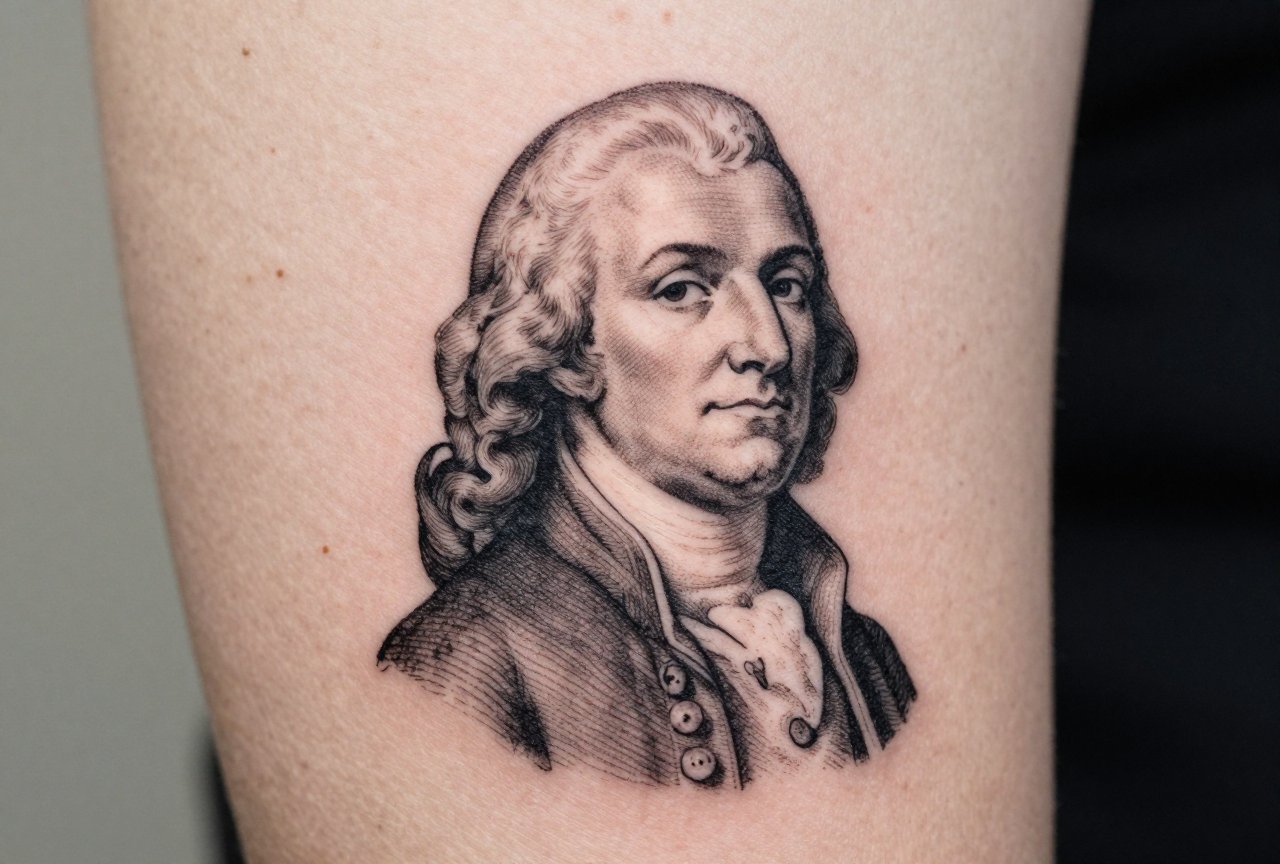
- Upper arm/shoulder: Excellent for incorporating surrounding imagery, eagles or historical portraits, in a sleeve context. The cylindrical surface requires careful font selection to prevent distortion.
- Back of neck/nape: Small 1776 tattoos work here, though visibility limits the personal significance for the wearer themselves. Often chosen for semi-private declaration.
- Hands and fingers: Generally discouraged for this specific design. The small scale forces excessive simplification, and the high-movement, high-exposure environment accelerates degradation dramatically.
Visibility and Professional Considerations
Unlike more ambiguous imagery, 1776 announces itself immediately. Collectors in conservative professional environments should consider placement accordingly. The forearm, increasingly accepted in many workplaces, still raises questions in others. The upper arm, easily covered, offers compromise between personal visibility and professional discretion.
What to Expect
Consultation for a 1776 tattoo should involve typeface discussion, not merely flash selection. Bring reference: historical documents, preferred fonts, or existing tattoos whose numeral quality you admire. The artist’s task is translation, adapting two-dimensional type to three-dimensional skin with appropriate technical adjustments.
Session duration typically runs one to two hours for straightforward numerals, extending to three or four with substantial secondary imagery. Pain levels correspond to placement more than design complexity. Aftercare follows standard protocol: gentle washing, appropriate moisturizer, sun avoidance during healing. The numerals’ simplicity actually aids aftercare, fewer areas of heavy saturation mean more uniform healing.
Working With Your Artist
Request a stencil preview in multiple sizes. The difference between 2.5 and 3.5 inches significantly impacts readability and aging. Discuss needle grouping explicitly; a 1776 tattoo benefits from the artist’s confidence in bold lining. Stippling or whip-shading, if included, should supplement rather than replace clean outlines. Finally, plan the long view: where will touch-ups happen, how will surrounding tattoos integrate, what happens when skin texture changes with age?
Key Takeaways
The 1776 tattoo succeeds through restraint and precision. Its power lies in recognition, immediate association with a specific historical moment and its ongoing interpretations. Collectors should prioritize typographic clarity over decorative embellishment, accept the visibility this design demands, and commit to sun protection as non-negotiable maintenance.
Aging favors bold, well-spaced numerals in consistent black and grey. Placement should accommodate both the body’s natural lines and the wearer’s professional context. The most enduring 1776 tattoos I have encountered share one quality: they treat the year as complete statement, requiring no explanation beyond the seven digits themselves.
Frequently Asked Questions
Does a 1776 tattoo automatically mean someone is politically conservative?
Not necessarily. The year attracts collectors across political positions, from libertarians emphasizing individual rights to progressives highlighting the Declaration’s radical egalitarian language. Some choose it for historical interest, family genealogy, or purely aesthetic appreciation of the numerals themselves. The meaning resides in the wearer’s specific intention, not universal interpretation.
What is the smallest size a 1776 tattoo can be while remaining legible over time?
Approximately two inches in width represents the practical minimum. Below this, stroke weight becomes too fine to resist natural spreading and fading. For optimal longevity, three to four inches allows appropriate boldness and potential for secondary elements without compromising the numerals’ immediate readability.
Why do most 1776 tattoos use black and grey rather than color?
The palette references historical documents, parchment and iron-gall ink, creating period-appropriate aesthetic coherence. Black and grey also ages more uniformly, while multiple colors fade at different rates, creating visual imbalance. When color appears, it typically functions as restrained accent rather than dominant treatment.
How should I prepare for a consultation specifically for this tattoo?
Bring typeface references, whether from historical documents, digital fonts, or existing tattoos you admire. Discuss needle grouping and stroke weight explicitly. Request stencil previews at multiple sizes. Consider long-term integration: how this tattoo relates to existing or planned work, and how placement affects both personal visibility and professional circumstances.









