
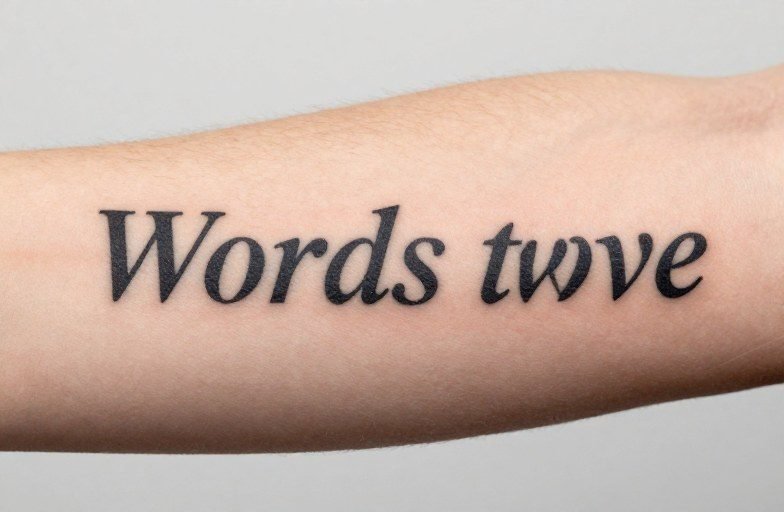
A tattoo of words with two meanings, ambigrams, palindromes, or words that read differently flipped or reversed, carries a built-in duality. The core symbolism is transformation: what you see from one angle becomes something else entirely when you shift perspective. These pieces speak to hidden identities, private codes, the tension between public face and private self, or the way time changes how we read our own lives.
Best Placements
Wrist and Forearm
The wrist remains the classic spot for readable word tattoos, and double-meaning pieces thrive here because the viewer can physically rotate their arm to catch the second reading. Forearm placement offers more real estate for longer ambigrams, names that become other names, or short phrases that invert into counter-phrases. The natural movement of turning the arm becomes part of the tattoo’s function. Inner forearm protects the ink from sun fading better than the outer edge, which matters because fine linework in ambigrams blurs faster than bold imagery.
Upper Arm and Shoulder
The deltoid and outer bicep handle circular ambigrams well, words that read the same rotated 180 degrees. These placements suit larger pieces where the viewer must walk around you to catch both meanings. The muscle movement here is minimal compared to the forearm, so intricate letterforms stay stable over time. Avoid the inner bicep if the second meaning matters equally; the natural arm position hides that surface from most angles.
- Chest: Centered over the sternum, ambigrams work in mirror symmetry, readable in a mirror, different from direct view. Heals relatively well, though the sternum area hurts more than most spots.
- Back of the neck: Small palindromes or short flipped words sit cleanly here. High sun exposure means black ink only; color fades fast on the neck.
- Fingers and hands: Functional for personal viewing, reading your own tattoo by flipping your hand, but ink falls out faster here, and fine details blur within a few years.
Common Variations & Styles
Ambigrams
The most technically demanding variation: a word or phrase that reads as another (or the same) when rotated 180 degrees. Tattoo artists rarely draw these freehand; most work from custom designs by lettering specialists or software-aided sketches. The style splits into rotational (flips upside-down), mirror (reads backward in reflection), and figure-ground (negative space forms a second word). Rotational ambigrams dominate tattoo culture because they reward the wearer with a private reveal, show someone, rotate, watch recognition hit.
Palindromes and Dual Readings
Palindromes read the same forward and backward, “radar,” “level,” “civic”, but in tattoo form, the visual layout matters more than linguistic purity. Some pieces stack words so one reads across, another reads down. Others use letterforms that function as completely different words depending on orientation: “angel” becoming “devil” is a common request, though the letterform compromise usually weakens both words. The best dual-reading tattoos accept some abstraction in the letterforms rather than forcing perfect legibility in both directions.
- Script vs. block lettering: Script ambigrams flow better but require more artistic license with letter shapes. Block lettering reads clearer but looks mechanical.
- Ornamental framing: Decorative borders can anchor one reading while the unframed center carries the second meaning.
- Split composition: Half the word in one style, half in another, merging at a central pivot point.
Religious & Spiritual Angles
Dual-meaning word tattoos intersect with spiritual practice in several traditions. The most frequent religious application is the name-form: a sacred name that becomes a protective word or devotional phrase when inverted. Some Christian wearers request “love” and “evol” (though “evol” lacks theological weight, the gesture toward reversal, sin and redemption, carries personal meaning). More sophisticated pieces pair Greek or Hebrew words with their transliterations, readable one way in the original script, another in Latin letters.
Eastern Traditions
Sanskrit and Tibetan scripts offer natural ambigram potential because the characters often function visually as abstract forms. The Om symbol, already carrying multiple phonemic layers, sometimes gets integrated into dual-reading designs. In Japanese, kanji compounds can be selected for readings that shift between on’yomi and kun’yomi pronunciations, though this is linguistic duality rather than visual rotation, the tattoo carries the same thematic weight of layered meaning.
Contemporary Spiritual Use
Modern spiritual-but-not-religious wearers often choose words representing shadow and light, “fear” becoming “free,” “love” becoming “pain”, as meditation objects. The tattoo functions as a physical reminder that emotional states invert. Whether this constitutes genuine spiritual practice or decorative psychology depends on the wearer’s relationship to the piece; the tattoo itself remains neutral.
Color vs Black and Grey
Black and Grey
The majority of double-meaning word tattoos execute in solid black. The reason is structural: ambigrams rely on precise negative space and consistent line weight. Greywash shading can obscure the letterform illusion that makes the second reading possible. When shading appears, it typically frames the word rather than filling it, or uses dotwork gradients that preserve edge clarity. Black ink ages most predictably; after ten years, a well-done black ambigram still reads, while color versions often need the second meaning guessed at.
Strategic Color
Color enters these designs primarily to differentiate the two meanings. One reading might be black, the other revealed only when color elements align, red accents forming one word, blue another. This requires exceptional planning; the healed color values must contrast enough to separate, yet harmonize enough to coexist. Watercolor backgrounds behind black letterforms can work, but the background must not compete with the letter shapes. Single-word palindromes sometimes use color shifts to emphasize the midpoint where the reading turns back on itself.
- White ink: Occasionally used for the “hidden” reading, but white ink heals unpredictably, sometimes vanishing, sometimes yellowing, and rarely achieves true invisibility against light skin.
- UV-reactive ink: The second meaning visible only under blacklight. High risk: these inks have less longevity data, and some artists refuse them entirely.
Design Tips & Pairings
Working With Your Artist
Bring reference, not finished art, unless you’ve commissioned a professional ambigram designer. Most tattoo artists can execute a clean ambigram; fewer can invent one that reads well in both directions. Expect to pay for design time separate from tattoo time if the piece requires original lettering. Test the design: rotate it yourself, show it to someone unfamiliar, see how long the second reading takes to register. If it requires explanation, the tattoo fails its primary function.
Common Pairings
Double-meaning words pair with imagery that reinforces the duality theme. Masks, faces in profile that become other faces, moon phases, hourglasses, scales, all visual metaphors for shifting perspective. Some wearers frame the word with a geometric shape that only completes in one orientation, adding a third layer of visual puzzle. Others keep the word isolated, letting the typography carry the entire concept.
- Compass roses: Natural fit with rotational ambigrams, the directional symbolism echoing the turning motion needed to read both meanings.
- Clock faces: Numbers that read as letters, or Roman numerals that form words when rotated, technically demanding, rarely executed well.
- Minimalist linework: Thin, precise lines suit the intellectual, puzzle-box quality of ambigrams. Heavy traditional styling fights against the concept’s delicacy.
Mythology & Folklore
The visual palindrome has ancient precedents, though direct tattoo application is modern. The Sator Square, SATOR AREPO TENET OPERA ROTAS, is a five-line Latin palindrome array, often linked to magical protection in Roman and medieval contexts. It reads multiple directions and has been found carved into walls across the former empire. Some trace the square’s use to early Christian communities as a covert symbol, though this remains debated among historians.
Trickster and Transformation Figures
Norse god Loki, Polynesian Maui, West African Anansi, all shape-shifters whose stories involve deceptive appearances and reversed expectations. The thematic resonance with dual-meaning tattoos is obvious, though direct visual quotation is rare. More commonly, wearers invoke these figures through paired words rather than imagery: a name that becomes another name, an attribute that inverts to its opposite. The riddle tradition across cultures, Oedipus and the Sphinx, Samson’s wager, privileges the solver who recognizes hidden meanings, a small parallel to the viewer who rotates an ambigram and sees the second word emerge.
Alchemical and Esoteric Traditions
Alchemical texts often used visual puzzles and reversible symbols to conceal knowledge from uninitiated readers. The ouroboros, snake consuming its tail, carries cyclic duality, creation and destruction, beginning and end joined. Some contemporary ambigram tattoos explicitly reference this tradition by choosing alchemical terms or planetary names that rotate into each other. The connection is usually aesthetic rather than initiatory; most wearers lack formal training in hermetic philosophy, but the symbolism of hidden knowledge accessible only to those who know how to look remains potent.
The Bottom Line
A tattoo of words with two meanings succeeds or fails on legibility and concept. The technical challenge of making two words coexist in one form often produces compromised results, both readings slightly off, neither satisfying. The best pieces accept one dominant reading with a secondary meaning that rewards attention, rather than demanding equal perfection in both directions. These tattoos age like all word tattoos: black ink holds, fine details blur, and the second meaning may require a hint where once it snapped into focus immediately. Choose placement with this in mind, areas of low sun exposure, stable skin, minimal stretching. The symbolism of hidden duality, of public and private selves, of transformation through changed perspective, that endures even if the letterforms soften over decades. The concept is stronger than any single execution, which is why this motif persists despite its technical difficulty.
Frequently Asked Questions
Do ambigram tattoos actually work from every angle?
No. Most ambigrams require a full 180-degree rotation to reveal the second reading. Viewing from slight angles usually shows abstract letterforms rather than either complete word. The effect depends on the viewer actively turning the piece, not passive observation.
How much should I expect to pay for a custom ambigram design?
Custom ambigram lettering from a specialist designer typically runs $100-$300 before tattooing even begins. The tattoo itself adds standard hourly rates. Pre-made designs cost less but risk duplication, someone else may wear your exact word combination.
Will an ambigram still read after ten years?
Bold, simple letterforms usually remain readable. Intricate designs with thin connecting strokes between letters tend to blur as skin ages and ink spreads. Black ink performs best; colored details in the letterforms often become illegible first.
Can any two words become an ambigram?
No. The letterforms must share structural similarities when rotated or mirrored. Short words with compatible letters, M/W, N/Z, d/p, work most naturally. Long phrases or words with incompatible shapes require extreme abstraction that sacrifices readability.
Related Tattoo Meanings
- World Is Yours Tattoo Meaning: Scarface Legacy Modern Ink
- Veni Vidi Vici Tattoo Meaning: Conquest in Ink
- Needle Look Like Tattoo Meaning: Symbolism, Styles Placement
- Explore more









