
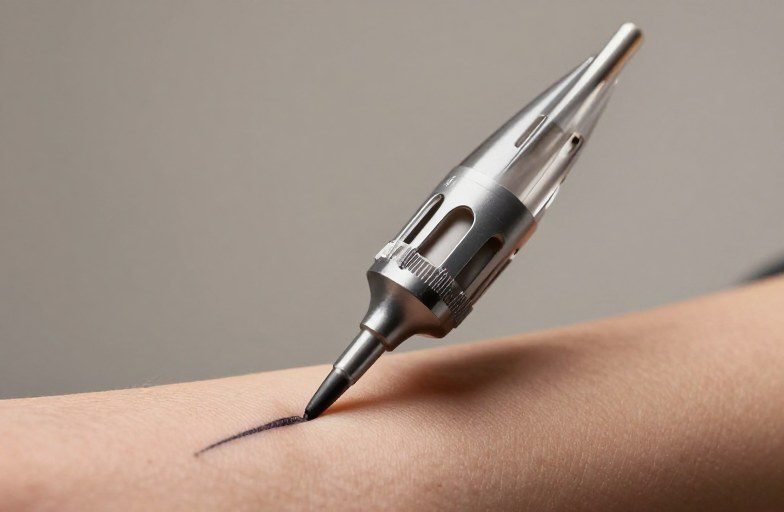
A tattoo needle, whether rendered as a sewing needle, medical syringe, or the tattoo needle itself, carries layered symbolism tied to precision, repair, transformation, and the act of marking skin. The meaning shifts dramatically based on type: sewing needles suggest mending and creation, medical needles evoke healing or survival, and tattoo needles represent the craft itself, permanence, and the threshold between blank skin and lasting art.
Symbolism & History
The Sewing Needle: Mending and Making
The sewing needle ranks among humanity’s oldest tools, with archaeological finds often linked to the Upper Paleolithic period. In tattoo form, it speaks to repair, emotional, relational, or literal. Someone who has rebuilt a life after fracture might choose this. The thread passing through the eye adds narrative possibility: a heart stitched shut, a name pulled through fabric, a gap closed. The needle here is active, not passive. It does something.
Common symbolic threads include:
- Resilience after breakage or loss
- Creative labor, sewing, quilting, garment work as inherited skill
- Feminine labor reclaimed from invisibility
- Connection: the thread that binds people across distance
The Medical Needle: Survival and Ambivalence
Hypodermic needles carry heavier freight. For diabetics, people in recovery, or those with chronic illness, this can mark survival, routine, or the body as site of ongoing maintenance. The meaning isn’t always positive, some wear it as ambivalent testimony to dependency, to the daily negotiation with a body that requires intervention. A needle dripping with color rather than medication transforms the symbol: the body becomes canvas, the injection becomes art.
The Tattoo Needle: Meta-Mark and Craft Devotion
Tattooing the tool that tattoos collapses distance between artist and medium. For tattooers, this is occupational insignia. For collectors, it acknowledges the process, the vibration, the breach of skin, the collaboration between hand and machine. Some designs show the needle grouping itself: three tight points for lining, seven for shading, the soldered cluster visible in close detail. This specificity matters. It says you know what happens in that contact moment.
Common Variations & Styles
Traditional and Neo-Traditional
Traditional needle tattoos favor bold black outlines, limited color palettes, and graphic clarity. A sewing needle might wrap with a banner reading “MEND” or thread through a rose. The tattoo needle in traditional style often includes the tube grip, coils visible, rendered as solid object with weight. Neo-traditional allows more ornament, filigree around the needle shaft, jewel-toned thread, decorative backgrounds that don’t compete with the central form.
Fine Line and Single Needle
Contemporary fine line work suits the needle’s actual scale. A single needle can render a needle at true size, the eye a hollow circle, the point tapering to almost nothing. This demands technical precision, ironic, given the subject. Fine line needles tattooed in fine line risk muddiness as the tattoo ages; the eye may close, the point blur. Experienced artists compensate with slightly heavier line weight in high-wear areas or place these designs where skin sees less friction.
Realistic and Technical
Photorealistic medical needles show the graduated barrel, the plunger mechanism, the subtle reflection on stainless steel. These read as still-life, sometimes unsettling in their clinical accuracy. Technical illustrations, exploded views of tattoo needle groupings, cross-sections of skin showing penetration depth, appeal to those who want the mechanics visible. These age better with strong black contrast; graywash alone softens too much over five to ten years.
Abstract and Combined Motifs
Needles paired with spools, thimbles, prescription bottles, or ink caps ground the symbol in specific practice. A needle piercing a map suggests travel and repair. A needle threading a constellation turns craft into cosmic connection. The combination dictates meaning more than the needle alone.
Best Placements
Needle tattoos suit linear placements that echo the form. The forearm’s length accommodates a sewing needle at scale, point toward wrist or elbow depending on desired directionality. The inner bicep holds medical needle designs with personal intimacy, visible when you choose, hidden otherwise. Hands and fingers work for small tattoo needle groupings, though ink here fades fastest; the constant use, washing, and sun exposure require touch-up commitment.
Consider skin movement:
- Forearm: stable, visible, good for detail
- Ribcage: private, painful, suits personal survival markers
- Calf: flat plane allows technical illustration
- Behind ear: discreet, suited to small sewing needle silhouettes
- Hand: high visibility, high maintenance, best for bold simple forms
Needle points facing the body read differently than points outward, subtle directional symbolism worth discussing with your artist during design.
Who Chooses This Tattoo / Personal Meanings
The needle attracts specific populations with little overlap. Sewing needle collectors often have textile practice in family history or personal life, quilters, tailors, fashion workers, those who learned at a grandmother’s knee. The tattoo asserts continuity, not nostalgia. Medical needle wearers frequently have direct bodily experience: dialysis, insulin, hormone therapy, vaccination work, addiction and recovery. The symbol is earned, not decorative.
Tattoo needle designs cluster among industry professionals and serious collectors. For artists, it’s trade identification without the skull-and-machine cliché. For collectors, it signals participation in the process, awareness of what the tool does. Some choose it after a significant piece, marking the session, the collaboration, the transformation.
Less commonly, the needle represents piercing more broadly, body modification community, ritual bloodletting in some subcultural contexts, or the generalized threshold of pain and transformation. These meanings require careful handling to avoid appropriation or glibness.
Similar Symbols
Related imagery sometimes serves similar purposes with different connotations. The scalpel shares medical precision but reads more aggressive, more cutting than mending. The pen or brush marks creative making without the bodily penetration. The sword pierces but destroys; the needle pierces to build or heal. Thread alone, without needle, loses the active agent, the hand, the intention, the moment of contact.
Tattoo machines as whole objects compete with needle-specific designs. The machine shows the apparatus, the industry, the performance. The needle isolates the point of contact, the intimate transaction between tool and skin. Your choice between them reveals what aspect you want to commemorate.
Final Thoughts
The needle tattoo rewards specificity. A generic needle without context risks vagueness; the symbol is too functional, too universal, to carry weight alone. The meaning sharpens when you identify which needle, whose hand, what thread, what healing, what mark. Work with an artist who understands the tool’s actual proportions, the taper of a sewing needle’s eye, the solder dimple on a tattoo grouping, the graduation marks on a syringe. Accuracy honors the subject. The needle deserves that precision.
Frequently Asked Questions
Does a tattoo needle design have to include blood or thread to look complete?
Not at all. A clean needle silhouette can stand alone with graphic impact. Blood or thread adds narrative but isn’t required, the tool itself carries sufficient symbolic weight when rendered well.
How well does fine line needle detail hold up over years?
Fine line work anywhere on the body spreads slightly as skin ages. Needle eyes and very fine points are especially vulnerable. Slightly bolder line weight in the design phase helps, as does placement away from high-friction areas like hands and fingers.
Can a tattoo needle design work as a cover-up?
The elongated form suits covering narrow existing tattoos, names, small words, thin lines. The needle’s shaft can incorporate or obscure older ink. Wider cover-ups require combining the needle with larger companion elements like thread spools or floral work.
Is there a stigma around medical needle tattoos in professional settings?
A straightforward syringe or IV needle might raise questions in conservative workplaces. Stylized versions, colorful drips, ornamental framing, or integration with floral elements, soften the clinical association while keeping personal meaning intact.
Related Tattoo Meanings
- Amber Rose Face Tattoo Meaning: Symbolism, History Style Guide
- Lindsey Slater Say Tattoo Meaning: Symbolism Design Guide
- Scarring Look Like Tattoo Meaning: Symbolism Design Guide
- Explore more









