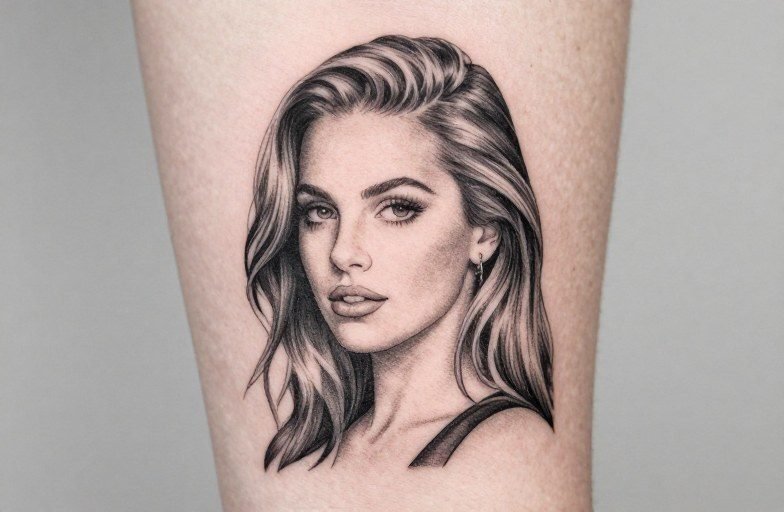
The Lindsey Slater “say” tattoo is a minimalist word piece that centers on the act of speaking up, giving voice to what might otherwise stay internal. It functions as both a personal mandate and a quiet declaration, its power coming from the stark simplicity of a single imperative verb. The design typically renders “say” in clean, unadorned lettering, often lowercase, stripping away decoration to focus entirely on the weight of the word itself.
Symbolism & History
The Core Meaning: Voice as Action
At its foundation, this tattoo captures the tension between thought and speech. “Say” demands movement from interior to exterior, from private to shared. For many wearers, it marks a specific moment of finally articulating something long held back, a coming out, a boundary set, a truth admitted aloud. The word choice matters: not “speak,” which carries formality, or “talk,” which suggests casual exchange, but “say,” direct and unsoftened.
The tattoo’s lineage connects to broader traditions of word-as-talisman in tattooing. Text pieces have served as reminders, commitments, and protective statements across cultures. Single-word tattoos specifically gained traction in the 2000s alongside the rise of fine-line minimalism, though the “say” variation carved out its own niche through its particular grammatical urgency. Unlike noun-based tattoos (“strength,” “breathe”), the verb form creates an active, ongoing instruction to the wearer.
Layered Interpretations
- Self-permission: authorization to take up space with one’s words
- Accountability: a commitment to honesty in relationships
- Creative practice: a prompt for writers, performers, and artists to produce
- Trauma response: reclamation after periods of silence or suppression
- Political statement: assertion of right to speak in marginalized contexts
Common Variations & Styles
Typography Approaches
The most faithful renditions stick to the original’s unpretentious lettering, think handwritten or thin sans-serif faces, sometimes slightly imperfect to suggest human motion. Some wearers opt for typewriter-style fonts, evoking raw documentation. Others choose cursive flows that soften the command into something more intimate. The lowercase rendering dominates; uppercase “SAY” shifts the tone toward confrontation rather than invitation.
Placement-scale affects legibility decisions. A “say” behind the ear or on the inner wrist demands crisp, simple letterforms that won’t blur into illegibility as ink settles. Larger versions on ribs or forearms allow for more expressive, variable line weight.
Accompanying Elements
- Quotation marks framing the word (emphasizing speech itself)
- Small punctuation additions, ellipses suggesting continuation, periods for finality
- Minimal line work: single horizontal rules above and below
- Near-invisible placement: inside lip tattoo, finger side, or behind ear
- Color departures from standard black: soft grey for muting, red for urgency
Shading is generally avoided; the piece lives in pure line. Where shading does appear, it’s typically subtle greywash to create slight dimension without decorative weight. The aesthetic commitment is to restraint, anything that distracts from the word itself undermines the concept.
Best Placements
Proximity to actual speech organs carries obvious resonance. The side of the neck, visible when turning to address someone, makes the word part of the body’s communication apparatus. Inner lip tattoos offer literal concealment until the mouth opens, maximum privacy, maximum revelation. These placements carry professional visibility risks that wearers should weigh against the symbolic payoff.
Hands and fingers extend the word toward the world, literally pointing the tattoo outward during gesture. The writing hand specifically connects to physical production of words. Ribs and sternum protect the piece under clothing, making revelation a chosen act rather than default exposure. Ankles and feet ground the command in movement, each step carrying the prompt forward.
Scale constraints matter. “Say” requires minimal horizontal space, four letters, but cramped placement sacrifices the breathing room that makes the word feel considered rather than squeezed in. Artists typically recommend at least 1.5 inches of width for clean readability over decades.
Who Chooses This Tattoo / Personal Meanings
The demographic skews toward people in transition, those who’ve recently exited suppressive environments, started public-facing careers, or undergone therapeutic breakthroughs. It’s heavily represented among writers, journalists, and performers for whom voice constitutes professional identity, but plenty of wearers have no public platform; the audience is themselves.
Age distribution tends younger, partially due to minimalist tattoo’s association with newer generations, but the meaning resonates across life stages. Older first-time tattoo clients sometimes select this piece specifically for its conceptual clarity, there’s no ambiguity to explain away, no imagery requiring interpretation they don’t control.
Gender patterns show slight female skewing, likely reflecting social conditioning around feminine silence and the subsequent reclamation projects that follow. However, male wearers often emphasize the accountability dimension, “say what you mean” as ethical commitment rather than self-expression.
The tattoo’s adaptability to non-English speakers deserves mention. “Say” functions as recognizable loanword in many linguistic contexts, carrying slightly different valences, sometimes more casual, sometimes more charged, while remaining legible to global tattoo culture.
Similar Symbols
Related word tattoos occupy adjacent conceptual territory. “Speak” carries more formal, almost oratorical weight. “Breathe” addresses regulation rather than expression. “Truth” states a value rather than enacting it. The imperative verb form specifically distinguishes “say”, it’s instruction, not identity.
Visual analogues include the unalome (path to clarity, often including voice), though that carries spiritual baggage some wearers avoid. Microphone imagery literalizes the concept too heavily for many. Open mouth or lips designs trend more decorative than this piece’s stripped urgency. The single-word format itself connects to broader minimalist text traditions, “this too shall pass,” “memento mori”, but “say” reverses the typical consolation function; it demands rather than comforts.
Pairing possibilities with other small tattoos: a period on one wrist, “say” on the other (completion of thought); “say” near a semicolon (continuation after interruption); coordinating with a partner’s “hear” or “listen” (dialogic relationship). These combinations should be planned for visual balance and aging consistency, mixing heavy traditional with whisper-thin “say” creates discord that time exaggerates.
Final Thoughts
The Lindsey Slater “say” tattoo succeeds through radical economy. Four letters, two phonemes, one command, yet the compression forces contemplation. It refuses to decorate, illustrate, or distract. What remains is the bare mechanism of voice itself, made permanent at the moment of choosing.
For anyone considering this piece, the design decisions are fewer than with complex imagery, which paradoxically makes each choice weightier. Font, scale, placement, and punctuation each carry disproportionate meaning because there’s nothing else to distribute significance across. Consultation with an artist experienced in fine-line text work matters enormously; technical precision substitutes for compositional complexity. The tattoo ages well when executed with this discipline, simple letterforms hold their structure where elaborate designs blur and require reworking.
The commitment is ultimately to ongoing practice. Unlike image tattoos that commemorate completed experiences, “say” prescribes continued action. It’s a tattoo that keeps asking something of you, long after the needle work heals.
Frequently Asked Questions
Does the Lindsey Slater ‘say’ tattoo have to be in lowercase?
Lowercase is most common and matches the original’s understated tone, but the choice is yours. Uppercase shifts the energy toward demand rather than invitation, which some wearers prefer. Discuss with your artist how case affects readability at your chosen scale.
How small can this tattoo be before it becomes illegible?
Below one inch wide, the letters risk blurring into solid shapes within five to ten years. Most artists recommend 1.5 to 2 inches for longevity. Finger placements especially suffer from rapid fading due to constant friction and sun exposure.
Can I add color to a ‘say’ tattoo without losing the minimalist feel?
Subtle greywash or extremely muted tones can work, but saturated color typically fights the concept’s restraint. If you want variation, consider a single accent, red quotation marks, for instance, rather than full color fills.
What’s the typical healing time for a fine-line word tattoo like this?
Surface healing runs about two weeks, with full settling at four to six weeks. The thin lines common in this style can appear patchy during healing; resist the urge to judge the result until at least six weeks have passed.
Related Tattoo Meanings
- Puff Daddy Tattoo Meaning: Symbolism, Styles Placement
- Scarring Look Like Tattoo Meaning: Symbolism Design Guide
- Scarab Beetle Tattoo Meaning: Ancient Symbolism Modern Ink
- Explore more