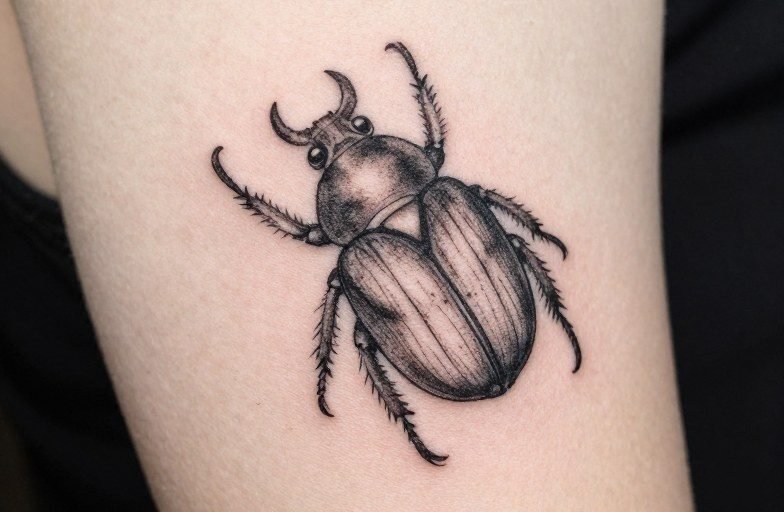
The scarab beetle carries layered meaning rooted in ancient Egyptian belief, where it represented rebirth, the cycle of the sun, and protection for the journey after death. In tattoo form, it has become a versatile symbol of personal transformation, resilience, and new beginnings. The imagery holds up across styles and sizes, from detailed realism to stripped-down geometric designs.
Symbolism & History
The Ancient Core
Egyptians observed scarab beetles pushing dung balls across the sand and drew a parallel to Khepri, the morning sun god who rolled the sun across the sky. This connection made the scarab a potent symbol of daily renewal and the eternal cycle. Amulets carved in the shape of scarabs, often inscribed with spells, were placed on mummies to protect the heart during judgment in the afterlife. Some trace the “heart scarab” tradition to Middle Kingdom funerary practices, though exact dating varies among scholars.
The beetle’s actual biology reinforced its symbolic weight. Scarabs lay eggs in decomposing matter, and new life emerges from what appears dead or waste. This natural process gave visual form to the concept of rebirth from decay, useful symbolism for anyone who has rebuilt after loss, addiction, burnout, or major life upheaval.
Modern Resonance
Contemporary wearers rarely invoke Khepri directly, but the core themes persist. The scarab now signals:
- Survival and adaptation, thriving despite circumstances
- Deliberate transformation, choice-driven change rather than passive drift
- Guardianship, protection of oneself or loved ones
- Persistence, small, steady effort over time
The dung-ball labor, once cosmic metaphor, now reads as grounded hustle. That shift from divine to everyday keeps the symbol accessible without requiring Egyptian mythology knowledge.
Common Variations & Styles
Traditional Egyptian Revival
These pieces reference actual artifacts: side-profile beetles with segmented legs, hieroglyphic bases, and lapis-blue or gold coloring. Artists often render the carapace with fine line work to mimic carved stone texture. Wing cases spread flat or folded determine the silhouette, spread wings read as active and protective, while folded wings feel more contained, almost amuletic.
Pairing the scarab with the Eye of Horus, ankh, or lotus anchors it in recognizable Egyptian visual language. Be cautious with hieroglyphic bands: inaccurate combinations are common, and actual Egypt enthusiasts notice. A competent artist will research or decline speculative lettering.
Biological Realism
Some prefer anatomically accurate scarabs, metallic greens, coppers, and bronzes achieved through careful color saturation. These work best at medium to larger sizes where mandible detail and leg segmentation remain visible as the tattoo ages. Single-needle or tight liner groups preserve fine edges; heavy black saturation in realism can blur into indistinct dark masses after five to ten years.
Geometric & Abstract Interpretations
Geometric scarabs break the form into triangles, hexagons, and circular patterns. This style scales down well and suits placement where curved organic shapes fight the body’s natural lines. Dotwork mandalas incorporating scarab silhouettes blend spiritual geometry with the beetle’s protective associations. Negative-space versions, scarab shape carved out of black fill, offer strong graphic impact but require precise healing to avoid patchy loss.
Neo-Traditional & Decorative
Bold outlines, limited palettes, and ornamental framing distinguish neo-traditional scarabs. These often incorporate jewels, filigree, or Art Nouveau flourishes that soften the insect’s natural hard edges. The style travels well across skin tones because it relies on contrast rather than subtle color gradation.
Best Placements
The scarab’s compact, symmetrical form adapts to many locations, but certain placements enhance specific meanings.
- Chest/upper sternum: Directly over the heart, echoing the protective heart-scarab amulet. Moderate pain, high visibility. Best for pieces with symbolic weight you want to feel, not just display.
- Forearm: Horizontal orientation follows the natural arm line. Easy to show or cover. Size flexibility from three-inch detail pieces to larger compositions.
- Back of neck/nape: Small scarabs work here as talismanic placements, visible to others when hair is up, private otherwise. Consider how hair growth and sun exposure will affect long-term clarity.
- Thigh: Large canvas for detailed biological or Egyptian revival pieces. Less sun damage than exposed areas, preserving color longer. The rounded muscle shape complements the beetle’s domed carapace.
- Hand or fingers: Trendy but high-maintenance. Ink falls out faster on hands due to constant use and regeneration. Small scarabs here read as personal reminders rather than show pieces. Expect touch-ups.
Orientation matters. A scarab viewed from above (dorsal view) emphasizes the wing case pattern and reads as decorative. Side profile emphasizes the pushing legs and forward motion, reinforcing the persistence narrative. Discuss both with your artist; the wrong angle can flatten a three-dimensional subject.
Who Chooses This Tattoo / Personal Meanings
No single demographic owns the scarab. It attracts people drawn to ancient symbolism without the aggressive connotations of some warrior imagery. Common threads among wearers include recovery from significant change, career pivots, gender transitions, religious exits, health crises, and a preference for symbols with historical depth over purely decorative choices.
The scarab also appeals to those who work with death professionally: funeral directors, hospice workers, therapists specializing in grief. The Egyptian afterlife connection provides symbolic vocabulary for confronting mortality without grim reaper theatrics. For others, the beetle’s literal emergence from waste resonates with overcoming poverty, abusive environments, or systemic barriers.
Some choose it simply for aesthetic reasons, the beetle’s natural armor plating offers visual interest that translates well to skin. That motivation is valid. The symbol’s density of meaning means it accrues personal significance over time regardless of initial intent.
Similar Symbols
If the scarab appeals but doesn’t quite fit, consider these alternatives:
- Phoenix: More dramatic, explicitly fire-based rebirth. Larger scale typically; harder to render small. Less protective, more triumphant.
- Ouroboros (snake eating its tail): Cyclical renewal without the Egyptian specificity. Works in simpler linework. Less biological texture to carry.
- Butterfly: Transformation symbolism, softer, more culturally feminine-coded. Less ancient gravitas, more universal recognition.
- Dung beetle (non-Egyptian framing): Same animal, stripped of mythological overlay. Reads as ecological, humble, possibly humorous. Niche appeal.
- Scarab with wings extended: Distinct from the compact beetle, more angelic or protective, less grounded.
The scarab occupies middle ground: ancient but not overused, insectoid but not repulsive to most, symbolically rich without requiring explanation.
Final Thoughts
The scarab beetle endures in tattoo art because its meanings operate on multiple registers simultaneously, cosmic and mundane, ancient and immediate, protective and proactive. It rewards good craftsmanship: the segmented body, textured wing cases, and precise leg joints give artists concrete challenges that separate competent work from exceptional. For the wearer, it offers a symbol that feels weighted without being weighed down, carrying history without demanding orthodoxy. Choose it for genuine connection to its themes, not exotic cachet, and it will hold meaning through the years as reliably as the beetle’s own persistent roll across the sand.
Frequently Asked Questions
Does a scarab beetle tattoo have to be Egyptian-themed?
Not at all. While the Egyptian association is strongest, biological realism, geometric abstraction, or neo-traditional styles work without any hieroglyphic or god references. The core symbolism of transformation and persistence stands independent of specific cultural framing.
How well does scarab detail hold up over time?
Fine leg segments and tiny mandibles can blur after several years, especially on high-movement areas like wrists or ankles. Prioritize bold carapace shapes over micro-detail, and plan for a touch-up if you want intricate elements crisp long-term.
Is the scarab considered culturally appropriative?
The scarab is widely recognized as ancient Egyptian heritage, not living indigenous practice. Most scholars and Egyptian descendants view respectful engagement with pharaonic symbols as appreciation rather than appropriation. Avoid treating it as mere aesthetic exoticism, and you’re on solid ground.
What colors work best for scarab tattoos?
Metallic greens, coppers, and bronzes suit biological realism; gold and lapis blue anchor Egyptian revival pieces. Black and grey emphasize form over symbolism. Consider your skin’s undertone, cooler complexions carry blue-greens well, warmer tones often suit gold and copper tones.
Related Tattoo Meanings
- Ant Tattoo Meaning: Hard Work, Teamwork Quiet Strength
- Fly Tattoo Meaning: Decay, Resilience, and Unflinching Honesty
- Symbolisms of Death Tattoo: Meaning, History Personal Stories
- Explore more