I got my first snake the week I turned 30, and I almost didn’t. I’d saved the patch of skin below my collarbone for two years waiting for “the right idea,” and when I finally walked into the studio with a folder of references, my artist asked me one question that changed everything. What I didn’t know then is what I’ll tell you now: every decision after that, the coils, the scale, the placement, had trade-offs nobody puts on Instagram. This is the stuff I wish someone had said out loud before I sat down.
A snake tattoo is a moving subject on a still body. That’s the whole design problem in one line.
And it’s why the same drawing on your ribs reads completely different than on your wrist, your thigh, or behind your ear. Before you pin another 200 references, here’s what the actual process looks like when you stop chasing Pinterest-perfect and start thinking like someone who has to live with the line for ten years.
[IMAGE: fine line snake tattoo on sternum, healed 6 months, soft single-needle contour, photographed in natural daylight]
Here’s what it looked like before
The skin I’d been “saving” was a soft patch of sternum, pale enough that every vein showed through, untouched and a little precious about it. I had a stack of saved snake drawings on my phone, none of them by the same artist, all of them from different styles. A coiled viper from a trad flash sheet. A single-needle ouroboros I found on a Korean illustrator’s page.
A Japanese snake wrapping a daiken with peonies. They didn’t belong together.
I knew that. I sat with the folder for eleven months before I admitted I needed an artist, not more screenshots. If you’re in the same spot, the snake tattoo meaning guide is the fastest way to settle on a species and vibe before you book.
[IMAGE: messy tattoo reference board on phone, mixed snake styles piled together]
- Asked My Artist To Sketch A Fine Line Snake Tattoo
- Picked A Coiled Snake Tattoo For My Ribs
- Compared Realistic Snake Head Tattoo References
- Studied Traditional Japanese Snake Tattoo Stencils
- Watched The Snake Tattoo Stencil Transfer Heal
- Chose A Blackwork Snake Tattoo For My Thigh
- Sized A Tiny Snake Wrist Tattoo Properly
- Checked Snake Scale Linework On My Calf
- Sat Through A Spine Snake Tattoo Session
- Added A Snake And Dagger Combination Piece
- Booked A Snake Tattoo Touchup After Healing
- Walked Past Six Brooklyn Flash Sheets First
1Asked My Artist To Sketch A Fine Line Snake Tattoo
Walking in with references instead of a finished drawing is the move. I told my artist (fine line specialist, three years at a Brooklyn shop) that I wanted a snake but couldn’t pick a style.
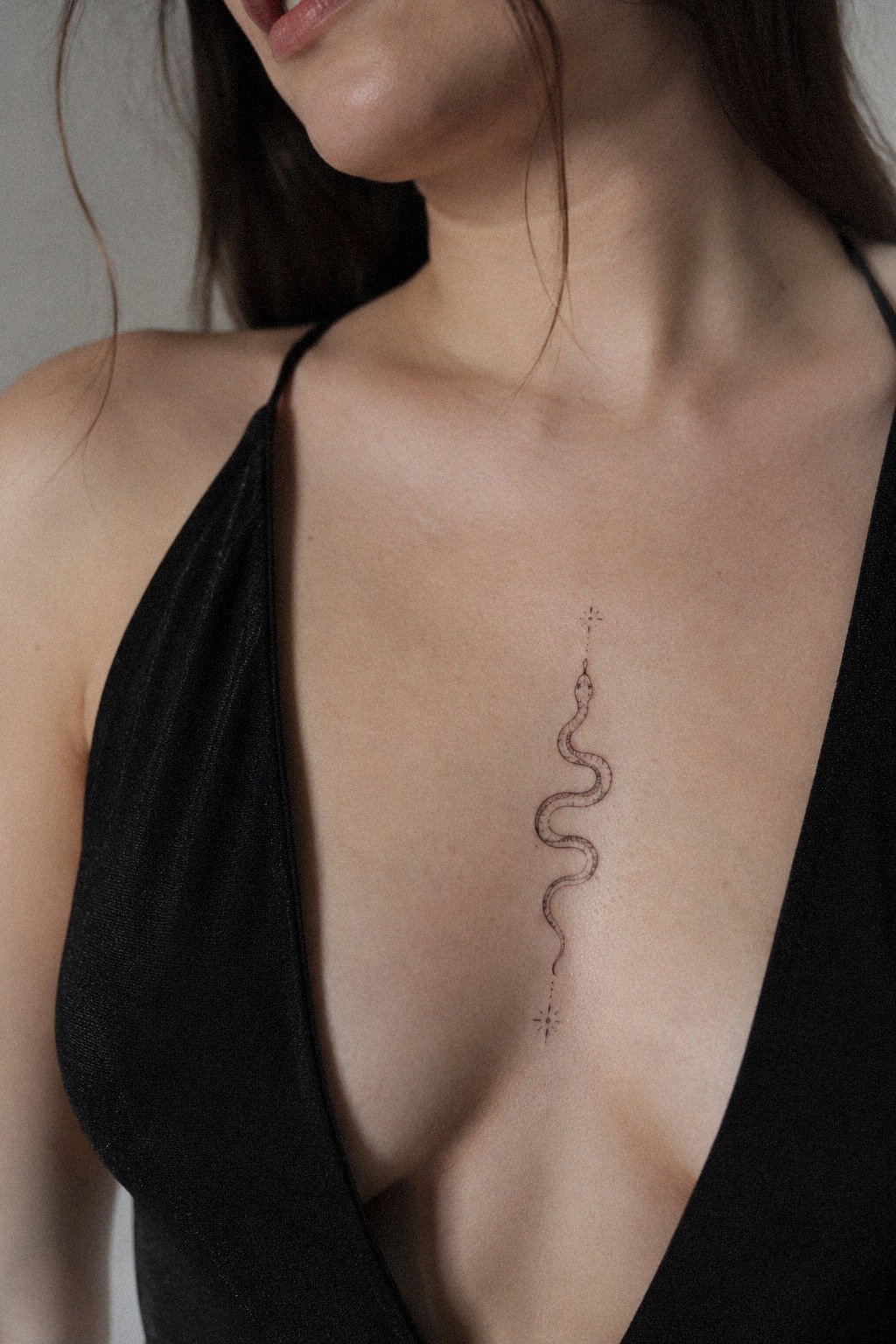
She asked what I wore every day (crew necks, mostly), where my skin was least fussy (sternum, not ribs), and whether I wanted people to read it from across the studio or up close. That last question is the one nobody asks you. It decided everything.
She sketched a single-needle serpent the next morning: a hand-drawn fine line, soft curvature, no shading, just clean linework that sits in the natural hollow under the collarbone. The tattoo took about 90 minutes, single-needle 0.18mm, single-pass linework with a 5RL mag.
It cost me $280 flat at a mid-tier Manhattan shop in 2025. Heals like a dream if you don’t suffocate it with ointment the first week, seriously, less is more!
If you’re still in the planning phase, the tattoo symbols and meanings index is genuinely useful for sorting snake mythology from snake aesthetics before you commit.
[IMAGE: artist drawing fine line snake stencil on tracing paper with single-needle pen]
2Picked A Coiled Snake Tattoo For My Ribs
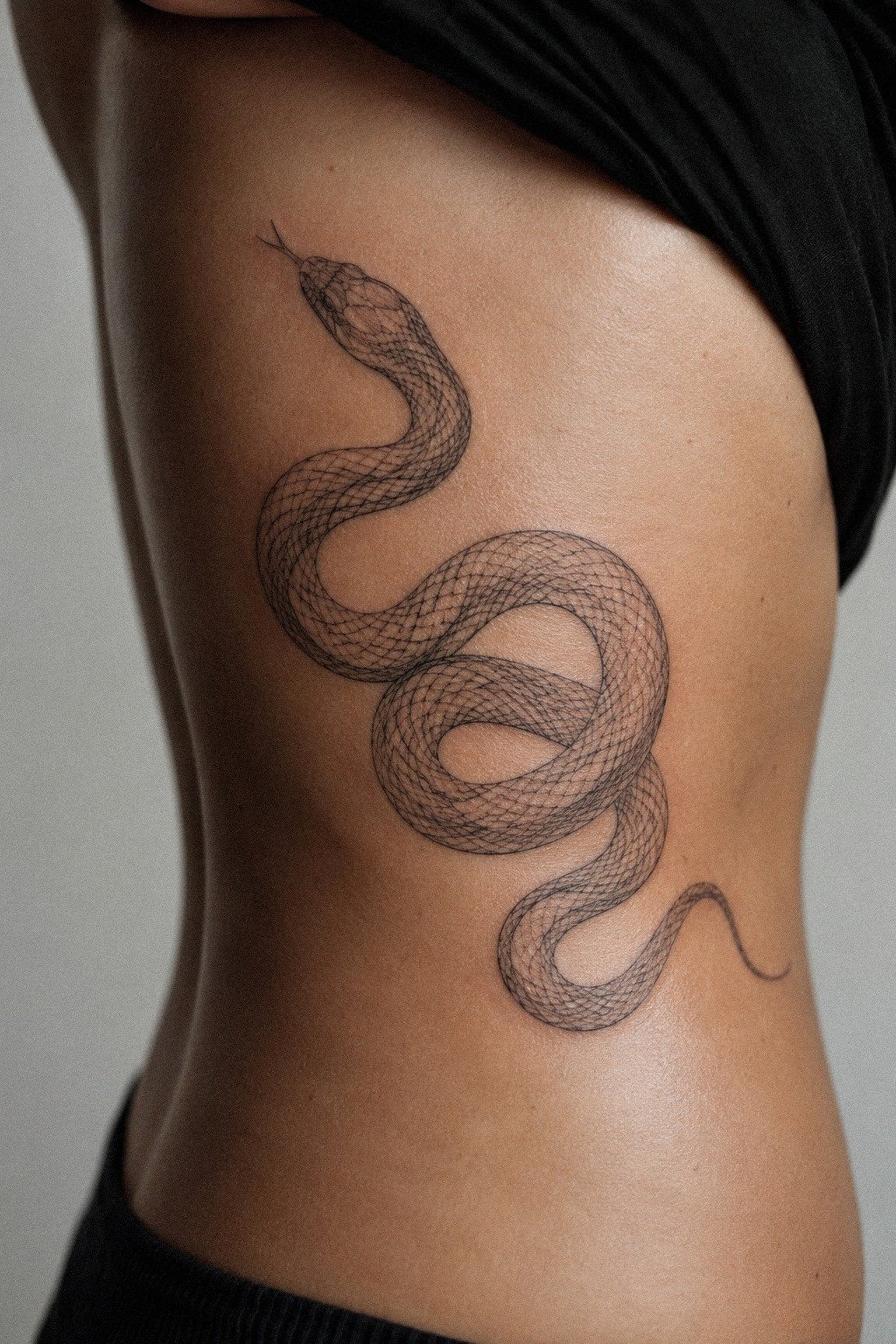
Ribs are a liar. Everyone says “oh, the ribs are SO painful,” but pain on ribs is a dull burn you can breathe through, not a sharp thing.
The real issue with ribs is the skin moves every time you inhale, so your artist has to anchor the linework against a stretching canvas. My coiled coral snake sits on the left side, three inches wide, drawn in American traditional style with bold black outlines and four saturated color passes: red, yellow, black, white.
No grey wash. Solid fill.
The session was two hours and twenty minutes. I paid $450 because traditional color packing is slow work and the shop charges by the hour.
The honest part: I had to tap out for five around the second hour because the color packing is the spiciest part of any tattoo, ribs or not. If you’re needle-shy, do the outline in session one, color in session two.
Your artist won’t mind. Mine preferred it, and you’ll heal cleaner too.
Pain-wise, ribs land exactly where the rib tattoo pain guide puts them: tolerable, but respect the chair!
[IMAGE: bold American traditional coral snake coiled on left ribs, fresh and shiny]
3Compared Realistic Snake Head Tattoo References
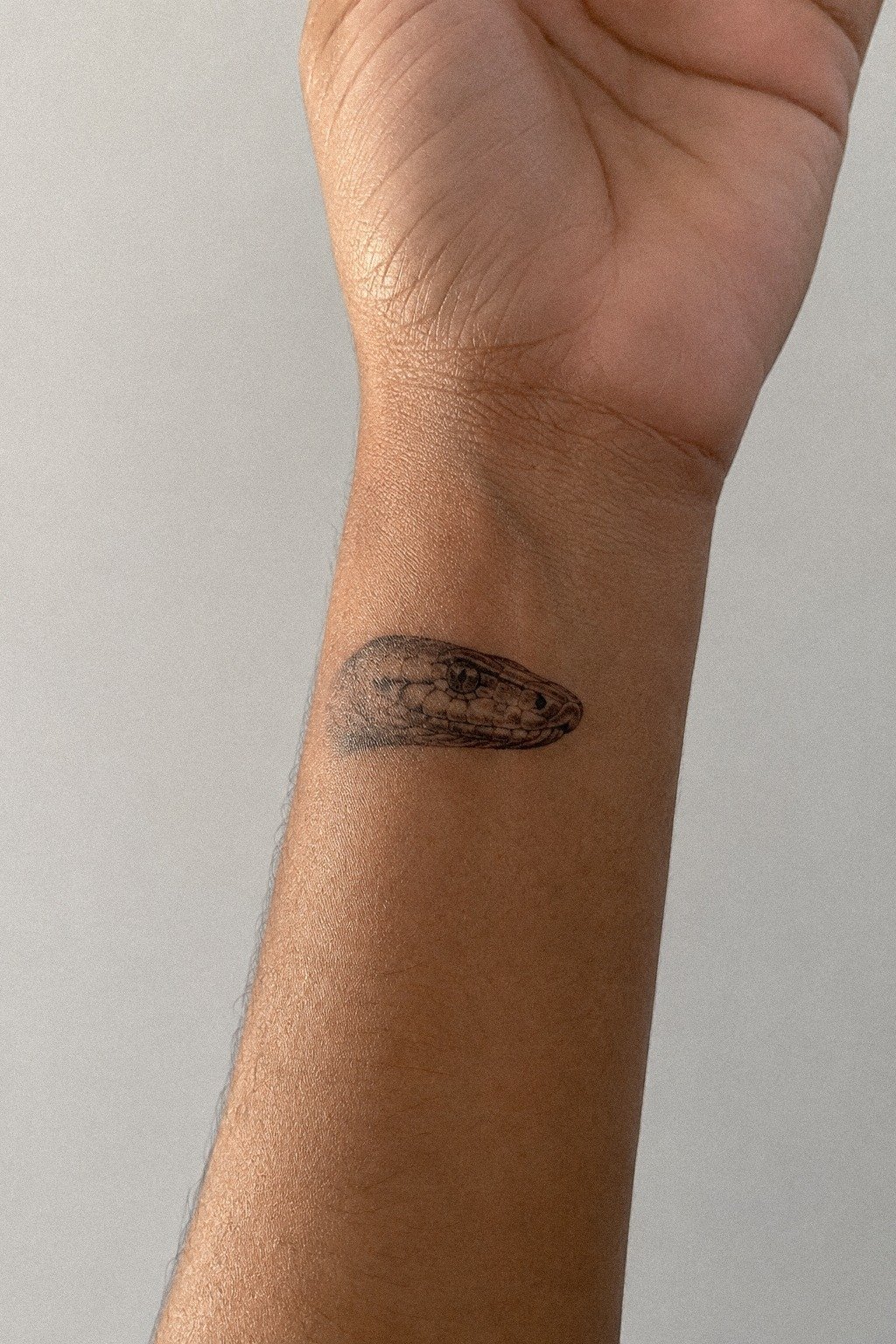
Realism is a different beast. A snake head done in micro-realism on a wrist, two inches of detailed scale and eye work, takes 6 to 10 hours across two or three sittings and ages best when the artist uses a magnum needle with diluted black ink, not grey wash. I spent two weeks comparing healed references on Instagram, not fresh ones.
Fresh tattoos look great. Healed ones show you the truth.
What I learned: any line under a millimeter will soften over five years. Bold black holds.
Micro-detail that reads “wow” today will read “soup” in a decade. If you want realism, commit to a wrist piece that is at least two inches tall, picked from a tattoo artist who shows healed work in natural daylight, not studio ring light.
And do not compare fresh work to fresh work, compare healed to healed. Trust the seven-year healed photo over the day-one studio flash every single time! If you are trying to decide between a micro-realism piece and something sturdier, the typical tattoo cost guide will tell you what realism actually runs per hour across the US.
[IMAGE: micro-realism snake head on wrist, healed 2 years, natural daylight, slight softening but reads clean]
4Studied Traditional Japanese Snake Tattoo Stencils
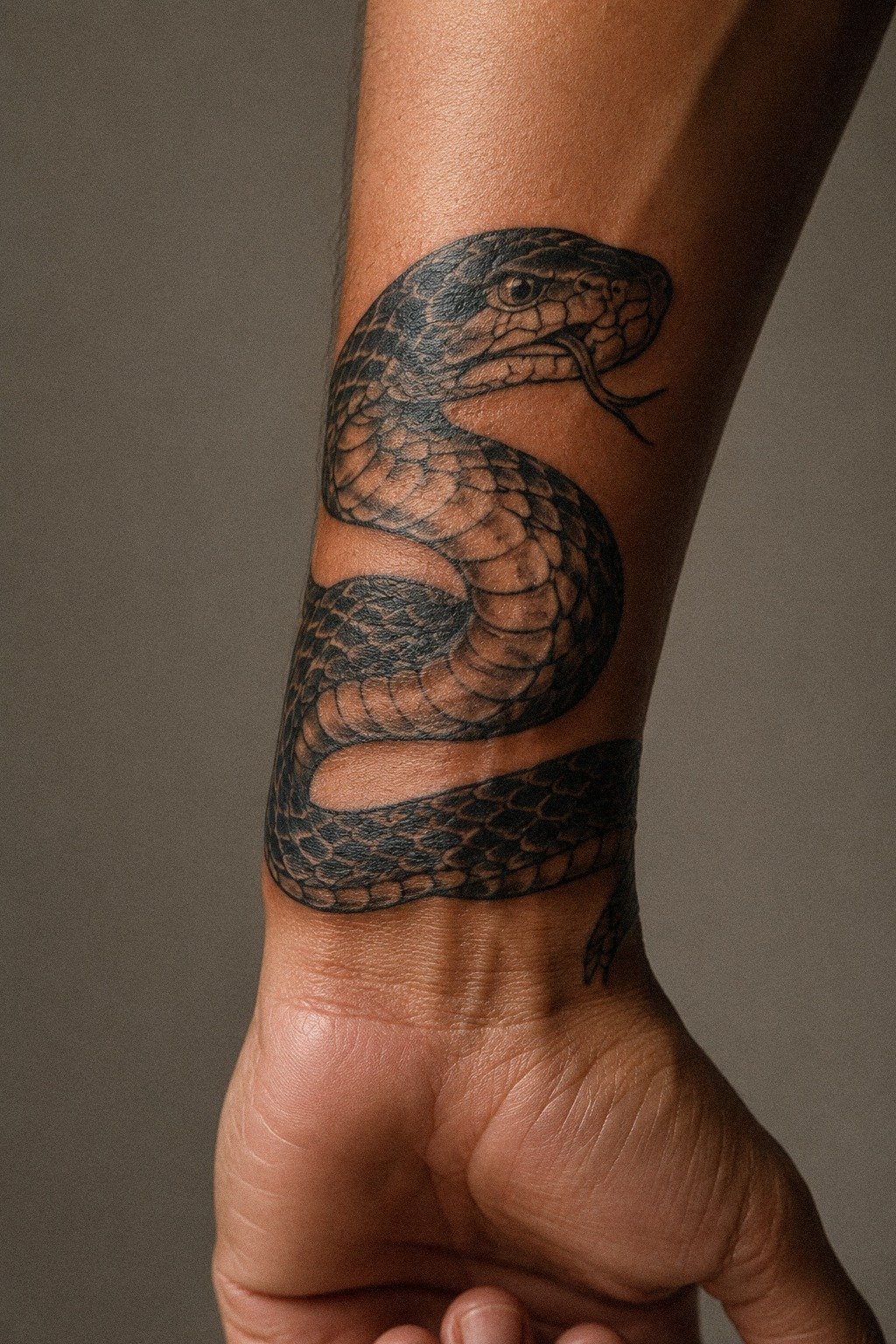
Japanese snake work, irezumi with the bold black sumi outlines, the wind bars, the peonies, is the opposite of fine line. The lines are thick, the colors are saturated, and the design wraps the body like a sleeve even when it is “just” a snake.
I flew to a tebori-trained artist in San Francisco for a consultation, not a session, because I wanted to see his stencils laid on the body before committing. If Japanese is on your radar at all, the great Japanese tattoo guide lays out the full vocabulary so you stop mixing up koi with daikon.
What he showed me changed my mind about placement entirely. A Japanese snake on the wrist reads cramped and small.
On the thigh, calf, or upper back, the design has space to breathe and the wind bars actually have somewhere to go. His hourly rate was $220, and a full sleeve starts at $3,500 for the outline alone.
He told me: “If you want Pinterest-exact, I am not your artist. References are for vibe, not for tracing.” That is the line every custom client needs to hear, and honestly, it is the line that saves you from a tattoo you will regret.
[IMAGE: Japanese irezumi snake stencil laid on upper thigh, bold sumi outlines, wind bars visible]
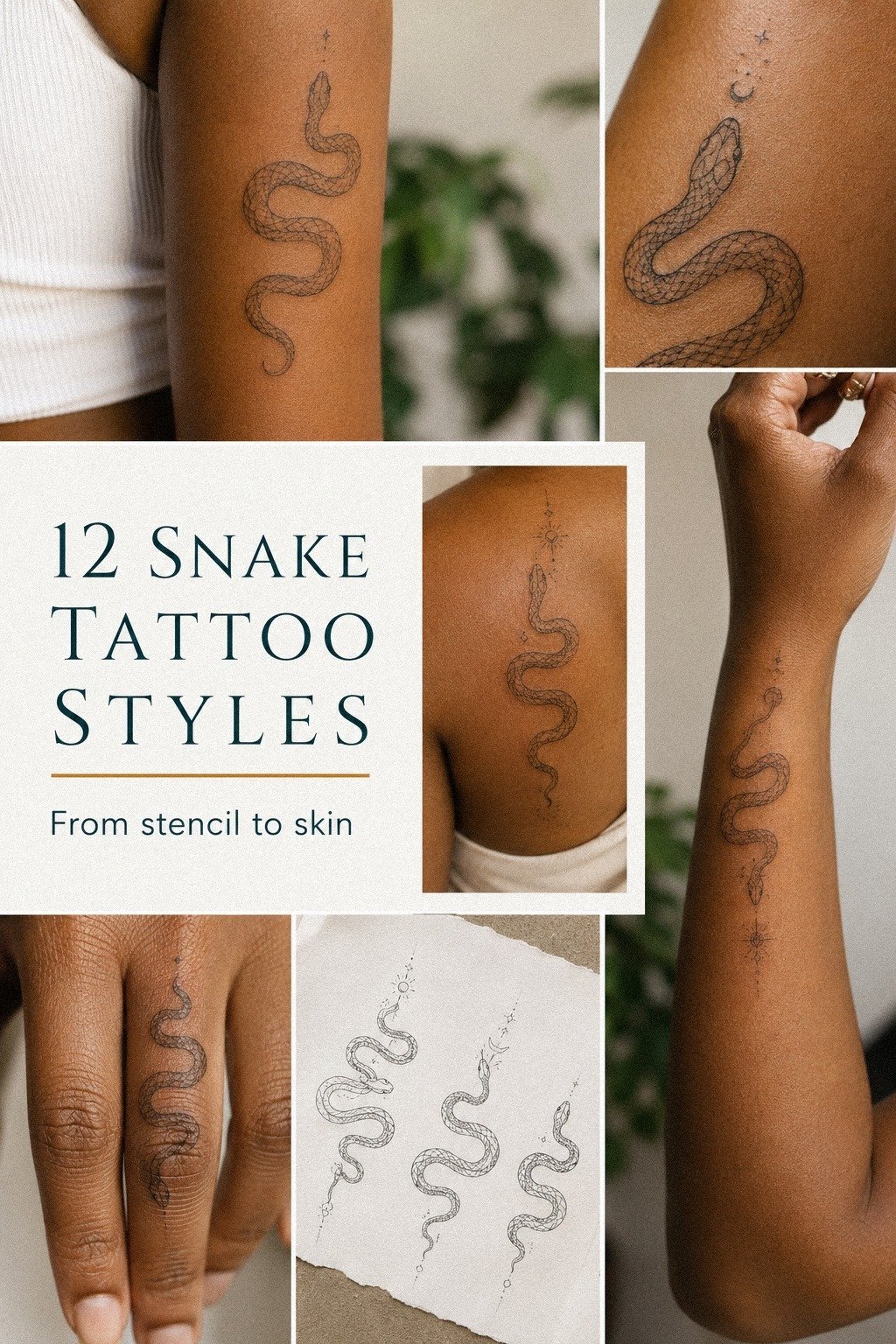
5Watched The Snake Tattoo Stencil Transfer Heal
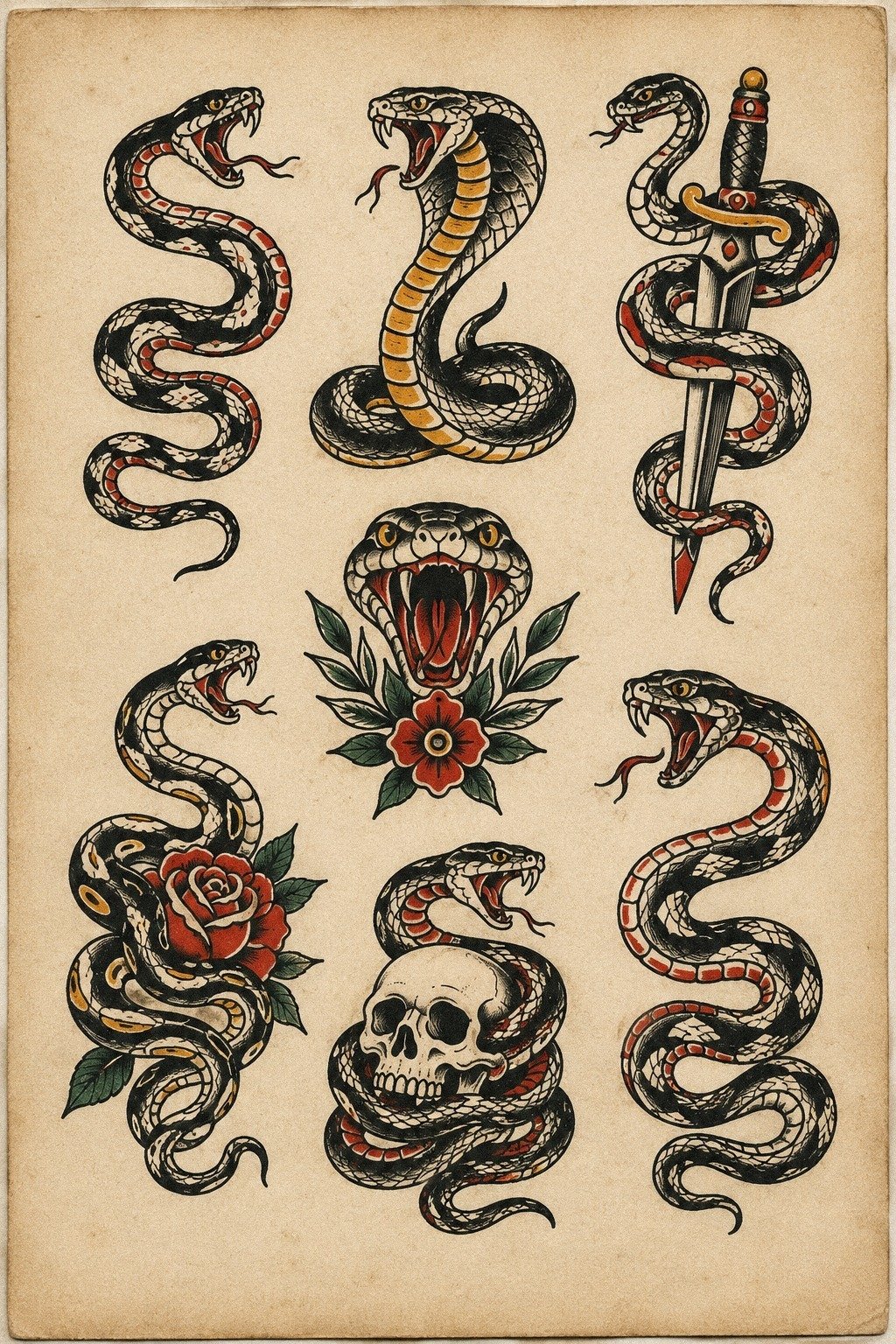
The stencil transfer is the part nobody films. Your artist shaves the area, lays the printed stencil, sprays it with green soap or sticks it on with Stencil Stuff (the green transfer gel that costs about $10 a tube), peels the paper, and the design sits on your skin like a temporary tattoo.
Then the artist checks the placement against your anatomy while you’re standing. If you’ve never done a stencil yourself, the stencil printing guide is the cleanest walkthrough.
This is where you speak up. If the head sits too low on your shoulder, if the tail curves wrong against your calf, if the coils do not match the curve of your ribs, say it now.
Once the needle hits, you are locked in. I watched three artists reposition stencils on different bodies in one afternoon, and every single one was happier because the client asked for a small shift before the linework started. Do not be shy.
This is your skin.
[IMAGE: stencil transfer of coiled snake sitting on client’s ribs, artist checking placement while client stands]
6Chose A Blackwork Snake Tattoo For My Thigh
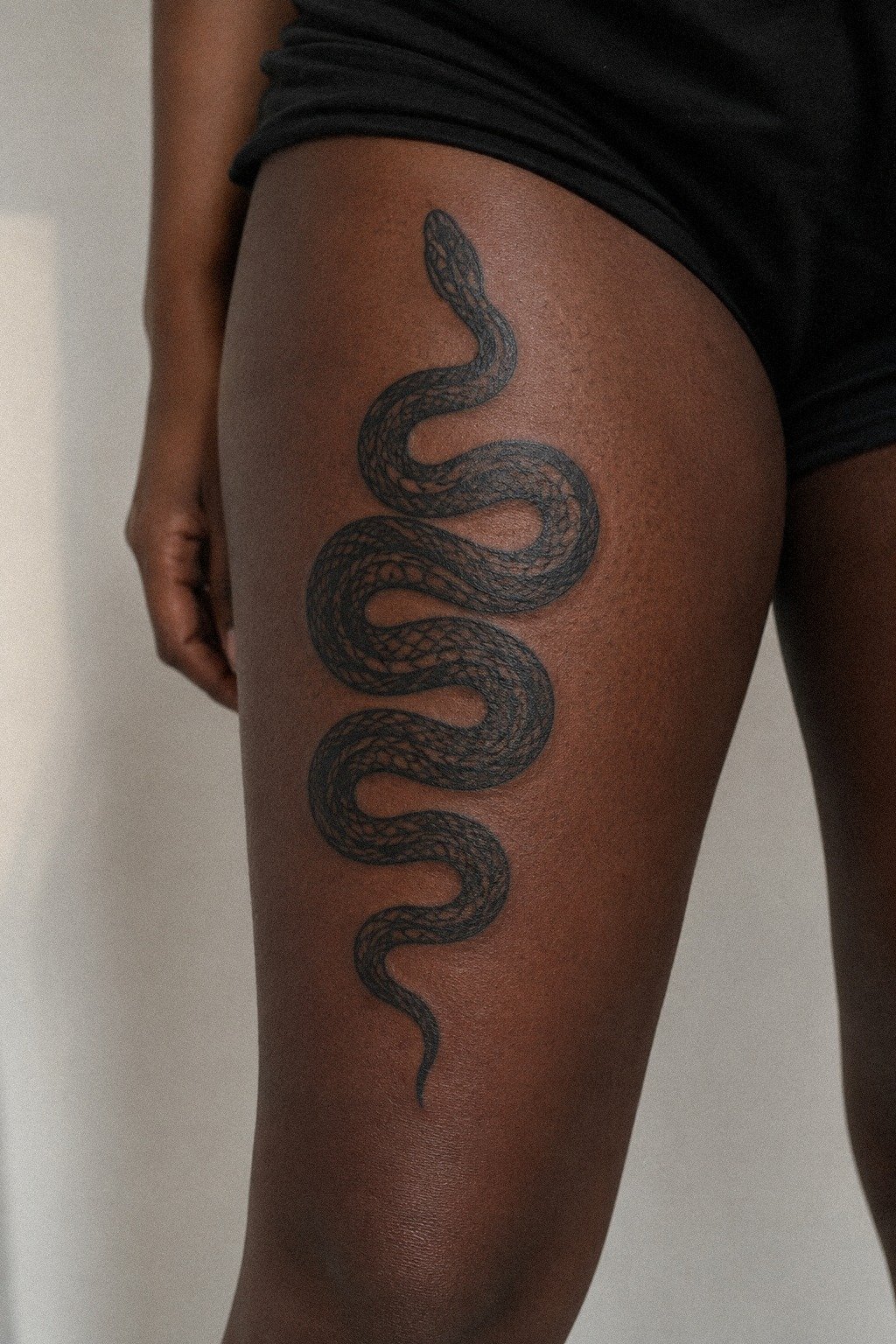
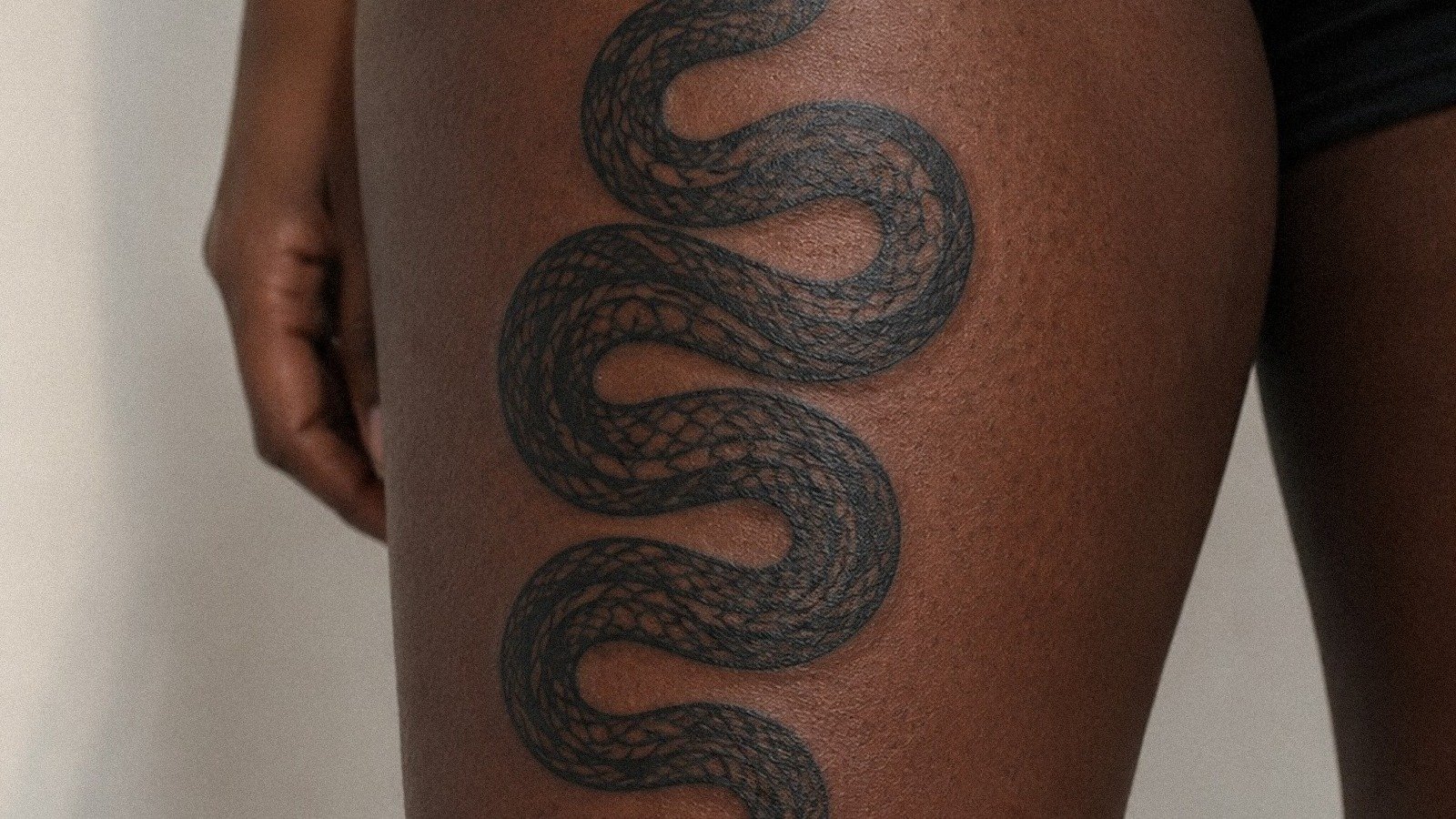
Blackwork is the boldest choice on the table. Solid black fill, no grey wash, no color, just black ink packed so dense it looks like a shadow cut into skin.
My blackwork adder sits on my outer thigh, 5 inches long, done in two sessions of three hours each. The artist used a 9-mag for the fills and 7RL for the outlines.
Cost: $650 total.
Why thigh? Outer thigh is a low-wear zone.
Does not get sun, does not rub against your waistband every day, does not flex like a bicep. That is where blackwork ages best.
A snake this dark and this dense on a finger would turn into a grey smudge in eighteen months. On a thigh, it will read crisp for ten years.
Do not put dense blackwork on high-wear zones unless you are ready for touch-ups every two to three years. For a side-by-side on what dense black actually does over time, the tattoo fading during healing guide is brutally honest.
[IMAGE: solid black blackwork adder on outer thigh, healed 18 months, dense and crisp]
7Sized A Tiny Snake Wrist Tattoo Properly
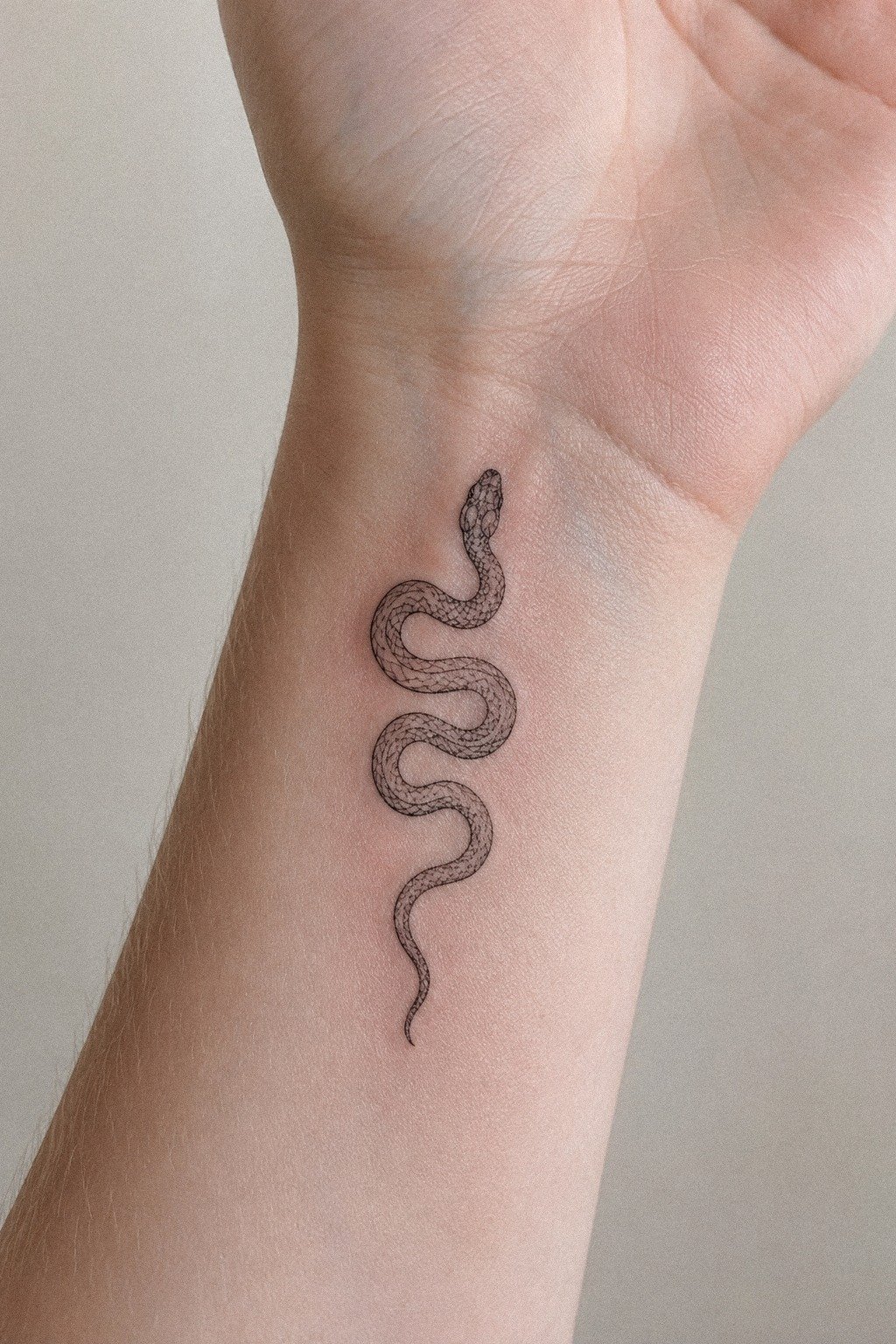
Tiny snake wrist tattoos are everywhere on Pinterest and they age terribly. Here’s the rule of thumb most artists will not say out loud: a snake design under 1.5 inches turns into a black squiggle in four years. Lines that close together blur into each other as the ink settles, and the silhouette that read “cute snake” fresh becomes “is that a snake or a worm?” healed. If you’re set on small, the tiny tattoo cost guide shows what small work runs at most shops.
My tiny snake on the inner wrist is 2 inches long, drawn in fine line single-needle, deliberately simple so the lines have space to breathe. No scales drawn into the body, no shading on the head, just clean contour.
That is the move. If you want a wrist snake, draw it bigger than you think or commit to touch-ups.
That size on a wrist is gonna mush out, so bump it up the forearm so it breathes and ages nicer. The lesson I learned the expensive way, and a lesson I would save you from if I could!
[IMAGE: fine line single-needle snake on inner wrist, 2 inches, healed 1 year, lines still crisp]
8Checked Snake Scale Linework On My Calf
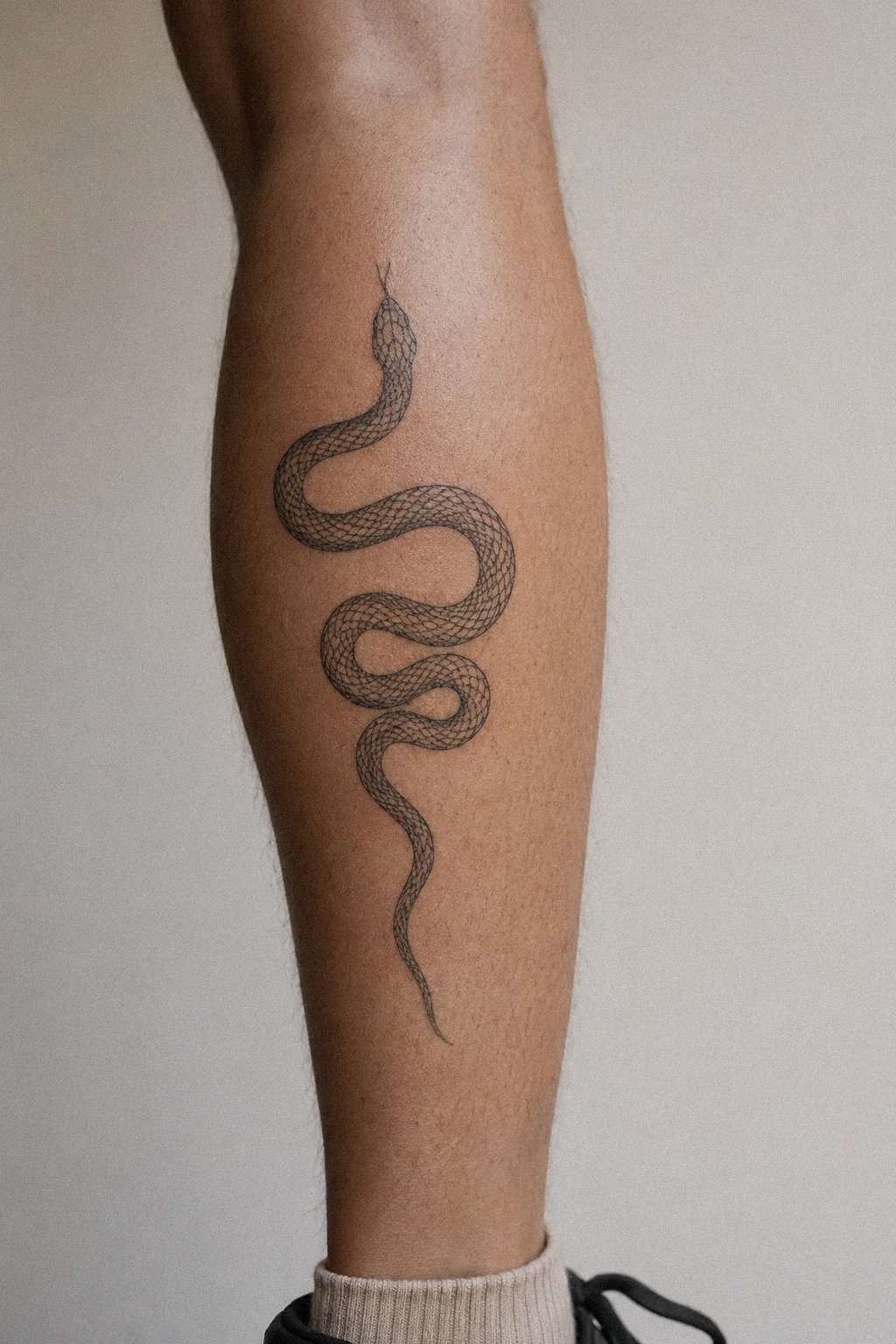
Calf is one of the best placements on the body for snake work. The muscle gives you a long canvas with natural curves, the skin doesn’t get much sun, and the pain level is genuinely mild.
Lines feel sharper than shading, but the calf is mostly chill. I got a snake scale pattern done in dotwork and fine line shading, 6 inches tall, wrapping the outer calf like a band.
The technique matters: each scale is a tiny arc of dots, not a solid line, built up in pepper shading so the texture reads as skin, not as geometry. The session took four hours.
I paid $420. The reason calf tattoos age well is the same reason outer arm tattoos age well: low friction, low UV, low movement. Most of my best-healed pieces are on the back of the arm or the back of the calf.
Front of anything fades faster. For a deeper look at how outer placements compare, the placement guide breaks down the wear zones by spot.
[IMAGE: dotwork snake scale band wrapping outer calf, healed 2 years, soft pepper shading]
9Sat Through A Spine Snake Tattoo Session
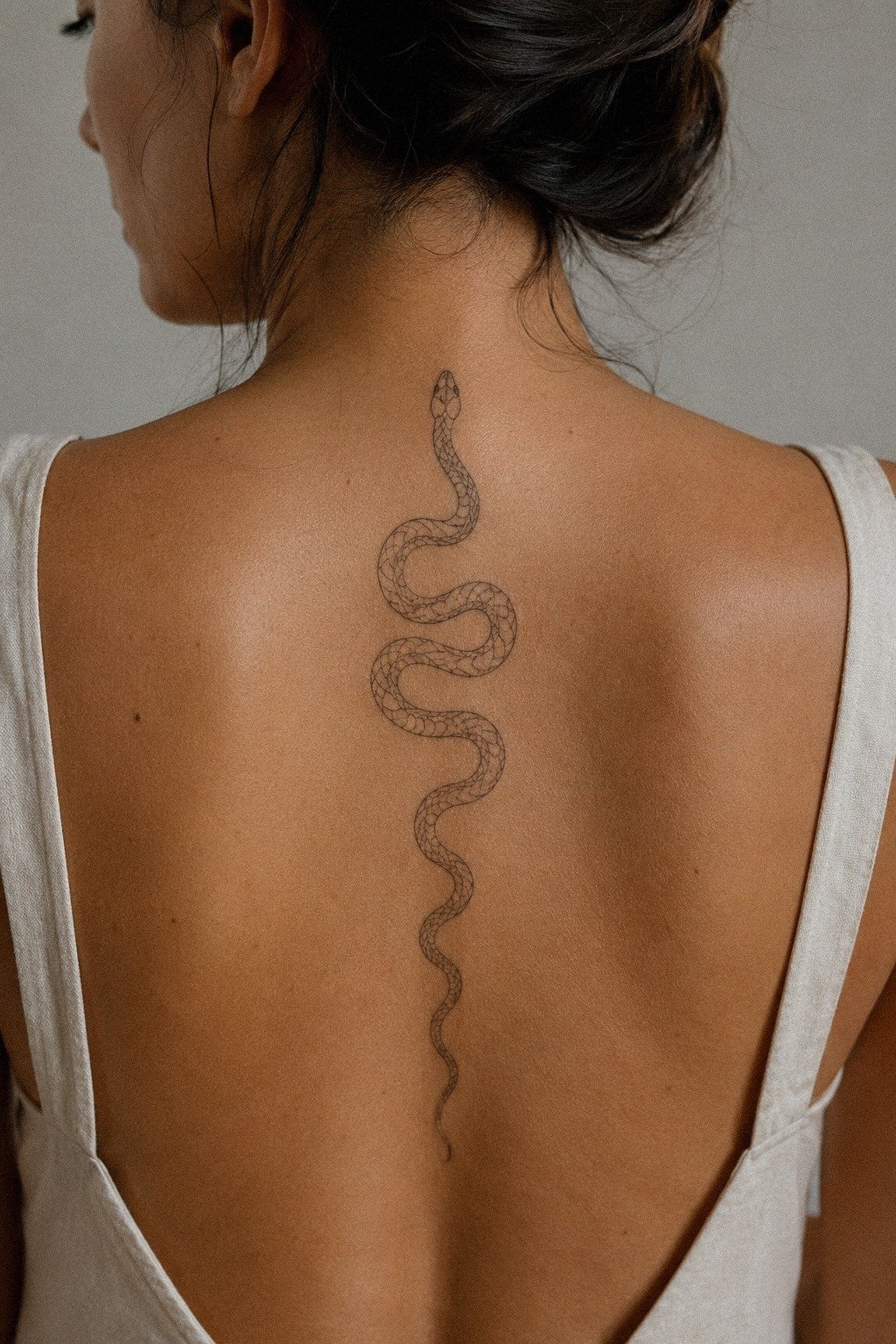
Spine tattoos are spicy. Not because the pain is sharper, but because it does not stop.
It’s a long, dull burn that runs from the base of your neck down to your tailbone, and every time the artist moves an inch, you get to feel that burn again. My spine piece is a fine line snake wrapping vertically, 8 inches long, drawn in single-needle with no shading.
Two sessions of two hours each. If you want a sense of how spine compares to the ribs and sternum, the spine tattoo pain reality check is worth reading first.
The art direction matters here: a snake on the spine needs to follow the actual line of the spine, not fight it. My artist sketched the curve with me bending forward, then again standing straight, so the design sits naturally instead of looking stuck-on.
Cost: $520. Pain management: I brought a sugary drink, listened to music on one earbud, and tapped out twice for ten-minute breaks.
Do not be a hero. Tap out for five rather than pass out on me, my artist said, every session.
Hydrate, eat before you sit, and breathe slow. The pain reduction playbook saved me on session two.
[IMAGE: fine line single-needle snake wrapping the spine, healed 4 months, follows natural curve]
10Added A Snake And Dagger Combination Piece
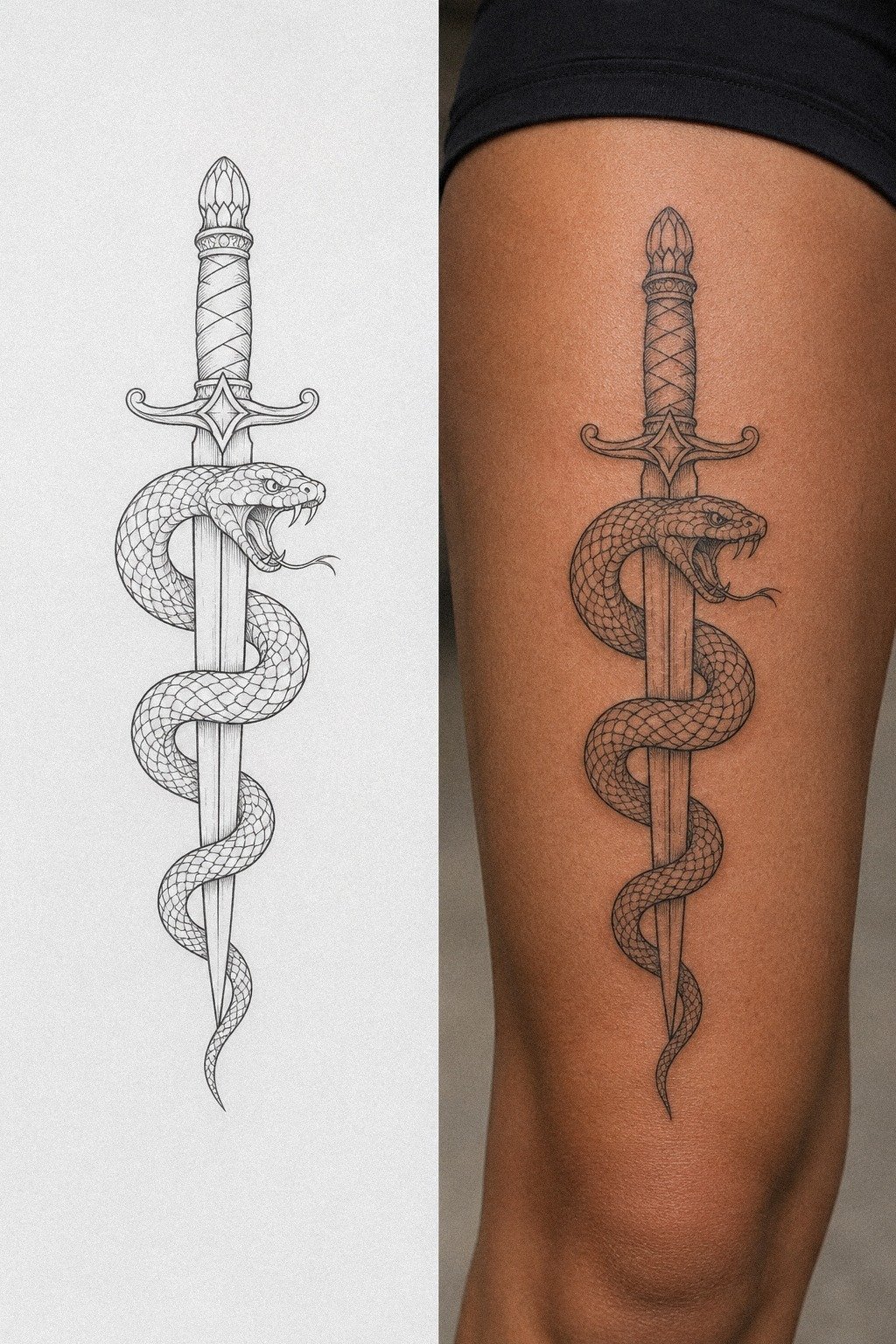
The snake-and-dagger is one of the most re-tattooed designs in the world, and almost every version of it is mediocre. The move is the dagger has to be hand-drawn, not flash. The snake has to be a specific species, not a generic serpent.
Mine is a rattlesnake coiled around a 19th-century medical dagger, drawn in illustrative style with thick black outlines and selective red shading on the snake’s eye. If you’re tempted by traditional flash, the classic traditional tattoo guide is a reminder that flash can age gorgeous if you pick the right artist.
This is on the back of my upper arm, 4 inches tall, single session of three and a half hours. The reason it works: the artist used saturated red in one solid pass, not scratched at it fifty times, overworked skin heals patchy, and patchy color on a snake reads as bruising.
Cost: $380. The honest truth about combination pieces: every additional element doubles the decision fatigue.
Snake alone is one design. Snake and dagger is three (snake, dagger, ribbon).
Keep it tight.
[IMAGE: snake coiled around antique medical dagger on upper arm, illustrative style, selective red shading]
11Booked A Snake Tattoo Touchup After Healing
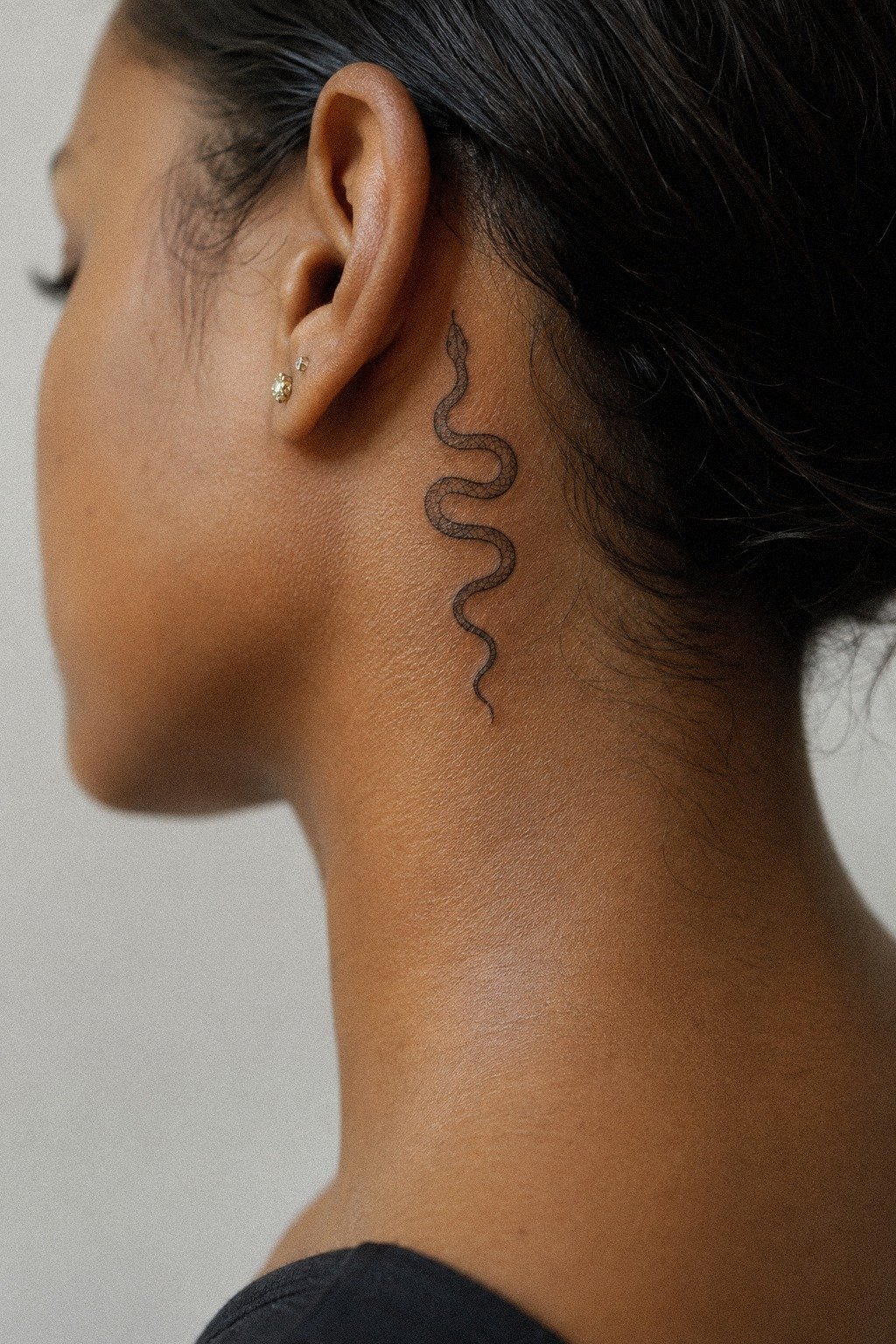
Here’s the part nobody talks about. Every tattoo needs a touch-up. Not because the artist did bad work, but because skin is a living organ and it heals unevenly. My fine line sternum snake needed a 20-minute touch-up at 8 weeks to reinforce a line that faded on the side where my bra strap sits.
The touch-up was free because I went back to the original artist within 90 days. Most shops include one touch-up in the original price if you book it during the healing window.
For the mechanics of when to book, the tattoo bandage timing guide and first-wash timing tell you what to do in the first 48 hours so you don’t blow your own heal.
Healing looks like this: the first three days it is an open wound, treat it like one. Gentle wash, unscented soap, thin layer of ointment, no suffocation.
Then it peels like a sunburn for a week, do not pick the flakes or you will pull color out. Around day 14 you get the silver skin, that tight shiny layer that makes you panic.
It is normal. By week 6 the real color comes through.
The full heal takes 2 to 3 months for surface tattoos and up to 6 months for dense blackwork. If something does go sideways, the healing faster guide is the cleanest protocol I have seen, and the itchy tattoo soother saved me during the silver-skin stage.
[IMAGE: healed snake tattoo at week 8 showing the silver-skin stage, shiny tight layer]
How much it cost
Here is the honest breakdown across all eleven sessions, all paid in 2024 and 2025 at three different US shops in the $150 to $250 per hour range. Single-needle and fine line run on the higher end because they are slow.
Trad and blackwork run cheaper per piece but take longer sessions. For the broad national numbers, the tattoo cost range guide lines up what hourly rates look like by region and the how much do tattoos cost page is the deep dive.
The shop minimum in most US cities is $80 to $150; anything smaller than that gets priced as the minimum, not by size. Tattoo design itself runs $50 to $300 flat if you are commissioning your artist to draw it from scratch (separate from the tattoo session). And if you want to draw your own flash before walking in, the flash drawing walkthrough is the kindest intro I have seen.
[IMAGE: tattoo receipt printed on kraft paper next to a sketch of a coiled snake]
Blackwork or fine line? Pick the lane before you book
If you haven’t already chosen a style, do it before you book. The reason is mechanical: a fine line single-needle artist and a solid blackwork artist use different machines, different needle configurations, and different needle depths.
Asking a fine line specialist to “just pack it darker” is the fastest way to overwork the skin and end up with patchy healing. Asking a blackwork artist to “keep it really thin” will give you blowout and fuzzy edges within a year.
The styles are not interchangeable, and a good artist will tell you that up front. Pick the lane, then pick the artist, then book.
If you don’t know which lane you belong in yet, the botanical tattoo roundup is a clean way to see what fine line looks like at scale, and the geometric cat guide shows how clean blackwork ages when done right.
[IMAGE: side-by-side fine line snake vs blackwork snake, both healed 2 years, on forearm and thigh]
A tattoo artist’s actual advice on snake designs
I have watched a lot of snake tattoos heal, and the ones that still look good five years later share three things. First, the linework is crispy and confident, not scratchy, one clean pull, not ten fuzzy ones.
If your artist’s lines look hairy up close, find another artist. Second, the contrast is pushed hard at the start, bold will hold, faded black is the enemy of a snake design. Third, the placement matches the design’s personality.
A coiled adder needs a flat surface (thigh, ribs). A wrapping Japanese snake needs a long canvas (arm, calf, back).
A tiny wrist snake needs to be bigger than you think.
The part I see people get wrong: they chase Pinterest-perfect and pick a flash design from a trad sheet, then ask an artist who specializes in micro-realism to copy it. The artist either refuses or produces something that doesn’t read in their style. Pick the artist first, then pick the design. Their portfolio is the menu.
If their healed work looks like what you want on your skin, you’re in the right studio. The selecting a tattoo checklist walks you through that decision without the salesy nonsense, and the full commitment Japanese piece guide is the honest version of “should I go big?”
One more thing. Black is your best friend for longevity, color is spice. A snake done in solid black will read from across the studio in ten years.
A snake done in pale watercolor will heal into a faint shadow by year five. That’s not a moral judgment, watercolor anchored with linework can be gorgeous, it’s a physics judgment about how ink settles under skin.
Make the choice with your eyes open. And if you want a smaller symbol with the same vibe, the meaningful female tattoo roundup is full of pieces that age the way you’d hope.
[IMAGE: side-by-side healed snake tattoos at 5 years, fine line vs solid black, contrast difference visible]
Manhattan, Brooklyn, San Francisco: where I sat for each one
Each of my eleven snake sessions happened in a different studio, and the geography mattered more than I expected. Manhattan mid-tier shops in 2025 ran $200 to $250 per hour and were packed, walk-in friendly, heavy on flash and trad.
Brooklyn is where I found the fine line specialist who did the sternum piece ($280 flat for a 90-minute single-needle session, her rate at the time was $185 per hour). San Francisco was the tebori-trained irezumi artist ($220 per hour, full sleeve consult-only at $110).
The lesson: the same word “snake tattoo” can cost you $200 or $3,500 depending on the postcode and the artist. If you’re price-shopping across cities, the tattoo cost range guide and how much do tattoos cost are the cleanest starting points before you DM an artist.
[IMAGE: three different studio interiors side by side, Manhattan flash shop / Brooklyn private studio / San Francisco irezumi studio]
12Walked Past Six Brooklyn Flash Sheets First
Before I sat for the fine line sternum piece, I spent two Saturdays walking Brooklyn shop to shop, looking at flash sheets pinned to every studio wall. A flash sheet is a pre-drawn sheet of designs, you pick what you want, the artist inks it, no custom sketch required.
Most of what I saw on those sheets was trad-style snakes: coiled rattlers, daggers through mouths, roses tangled in tails. Solid work, but not my hand. What taught me the most was noticing how many sheets mixed snake styles in the same lineup, a watercolor snake next to a blackwork adder, a single-needle ouroboros next to a thick-outlined coral.
That is a yellow flag. Pick an artist whose flash sheet shows one lane, done well, not five lanes done okay.
The flash sheet primer is what I’d send anyone trying to read a sheet critically.
[IMAGE: Brooklyn studio wall covered in pinned flash sheets, mix of snake styles visible at varying sizes]
Should a snake tattoo wrap or coil?
This is the question I get asked the most in DMs, and the honest answer depends on canvas and species. A wrapping snake (Japanese-style, daiken, sumi outlines) needs a long muscle or a sleeve to do it justice.
Calf, thigh, upper arm, full back. On a wrist or a sternum, a wrapping snake gets cropped and the wind bars lose their flow.
A coiled snake (viper, rattler, adder) wants a flat surface with breathing room around it. Ribs, thigh, upper back, side of the chest.
The coil is a closed shape, so you need at least 2 inches of clear skin on every side or the silhouette collapses. If you’re stuck between the two, the rib tattoo pain guide is a clean read on how a coiled piece sits on ribs specifically, and the sternum tattoo pain reality covers the front-of-chest canvas.
[IMAGE: side-by-side comparison, wrapping Japanese snake on calf vs coiled viper on ribs, both healed 3 years]
Bold will hold over delicate detail, every time
Here is the rule I wish someone had tattooed on my forehead at 28. Bold will hold, fine detail fades. A snake done in thick, confident linework with solid black fill will look better in year seven than a micro-detailed snake will look in year three.
Skin is a living organ. It stretches, it ages, it loses elasticity.
The thinner the line, the faster it softens. The lighter the wash, the faster it disappears.
So when I sit across from a client who wants a tiny realistic snake head on their finger, I tell them the same thing every time: that piece will be beautiful for eighteen months, then it’ll need a touch-up every two years, forever. Bold black holds, color is spice, contrast is the only thing that survives a decade on skin.
Pick the snake that reads from across the studio, not the one that rewards a magnifying glass. For more on how line weight affects aging, the tattoo healing process shows exactly what a thin line does at the five-year mark, and the tiny tattoo reality check is what I’d send anyone planning a small piece.
[IMAGE: close-up of two healed snake tattoos side by side, one bold blackwork at 5 years still crisp, one fine line at 5 years showing softening]
The Questions I Get Asked Most
How much does a Snake Tattoo Design usually cost?
About $100 to $300 for a small to medium snake at most US shops in 2025. Hourly rates run $150 to $250 depending on artist and city, with shop minimums of $80 to $150.
A full sleeve starts at $3,500 and climbs. Tattoo design fees (the drawing, not the inking) run $50 to $300 flat.
Pricing varies by region, so always ask for the hourly rate upfront.
Are Snake Tattoo Designs a good idea for a first tattoo?
Yes, and here is why. A snake design is forgiving on placement because the curves hide small asymmetries.
Fine line snakes heal soft and readable. Solid black snakes hold contrast for years.
Pick a low-pain spot like the outer arm or thigh and you walk out with a piece that ages well. Just avoid the wrist for a first piece unless you’re committed to touch-ups.
The behind-the-ear placement risk guide makes the same case for other tiny placements.
How do I choose a tattoo artist for Snake Tattoo Designs?
Look at healed work, not fresh work. Their portfolio should show snake pieces specifically, with crispy lines and clean shading.
Studio hygiene matters: autoclave, single-use needles, gloves changed between clients. Specialize beats generalist.
An artist who does fine line every day will out-line a generalist every time. Book a consult before you book the session.
For broader tattoo design inspiration, the botanical tattoo roundup shows the same linework principles on flowers, which is a great way to vet a fine line artist’s hand.
How much do Snake Tattoo Designs hurt?
Honest scale by placement. Ribs, sternum, hands, feet, spine, and inner bicep are the spicy zones, lines feel sharper, color packing is a dull burn that does not stop.
Outer arm, thigh, calf, shoulder, and upper back are the chill zones, mild burn, easy to sit through. Your first tattoo should probably be on a chill zone.
Save the spicy stuff for piece two or three. The forearm pain reality and elbow pain guide are the two most-searched spots if you want the long version.
What about a watercolor snake?
Short answer: only if it is anchored with line. Pure watercolor ages into a faint shadow by year five. Anchored watercolor (where the wash sits inside a clean black outline) holds its shape far longer, and it still looks like a watercolor snake up close.
If you have your heart set on the look, ask your artist to draw the spine of the snake in a single 3RL line, then build the wash inside it. That is the move that gives you the painterly vibe without the five-year fade.
How long does a Snake Tattoo Design take to heal?
Surface heal takes 2 to 3 weeks. Full heal takes 2 to 3 months for most tattoos and up to 6 months for dense blackwork. Aftercare is short: gentle unscented soap, thin layer of ointment for the first three days, no sun, no pools, no picking the flakes.
The silver-skin stage at day 10 to 14 is normal. Do not panic.
For the first-48-hours protocol, the water exposure timing guide is the cleanest version I have read.
What’s the best placement for Snake Tattoo Designs?
Outer thigh, outer calf, upper back, and outer upper arm are the best for longevity and low pain. Ribs, sternum, and spine are great for visual impact but cost you on the pain scale.
Wrists and fingers look great for eighteen months, then need touch-ups every two to three years. If you want it to read crisp in 2035, pick a low-wear, low-UV zone.
For the full placement roundup, the 18 placement ideas is the version I’d send my own sister, and the hand tats fade-risk guide is the honest version of “should I get hand tats?”
[IMAGE: six snake tattoo placements mapped on a body diagram with wear and pain labels]
Closing the conversation
If I had to pick one, I’d start with the fine line sternum piece. It’s the one I look at most, the one that healed cleanest, and the one that taught me the most about what I wanted on my skin.
Bold will hold, but a single clean line that follows your anatomy will outlast every trend. Pin a fine line sketch for your consult and bring it to an artist who shows healed single-needle work. That is where it starts.
[IMAGE: final healed fine line sternum snake tattoo, 18 months old, photographed in natural window light]