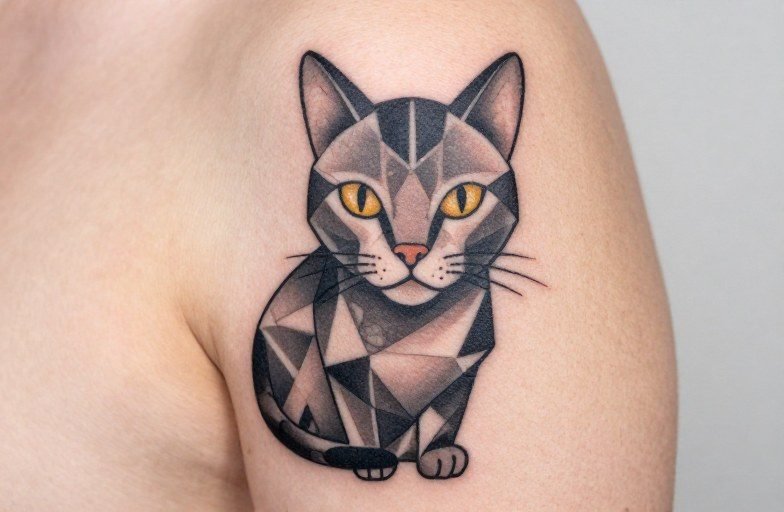
A geometric cat tattoo renders the familiar silhouette of a feline through triangles, polygons, and clean intersecting lines. The style borrows from sacred geometry and modern graphic design, flattening organic curves into angular planes while preserving enough recognizable anatomy that the subject remains unmistakably cat. Done well, these tattoos balance mathematical precision with the fluid grace cats represent, two aesthetics that shouldn’t work together but absolutely do.
Origins & History
The geometric tattoo surge of the 2010s pulled from multiple sources simultaneously. Dotwork and linework traditions from indigenous art, particularly Polynesian and some Native American geometric patterning, established the visual vocabulary of building images from repeated shapes. European sacred geometry, think Flower of Life, Metatron’s Cube, Platonic solids, provided the mathematical framework. The specific application to animals, cats included, emerged as digital design tools made vector illustration ubiquitous. Tattoo artists began translating Adobe Illustrator aesthetics directly onto skin.
Cats in Tattoo Culture
Feline imagery carries ancient weight across cultures. Egyptian Bastet worship, Norse Freya’s chariot-pulling cats, Japanese maneki-neko fortune symbols, cats occupy symbolic territory long before geometry entered the picture. The geometric treatment modernizes this lineage without erasing it. Some trace the specific geometric animal trend to European artists like Alexis Calvié or the German collective Dotstolines, though pinpointing exact originators proves difficult in such a collaborative, image-sharing culture.
Key Characteristics & Motifs
Geometric cat tattoos share structural DNA regardless of specific design. Understanding these elements helps you evaluate flash and custom work critically.
- Polygon breakdown: The cat form deconstructs into triangles, hexagons, diamonds, or irregular polygons. Smaller shapes cluster around detailed areas (eyes, whisker pads); larger planes dominate the body and tail.
- Line weight variation: Bold outer contours establish the cat’s readable silhouette. Interior lines are typically thinner, creating hierarchy and preventing visual mush.
- Negative space strategy: Skin shows through as intentional shape, not absence. The best designs use negative space polygons as actively as inked ones.
- Symmetry and asymmetry: Facial designs often exploit bilateral symmetry. Full-body compositions may break symmetry to suggest movement, crouching, leaping, tail curling.
- Dotwork accents: Stippled gradients fill some polygons, especially in black and grey pieces, softening the hard geometry without abandoning it.
Common Cat Poses
Sitting profiles with upright tails translate cleanly to geometric treatment, the tail becomes a sequence of diminishing triangles. Leaping or pouncing forms create dynamic diagonal lines across the composition. Head-only portraits focus detail budget on eyes, which artists often render with concentric circles or radiating lines rather than pure polygons. Sleeping curled cats suit mandala-style circular framing, the body geometry echoing the border pattern.
Color vs Black and Grey
This choice fundamentally changes the tattoo’s impact and longevity.
Black and grey dominates geometric cat work for practical reasons. The style’s readability depends on contrast between lines, shapes, and skin. Greywash fills add depth without color complexity. Black ink ages most predictably, fifty years of sun and skin regeneration will still leave a readable black geometric cat, whereas color shifts unpredictably. Dotwork stippling in black and grey creates texture that reads as “fur” without literal representation.
Color geometric cats work when the palette is restrained and purposeful. Limited schemes, two or three colors maximum, maintain the graphic clarity that defines the style. Jewel tones (emerald, sapphire, amber) suit the stained-glass quality of polygon fills. Pastel watercolor backgrounds behind geometric cat linework create tension between soft and hard aesthetics, though watercolor elements age faster and require more frequent touch-ups. Avoid rainbow explosions; they defeat the style’s structural logic.
Best Placements
Geometric cat tattoos demand flat, stable skin for line precision. Curves and movement distort polygon shapes over time.
- Forearm: The classic placement. Flat plane, visible for appreciation, easily covered. Outer forearm shows the design most clearly; inner forearm skin is thinner and lines may spread slightly more.
- Upper arm/shoulder: Excellent for medium-sized pieces. The deltoid’s rounded surface suits circular mandala-style cat compositions. Avoid wrapping too far around the arm, geometry distorts on the curve.
- Thigh: Large canvas for detailed full-body cats. Front thigh stays flatter than side; consider this for pieces with extremely fine interior lines.
- Calf: Surprisingly good for vertical compositions. The muscle’s long axis echoes a sitting cat’s proportions. Shin bone proximity means more discomfort during application.
- Ribcage/side: Challenging. Breathing moves the canvas constantly during tattooing, testing the artist’s steady hand. Post-healing, torso expansion and contraction gradually stress geometric precision. Save this for experienced collectors with established tattoo tolerance.
- Hands, feet, neck: Generally inadvisable. These high-movement, high-wear areas blur fine lines fastest. The geometric style’s precision becomes its vulnerability here.
Who It Suits
Not a personality assessment, practical matching between design and collector.
Geometric cat tattoos appeal to people who want symbolism without literalism. The cat references independence, mystery, agility, but the geometric treatment filters these through intellect and design consciousness rather than sentiment. You don’t need to be a “cat person” to wear this well; plenty of collectors choose the form for its graphic power alone.
Skin tone matters for execution. Very dark skin requires bolder lines and more negative space to maintain readability, fine interior geometry may close up and disappear. This isn’t limitation so much as design parameter. Artists experienced across skin types adjust polygon size and line weight accordingly. Ask to see healed photos on skin similar to yours before committing.
Professional considerations: geometric cat tattoos read as artistic and contemporary rather than rebellious. They’re generally workplace-compatible in creative, tech, and increasingly corporate environments. Placement controls this more than design, forearm or calf visible, ribcage hidden.
Modern Variations
The style continues mutating as artists push boundaries.
Biomechanical Fusion
Geometric cat forms with mechanical interior details, gears, pistons, circuit traces, suggest cyborg or steampunk aesthetics. The polygons become panels that open onto machinery beneath. Requires exceptional technical precision; interior details must read at small scale.
Double Exposure
Cat silhouette filled with geometric landscape, mountain ranges, moon phases, forest patterns. The cat becomes window rather than subject. Popular for memorial pieces, with specific landscapes holding personal significance.
Minimalist Reduction
Extreme simplification: ten lines or fewer suggesting cat form through negative space and single continuous geometry. Think logo design translated to skin. Ages exceptionally well due to bold simplicity, but demands perfect execution, no room for error.
3D/Isometric
Polygons shaded to suggest depth, creating impossible cat architectures that seem to project from or recede into skin. M.C. Escher meets feline anatomy. These read best at larger sizes where the dimensional illusion has room to operate.
Choosing an Artist
Geometric work is unforgiving. A wavering line in a traditional rose becomes character; in a geometric cat, it’s a mistake that throws off every adjacent polygon. Vet artists specifically.
- Portfolio examination: Look for healed photos, not just fresh work. Crisp lines on day one mean nothing if they blur by year three. Ask for one-year-healed geometric examples specifically.
- Line consistency: In their portfolio, measure line weight variation against intention. Do thin lines stay thin? Do parallel lines actually parallel? Hold your phone at arm’s length, does the design still read?
- Stenciling precision: Geometric designs require exact stencil transfer. Artists who freehand geometric elements often introduce subtle asymmetries that become obvious once inked. Ask their process.
- Color saturation: If considering color, check how densely they pack pigment. Geometric fills need solid, even saturation, patchy color breaks the illusion of flat planes.
- Specialization vs generalist: Artists who primarily do geometric work understand how ink spreads in polygon corners, how to adjust for skin texture variations, when to simplify for longevity. A talented realism artist attempting their first geometric cat may deliver technically competent work that misses style-specific nuances.
Consultation red flags: promising exact replication of a Pinterest image (geometric work should be customized to your proportions), dismissing concerns about line spread on your chosen placement, or inability to explain how they’ll handle a specific curved area geometrically.
Final Thoughts
Geometric cat tattoos occupy a satisfying middle ground, recognizably symbolic without being obvious, technically demanding without being ostentatious, contemporary without trending toward obsolescence. The style rewards patience in artist selection and placement consideration. A well-executed geometric cat ages into a graphic element that integrates with your body’s architecture rather than fighting it. The polygon decomposition that seems cold at first glance actually serves the subject: cats themselves are geometry in motion, all calculated angles and efficient curves, muscle and bone arranged for function made beautiful. The tattoo simply makes visible what was already true.
Frequently Asked Questions
How well do geometric cat tattoos age compared to traditional cat portraits?
Geometric designs generally age better than detailed realism because they rely on bold lines and negative space rather than fine shading. However, extremely small interior polygons may blur together over a decade. Scale matters, medium to large pieces maintain readability longer than miniature geometric work.
Can a geometric cat tattoo incorporate my actual cat’s markings?
Yes, but with translation. A spotted tabby pattern becomes varied polygon sizes; a white chest patch becomes a negative space shape. The artist interprets organic markings through geometric vocabulary rather than copying them literally. Bring clear photos, but expect stylization.
What’s the typical price range for a quality geometric cat tattoo?
Geometric work commands premium rates due to time-intensive precision. A palm-sized black and grey piece typically runs $400-800; larger thigh or arm compositions with complex interior geometry range $1,200-2,500. Color adds 20-40%. Highly specialized geometric artists in major cities may exceed these ranges.
How painful is geometric linework compared to shaded tattoos?
Linework concentrates needle impact in precise channels rather than diffusing it through shading. The sensation is sharper, more localized, but often less overall duration since geometric pieces typically complete faster than equivalent-sized realism. Bone-adjacent areas (ankle, wrist, collarbone) intensify the sharp quality significantly.
Related Style Guides
- Realistic Anchor Tattoos: Complete Style Guide
- Realistic Deer Skull Tattoos: Complete Style Guide
- Realistic Jewelry Tattoos: Complete Style Guide
- Explore more