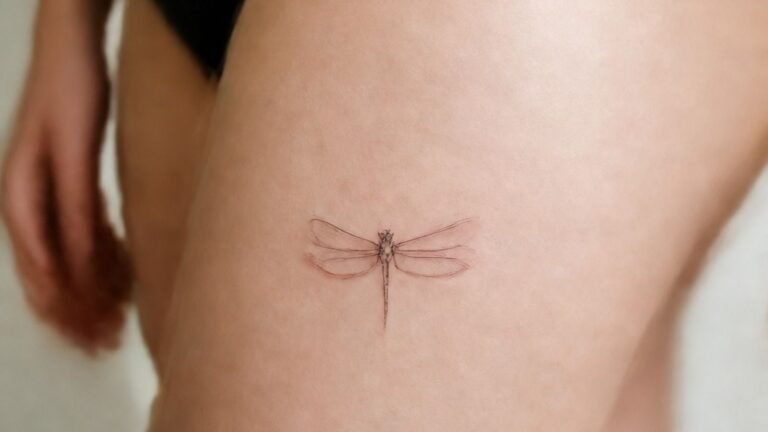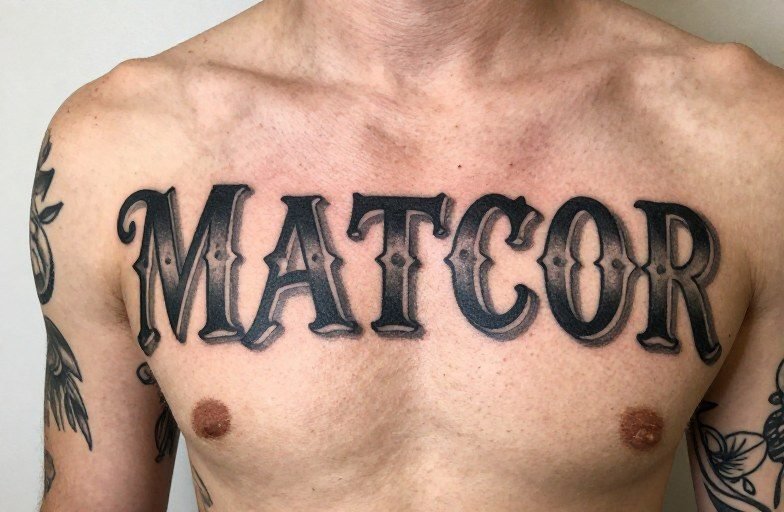
American traditional letter tattoos are built on the same principles as the style’s iconic imagery: thick black outlines, minimal shading, and a deliberate lack of fuss. The lettering draws from early 20th-century sign painting, carnival banners, and military flash sheets, serif-heavy, slightly slanted, designed to read clearly from across a room and hold up for decades. Unlike modern script tattoos that chase thin, flowing cursive, traditional lettering sits upright, punches hard, and trusts simplicity over ornament.
Cost & Sessions
What Drives the Price
Lettering tattoos often get underestimated because they look straightforward. The reality: a clean traditional word or banner requires steady, confident line work with no room to hide shaky hands. You’re paying for the artist’s ability to make something look effortless. Small pieces, single words on the forearm, a name across the knuckles, a brief phrase on the bicep, typically run $150, $400 in most US shops. Larger banners that wrap around limbs or span the chest can climb to $800, $1,500, especially if the artist needs to draft custom lettering to fit a tricky curve.
Hourly rates for dedicated traditional specialists range from $150, $250 in major cities, sometimes higher for artists with long waitlists. Don’t expect a discount for “just words.” The best letterers often charge more than their colleagues who specialize in imagery, precisely because bad lettering is immediately obvious to everyone.
Session Length Reality
Most traditional lettering finishes in one sitting. A single word might take 45 minutes. A chest banner with a scroll or ribbon background could stretch to three hours. The limiting factor is usually skin trauma, going too long on one area swells the surface and makes consistent line work harder. If you’re getting multiple words or a large banner, your artist may suggest splitting across two sessions a few weeks apart.
- Single small word: 30, 60 minutes, one session
- Forearm phrase (3, 5 words): 1.5, 2.5 hours, usually one session
- Chest or thigh banner with decorative elements: 2, 4 hours, potentially split
- Hands, fingers, or neck: faster to execute but premium placement pricing applies
Color vs Black and Grey
The Classic Palette
American traditional lettering lives most naturally in black and red. Black outlines form the structure; red fills banners, drops shadows, or highlights key words. This two-color approach isn’t just aesthetic tradition, it ages exceptionally well. Black ink holds its density, and traditional red pigments (particularly the older formulation favorites) tend to settle into a weathered brick tone rather than turning muddy pink.
Yellow shows up occasionally for accent highlights, though it demands a skilled hand to avoid healing patchy. Green and blue appear in banner backgrounds or ornamental flourishes, but full-color traditional lettering is rare for good reason: too many hues compete with readability. The whole point of this style is immediate legibility.
Black and Grey Variations
Black and grey traditional lettering strips away color entirely, relying on solid black fills, negative space, and occasional greywash for depth. This approach suits larger pieces where the words integrate with black-dominant imagery, ships, eagles, skulls. The trade-off: without red accents, banners can flatten visually. Skilled artists compensate with heavier drop shadows or subtle stippling to create dimension.
One practical note: black and grey heals more predictably than color on tricky skin types. If you’ve had color fall out before, or if you’re getting tattooed on an area that sees heavy sun exposure (forearms, hands), black and grey offers safer longevity.
Origins & History
From Flash to Skin
The lettering style commonly associated with American traditional tattooing traces directly to the flash sheets of the 1920s, 1950s. Before electric stencil machines, artists hand-painted designs on heavy paper or cardboard, and the lettering needed to be legible at small sizes and reproducible by multiple artists with varying skill levels. The solution was standardized, bold serif fonts with consistent spacing, essentially tattoo-friendly sign painting.
Carnival and circus banners provided another visual source. The same painters who lettered sideshow attractions often picked up tattoo machines during off-seasons. Their influence shows in the slight forward slant, the exaggerated serifs, and the decorative scrollwork that frames many traditional word pieces. Sailor Jerry Collins, whose flash remains widely referenced, incorporated nautical phrases and banner designs that are often linked to naval traditions of commemorative tattooing.
Regional Variations
East Coast shops, particularly in New York and Philadelphia, developed a slightly more compressed, vertical letterform suited to narrow spaces like forearms and ribs. West Coast traditions, especially in Honolulu and Los Angeles, tended toward wider, more flowing banners that accommodated the larger imagery popular in those scenes. These distinctions have blurred over decades of travel and convention culture, but attentive eyes still spot regional habits in how artists handle the curve of an “S” or the weight of a “T” crossbar.
Aftercare Notes
The First Two Weeks
Lettering tattoos heal differently than shaded imagery. Solid black fills and thick lines create more surface trauma than fine detail work, so expect heavier scabbing and more pronounced peeling. The critical mistake is picking at thin scabs that form over letter interiors, those “R” loops, “O” centers, “A” triangles. Disturbing these areas pulls ink unevenly and leaves obvious gaps.
Keep the area clean with unscented soap, pat dry, and apply a thin layer of recommended ointment or lotion. Traditional lettering’s bold lines forgive minor healing imperfections better than delicate scripts, but blown-out edges from over-moisturizing or friction show clearly on these geometric forms.
Long-Term Aging
This is where American traditional lettering earns its reputation. The heavy outlines act as containment walls, preventing the ink migration that turns fine scripts into blue smudges. A well-executed traditional word tattoo at ten years looks remarkably similar to its fresh state, slightly softened, perhaps, but structurally intact. The primary enemy is sun exposure; UV degrades black ink to grey-green and fades red to dull rose. Location matters: inner bicep pieces age better than outer forearm or hand tattoos that see daily sun.
- Apply SPF 30+ whenever the tattoo is exposed, even years later
- Avoid prolonged soaking during healing, pools, hot tubs, long baths
- Tight clothing over fresh lettering causes friction and uneven healing
- Touch-ups are normal; schedule one at 6, 12 months if any spots dropped
Common Mistakes to Avoid
Font Selection Errors
Clients frequently arrive with reference images of modern calligraphy or typewriter fonts, wanting “traditional style.” These don’t translate. Traditional lettering requires specific structural elements: uniform stroke weight, visible serifs, slight forward lean, and consistent baseline alignment. Cursive scripts, bubble letters, or ultra-condensed modern fonts break the visual language entirely. Trust your artist to adapt your words into appropriate letterforms rather than forcing a font that fights the style.
Placement and Scaling Problems
Traditional lettering needs room to breathe. Packing too many words into too small a space forces the artist to reduce line weight, defeating the style’s punch. Conversely, a single short word blown up huge on a chest or back can look stranded and incomplete without supporting imagery. Banners and ribbons help fill space organically, but they must be designed with the specific body curve in mind, a flat drawing that looks balanced on paper often distorts awkwardly on a rounded shoulder.
Another frequent error: choosing the underside of the forearm or inner wrist for maximum visibility, then discovering that constant twisting and flexing accelerates aging and makes healing miserable. The top of the forearm, outer calf, and upper chest offer more stable surfaces.
Who It Suits
Skin Type and Lifestyle Considerations
Traditional lettering accommodates most skin tones better than fine-line alternatives because the heavy black pigment provides strong contrast regardless of melanin levels. On very dark skin, artists may emphasize solid black fills over red accents to ensure visibility, but the core style remains viable. The main lifestyle factor is professional visibility: knuckle, hand, and neck placements are commitments that not every workplace accepts, and these locations also age faster due to constant use and exposure.
Aesthetic Fit
This style suits people drawn to permanence and clarity over trend. If you want your tattoo to look essentially the same at sixty as at thirty, traditional lettering delivers. It pairs naturally with existing traditional imagery, completing a sleeve, adding a name to a ship or swallow, framing a central piece with a banner. It also stands alone effectively for commemorative words, short phrases with personal weight, or names of people and places.
Those attracted to minimalism, negative space, or delicate aesthetics will likely feel this style too heavy. That’s not a flaw; it’s a mismatch. Traditional lettering makes a statement by refusing to whisper.
Key Takeaways
American traditional letter tattoos succeed through structural honesty: thick outlines, readable serifs, limited color, and placement that respects how skin moves and ages. The style demands artists who understand historical letterforms, not just general tattooing. Costs reflect the precision required, not the simplicity assumed. Healing requires patience with heavier scabbing than delicate styles produce. Most importantly, this approach offers longevity that thinner, more fashionable scripts cannot match, the words you choose stay legible, the design stays coherent, and the visual impact stays immediate across decades.
Choose an artist with a dedicated lettering portfolio in this specific style. Ask to see healed photos at one year or more. Discuss how your chosen words will adapt to body curves, and whether supporting elements like banners or scrolls would strengthen the composition. The best traditional lettering looks inevitable, like it was always meant to occupy that exact skin.
Frequently Asked Questions
What’s the difference between American traditional lettering and neo-traditional script?
American traditional lettering uses standardized bold serifs, minimal variation, and heavy black outlines. Neo-traditional script incorporates more flowing, custom letterforms with greater variation in line weight and often more elaborate decorative elements. The classic style prioritizes immediate legibility and historical consistency; neo-traditional allows more personal expression at some cost to long-term predictability.
Can I use a specific font I found online for my traditional lettering tattoo?
Most online fonts won’t translate directly to skin or match traditional aesthetic requirements. Your artist needs to redraw any reference into proper tattoo letterforms with appropriate spacing, stroke weight, and structural elements that account for how ink spreads in skin. Bring references for discussion, but expect the final design to be the artist’s interpretation.
Why do some traditional lettering tattoos look blurry after healing while others stay crisp?
Blurring usually stems from one of three causes: the artist used line weight too thin for the placement, the client picked at scabs during healing, or the tattoo was placed on an area with high movement or sun exposure. Traditional style specifically avoids this problem through heavy outlines, but poor execution or aftercare undermines even the most forgiving approach.
How do I know if an artist is actually skilled at traditional lettering versus just traditional imagery?
Request to see their lettering-specific work, including healed photos. Strong traditional letterers display consistent serif structure, even spacing, and banners that follow body curves naturally. Be wary of artists who only show fresh photos, their line work may look sharp initially but heal poorly. Ask how they approach custom word placement for your specific body area.
Related Style Guides
- American Traditional Tattoos for Females: Style Guide
- Chicano Stomach Tattoos: Style Placement Guide
- Colorful Traditional Tattoos: A Complete Style Guide
- Explore more