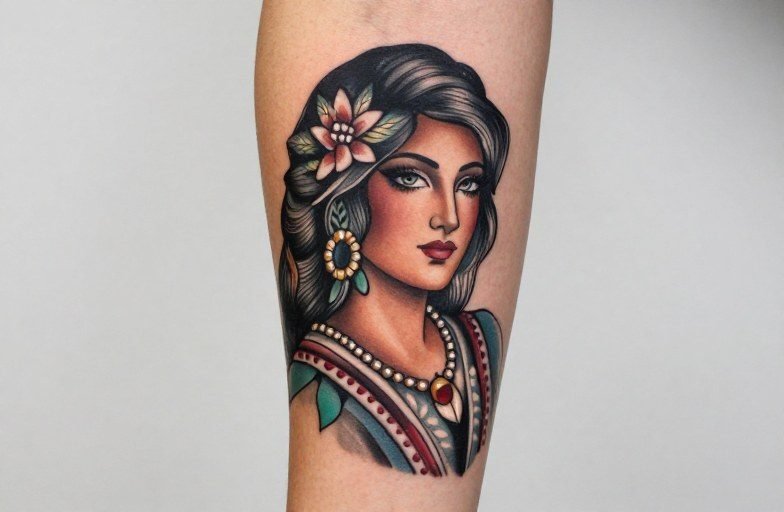
American traditional tattoos for females are defined by bold black outlines, a restricted color palette of red, yellow, green, and black, and iconic imagery like roses, swallows, anchors, and pin-up figures. The style emerged from naval and working-class roots, yet its graphic clarity and symbolic directness have made it a enduring choice across genders. For women specifically, the style offers a particular advantage: its heavy linework and saturated color hold up unmistakably over decades, and the imagery has always included feminine subjects, mermaids, daggers through hearts, beautiful women, and botanicals, rendered with the same graphic punch as any other flash sheet design.
Origins & History
The style’s visual DNA is often linked to 19th-century maritime culture, with Norman “Sailor Jerry” Collins, Don Ed Hardy, and Bert Grimm commonly associated with its codification. These artists worked in port cities, tattooing sailors with designs that needed to be readable from across a crowded bar or through weathered skin. The constraints, thick lines, simple shading, limited colors, weren’t aesthetic choices alone; they were practical solutions for longevity.
Women in Traditional Tattoo History
Female collectors have always been part of this history, though less documented. In the early-to-mid 20th century, women getting tattooed faced significant social stigma, which made the bold, unapologetic nature of American traditional particularly resonant. The imagery itself included women as subjects, pin-ups, hula girls, cowgirls, rendered with admiration rather than the more delicate, decorative approaches seen in other contemporary styles. This created a visual language where female figures could be powerful, alluring, or dangerous without being fragile.
- Sailor Jerry’s flash sheets included numerous female figures, often paired with weapons, animals, or nautical elements
- Bert Grimm’s famous “Beautiful Lady” head design remains a staple, copied and reinterpreted constantly
- The style’s working-class roots meant it was always more accessible than fine-art tattooing, attracting diverse collectors
Aftercare Notes
American traditional’s heavy saturation and dense packing actually simplify aftercare compared to more delicate styles. The ink sits solidly in the skin, and the bold outlines create less ambiguity about what’s healing normally versus what’s concerning.
The First Two Weeks
Keep the tattoo clean and lightly moisturized. Because traditional work uses so much solid black and saturated color, you’ll see more peeling and flaking than with fine-line work, this is normal. The thick ink deposits form a more substantial scab layer. Avoid soaking in baths, pools, or hot tubs until all flaking resolves, typically 10-14 days. Sun exposure during healing will dull the red and yellow pigments disproportionately, so keep it covered or use clothing rather than sunscreen on fresh work.
Long-Term Maintenance
Traditional tattoos age better than most styles, but the bright yellows and reds are most vulnerable to sun fading. After healing, SPF 30+ on exposed pieces preserves the color balance that makes the style distinctive. The black outlines typically remain legible for decades, which is why touch-ups on traditional work often focus on color refresh rather than line reconstruction.
Modern Variations
Contemporary artists have expanded the traditional vocabulary while respecting its constraints. For female collectors, this means more options in both subject matter and placement without sacrificing the style’s graphic integrity.
Subject Matter Evolution
Modern flash includes animals beyond the classic eagle and snake, cats, rabbits, and moths appear regularly, rendered with the same bold outlines and flat color fields. Botanical imagery has expanded from simple roses to peonies, chrysanthemums, and wildflowers, all adapted to the traditional palette and shading conventions. Some artists incorporate feminist iconography, protest imagery, or personal symbolism while maintaining the visual grammar of heavy black lines and limited color.
Placement Adaptations
Smaller scale traditional work has become more common, fitting on forearms, ribs, and behind the ear without losing impact. The style’s graphic nature means it reads clearly even at reduced sizes, though extremely tiny pieces (under 2 inches) may sacrifice the subtle color gradations that distinguish skilled traditional work. Thighs and upper arms remain classic placements, offering enough real estate for the design to breathe and the artist to execute proper whip-shading.
How It Ages
This is where American traditional genuinely distinguishes itself. The thick black outlines function as structural insurance, as the tattoo ages and spreads slightly, the lines remain distinct rather than blurring into indistinct grey. The limited color palette was originally a practical constraint (artists worked with what was available and stable), but it happens to favor pigments that age well.
Black ink, traditional red, and yellow have proven track records for stability. The flat, unblended application means there’s no subtle gradation to lose over time. A 20-year-old traditional tattoo typically looks like a slightly softened version of its original self, not a muddy reinterpretation. For women specifically, this matters because hormonal changes, pregnancy, and weight fluctuations can affect skin elasticity; traditional’s bold structure accommodates these changes better than fine-detail styles.
- Line weight: traditional uses 7-14RL needles for outlines, creating physical depth in the skin that persists
- Color packing: dense, saturated application means the pigment remains visible even as some particles migrate
- Contrast: the black-to-skin ratio is high, maintaining readability under tanning, aging, and slight stretching
Color vs Black and Grey
Pure black and grey traditional exists, often called “blackwork traditional” or “bold traditional”, but it’s a minority approach. The classic style depends on its restricted color palette for visual impact.
When Color Works Best
Color traditional demands more skin real estate. The red, yellow, and green need enough space to register as distinct fields rather than muddled spots. On smaller pieces, many artists limit to black and red only, or use color as minimal accents. The classic “sparrow with red breast” formula works because the color is concentrated and surrounded by black.
Black and Grey Alternatives
Some collectors prefer black and grey for professional environments where color might draw unwanted attention, or for placements where color fading would be most noticeable (hands, feet, frequently sun-exposed areas). The trade-off is reduced visual punch, traditional color was designed for maximum contrast, and removing it changes the energy significantly. Black and grey traditional can feel more somber, more graphic, sometimes closer to illustration than the celebratory, almost poster-like quality of full-color work.
Who It Suits
American traditional isn’t about body type or gender presentation, it’s about aesthetic preference and lifestyle compatibility. The style rewards collectors who want immediate visual impact, who appreciate the historical lineage, and who aren’t seeking hyperrealism or delicate minimalism.
Skin Tone Considerations
The bold black outlines read on every skin tone, but color saturation behaves differently. On darker skin, the red and yellow may appear more muted; skilled artists compensate with heavier black contrast and sometimes adjusted color choices (deeper crimson rather than bright red, for instance). The style’s graphic nature actually makes it more adaptable across skin tones than styles dependent on subtle shading or negative space.
Lifestyle Fit
Traditional tattoos announce themselves. They’re not easily hidden in the way fine-line work can be, and they don’t rely on intimacy or close viewing. This suits people in creative fields, service industries where personal expression is valued, or anyone whose professional environment accommodates visible art. The commitment is also practical: choosing a style that ages well means less future maintenance, less anxiety about long-term appearance, and a tattoo that looks intentional at every stage of life.
Key Takeaways
American traditional tattoos for females offer a rare combination: historical depth, visual boldness, and practical longevity. The style’s constraints, heavy lines, limited colors, iconic imagery, are features, not limitations. They create work that remains legible and striking for decades, through skin changes and fashion shifts. For women specifically, the tradition has always included powerful female imagery, and contemporary artists continue expanding that vocabulary. The aftercare is straightforward, the aging is graceful, and the aesthetic is unapologetic. If you want a tattoo that looks as intentional at fifty as it did fresh, this is the style that delivers.
Frequently Asked Questions
Do American traditional tattoos hurt more because of the heavy linework?
The dense black outlining can feel more intense than fine-line work, but pain varies enormously by placement. Ribs and feet hurt regardless of style; the upper arm or thigh, where much traditional work goes, is manageable for most people. The session time is often shorter than with detailed realism, which can balance the intensity.
Can I get a small traditional tattoo, or does it need to be large?
Traditional work can scale down, but there’s a minimum size for the style to function, typically around 2-3 inches for simple designs. Below that, the whip-shading and color separation become impossible to execute properly. Very small traditional pieces often become permanent black shapes as color details blur together.
How do I find an artist who specializes in authentic American traditional?
Look for portfolios with consistent bold outlines, visible whip-shading technique, and classic imagery executed with personal variation. Flash sheets, pre-drawn designs, are still common in traditional shops. Artists who paint their own flash and participate in tattoo conventions typically have deeper commitment to the style’s integrity.
Will pregnancy affect my traditional tattoo if it’s on my stomach or thighs?
Skin stretching from pregnancy can affect any tattoo in those areas, but traditional’s bold structure handles it better than fine-detail work. The black outlines maintain their integrity; some color saturation may soften. Most artists recommend waiting six months postpartum before assessing whether any touch-up is needed.
Related Style Guides
- Chicano Stomach Tattoos: Style Placement Guide
- Colorful Traditional Tattoos: A Complete Style Guide
- Coolest Traditional Tattoos: Style Guide
- Explore more