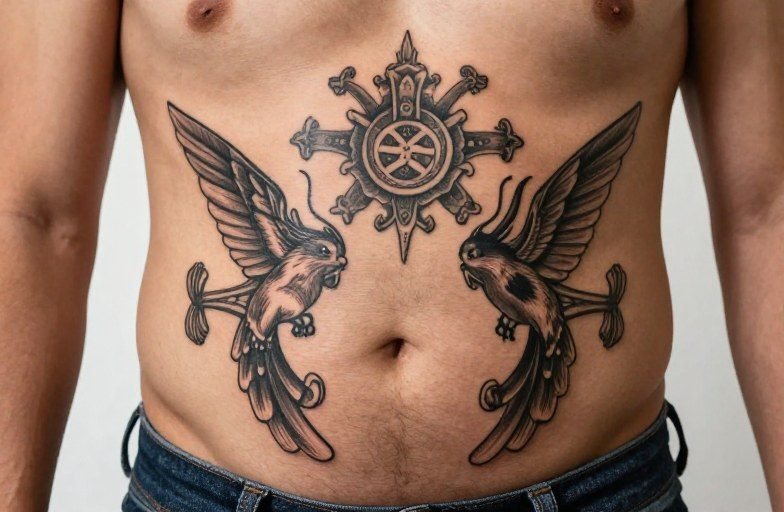
Chicano stomach tattoos sit at the intersection of cultural tradition and technical difficulty. The style pulls from Mexican-American street art, California prison art, and Catholic religious imagery, usually executed in fine-line black-and-grey. Common subjects include the Virgin of Guadalupe, praying hands, roses, clown faces, and ornate script. The stomach itself complicates everything: skin stretches with breath, folds when seated, and shifts with age. A successful piece requires an artist who understands both the visual vocabulary and the physical behavior of abdominal skin.
Origins and Historical Context
The Chicano tattoo style is often linked to the Pachuco era of the 1940s and 1950s, though the direct connection to tattooing is less documented than the broader cultural identity. What is clearer is the style’s development through prison art traditions in California and the Southwest during the mid-to-late twentieth century. Religious imagery dominated early work. Crosses, rosaries, and the Virgin of Guadalupe served as spiritual protection and markers of cultural belonging. The stomach emerged as a placement for larger compositions that arms and legs could not accommodate, though precise documentation of when this shift occurred is scarce.
From Improvised Settings to Professional Studios
Early prison artists worked with limited supplies: single needles, homemade machines, and ink derived from soot or pen fragments. These constraints shaped the fine-line techniques still associated with the style. The stomach’s visibility made it a deliberate statement. As the style moved into professional tattoo studios beginning in the 1970s and 1980s, artists refined the approach while maintaining core elements: photorealistic portraits, smooth grey washes, and lettering that reads with the weight of carved stone.
Religious and Cultural Symbolism
Catholic iconography remains central to Chicano tattooing. The Virgin Mary, crucifixes, and praying hands appear frequently, tied to family devotion and requests for protection. Clown faces, smiling above and crying below, reference the duality of street life and emotional survival. These symbols carried specific meaning within Chicano communities. The stomach placement amplified that significance by positioning the image at the body’s physical center.
Technical Demands of the Stomach
The abdomen presents problems that calmer skin does not. It stretches horizontally, moves with respiration, and compresses when sitting. Fine lines blur here more readily than on the back or outer arm. Chicano work depends on precise single-needle lines for facial details, hair strands, and lettering edges. Shading must transition from deep black to near-skin-tone through smooth grey washes, requiring multiple passes and controlled ink saturation.
Designing for Movement
A standing client looks different from a reclining one. Competent artists map designs across both relaxed and tensed states. Vertical compositions tend to fare better: rosaries dripping downward, script following the midline, designs that work with natural folds rather than against them. Horizontal layouts face more distortion risk. The belly button becomes either a compositional anchor or a problem to navigate. Some artists center designs around it; others avoid the area because of healing complications and inconsistent ink retention.
Lettering on Abdominal Skin
Chicano script requires particular attention on the stomach. Letters must remain legible despite skin movement. Common approaches include:
- Placing names or phrases above the navel, where skin stays relatively stable
- Using heavier outlines on lettering to slow blur over time
- Limiting extremely fine detail in script below the belly button
- Arching text to follow the rib cage line rather than fighting natural curvature
Old English and cursive styles dominate, often enhanced with shading or dimensional effects that make letters appear carved or raised from the skin.
What to Expect During the Session
Stomach tattooing hurts more than most placements. The skin is thin over the abdominal wall, with little muscle padding over the central linea alba and around the navel. Ribs flare at the upper abdomen, adding bone proximity. Breathing becomes a conscious act when needles work near the diaphragm. Sessions often run long because of the scale involved; large stomach pieces typically need multiple appointments rather than a single marathon session.
Pain Variations by Area
The upper stomach, near the sternum and rib cage, tends to be sharper. The area directly around and below the navel registers deeply for many people. The lower abdomen, toward the pubic region, combines thin skin with nerve density. Sides of the stomach, where the obliques run, are generally more tolerable but still more intense than an outer arm or thigh.
Session Planning
Large compositions are usually broken into sections. An artist might complete the upper stomach in one session, the lower in another, with healing time between. This approach manages pain, allows the artist to assess how skin responds, and prevents excessive trauma that could affect healing. Ask your artist about their specific plan before committing to a timeline.
Finding the Right Artist
Not every black-and-grey specialist understands Chicano conventions. The style has established rules: how faces are structured, how roses are shaded, how shadows fall on lettering to create depth. An artist who works primarily in geometric or watercolor styles will not intuitively grasp these elements. You need someone with demonstrated experience in both the style and the placement.
Portfolio Red Flags and Green Lights
- Request healed photos, not just fresh work; stomach tattoos change significantly during healing
- Look for experience with large-scale compositions that flow around the navel
- Ask how designs are tested for readability when the client sits, stands, and bends
- Confirm the artist is comfortable with extended sessions, stomach pieces cannot be rushed without risking blowout and uneven healing
Be wary of artists who quote unusually fast timelines or seem unfamiliar with how abdominal skin behaves during healing.
How Stomach Tattoos Age
Abdominal skin changes faster than most tattooed areas. Weight fluctuations, pregnancy, and natural collagen loss all affect the result. Fine lines soften over time. Solid blacks can develop a blue haze if overworked during application. Grey washes sometimes heal patchy where skin tension varies.
Realistic Long-Term Expectations
Most Chicano stomach pieces need touch-ups within five to ten years. Lines that looked razor-sharp in your twenties may feather slightly by your mid-thirties. This is not failure; it is the nature of the placement. Designs with stronger contrast and bolder lettering elements age more gracefully than pieces relying entirely on photorealistic subtlety. A Virgin’s face rendered in whisper-thin lines demands more maintenance than heavy black script or solid rosary beads.
Body Changes and Pregnancy
Pregnancy dramatically reshapes stomach tattoos. Skin stretches, ink disperses, and the navel shifts position. Some designs recover well; others require significant revision. Some artists advise women to wait until after childbearing for elaborate stomach work. For those who proceed regardless, placing critical detail away from the direct centerline helps preserve the composition’s integrity through physical changes.
Aftercare Specifics
Stomach aftercare presents challenges that arm or leg placements do not. The area contacts clothing constantly: waistbands, shirt hems, bedding. Breathing moves the skin, flexing fresh wounds. Sitting bends the tattoo surface. These factors make the stomach more prone to irritation and slower to settle than calmer placements.
Practical Healing Steps
- Wear loose, soft-waistband pants or skirts during the first two weeks
- Sleep on your back if possible; side-sleeping presses the tattoo against bedding and traps moisture
- Expect more plasma and ink seepage than with arm tattoos; this is normal for the area
- Minimize core workouts and heavy lifting for at least ten days
- Keep the area dry; sweat pools in the navel and along the midline, risking infection
Surface healing typically takes three to four weeks, with full settling around two to three months. Some ink drop is common on the stomach due to movement; do not panic if small touch-ups are needed.
Contemporary Directions
Some modern artists have expanded the traditional Chicano vocabulary while respecting its roots. Color appears occasionally: deep reds in roses, muted earth tones in backgrounds, always anchored by black-and-grey foundations. Others blend Chicano lettering with illustrative or neo-traditional elements. The stomach remains a favored placement for these experiments because its scale accommodates complex compositions that would feel cramped elsewhere.
Shifting Demographics
Historically male-dominated, Chicano stomach tattoos have grown popular across genders. Women often favor softer grey transitions, floral-heavy compositions, and script honoring children or family members. The technical approach adapts to different skin elasticity and fat distribution patterns, though the core style vocabulary remains consistent. Artists increasingly design with these variations in mind, creating pieces that complement the female abdomen rather than simply occupying it.
Global Spread, Uneven Understanding
Chicano style has traveled far beyond California. European and Asian tattooers now produce technically proficient work, though some miss the cultural nuance that gives the style its emotional weight. The best contemporary pieces honor both the aesthetic rules and the lived experience behind them. On the stomach, this authenticity matters particularly; there is nowhere to hide a superficial understanding of the form on such a prominent, demanding canvas.
Before You Decide
Chicano stomach tattoos require honest assessment of your commitment. The style demands an artist with specific experience in both Chicano conventions and abdominal placement. The placement demands acceptance of pain, extended healing, and future maintenance. Body changes will affect the work over decades. The cost reflects the skill and time involved; this is not budget tattoo territory.
If you proceed, choose your artist through healed portfolio work, not fresh photography. Discuss how your specific body type affects the design. Plan for multiple sessions. Budget for touch-ups. Accept that the stomach is a living, moving surface, not a flat board, and the tattoo will live with that movement for as long as you do. Done with patience and respect for the tradition, these pieces carry visual weight that few other placements achieve: the entire design visible at once, centered on the body’s core, rendered in blacks and greys that carry the full history of the form.
Frequently Asked Questions
How painful is a stomach tattoo compared to other placements?
The stomach ranks among the more painful areas. Skin is thin over the abdominal wall, with little padding near the sternum and navel. Breathing becomes conscious work when needles approach the diaphragm. Most people find it significantly more intense than arms, thighs, or outer back. The lower abdomen and area around the navel tend to hurt most.
Can I get a Chicano stomach tattoo if I plan to have children?
You can, but understand the risks. Pregnancy stretches abdominal skin considerably, which can disperse ink and distort designs. Some tattoos recover well post-pregnancy; others need substantial revision. Some artists advise waiting until after childbearing for elaborate stomach work. If you proceed, placing critical detail away from the direct centerline helps preserve the composition.
How do I find an artist who truly understands Chicano style?
Look for portfolios with consistent fine-line work, smooth grey washes, and actual stomach pieces, not just arms and legs. Request healed photos specifically. Ask how they test designs for readability across different body positions. Be cautious of artists who work primarily in unrelated styles like geometric or watercolor, as Chicano conventions have specific rules about facial structure, rose shading, and letter shadowing that require dedicated study.
Why do stomach tattoos need more touch-ups than other placements?
Abdominal skin moves constantly with breathing, sitting, and standing. It stretches with weight changes and pregnancy. Fine lines soften faster here than on more stable skin. Most stomach pieces need touch-ups within five to ten years. Designs with stronger contrast and bolder elements age better than those relying on photorealistic subtlety.
What makes healing a stomach tattoo different from other areas?
Constant contact with clothing waistbands, movement from breathing, and bending when sitting all irritate fresh work. The stomach typically produces more plasma and ink seepage than calmer areas. Healing takes three to four weeks for surface closure, with full settling around two to three months. Loose clothing, back-sleeping, and avoiding core workouts for ten days are essential.