
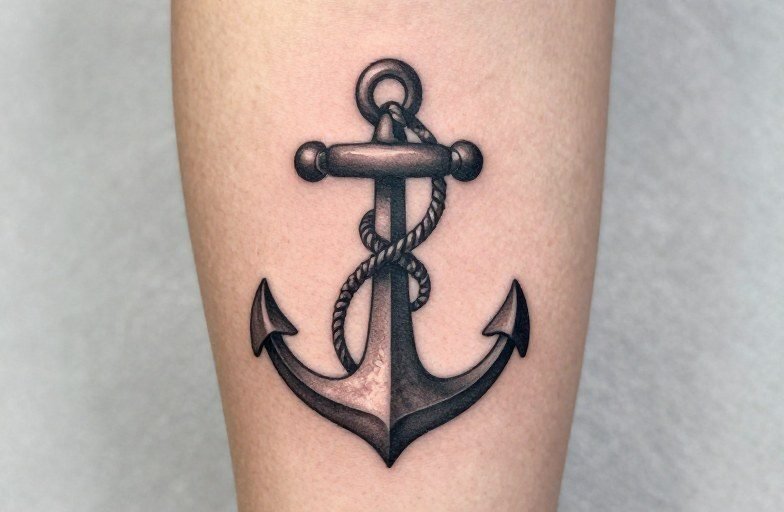
A realistic anchor tattoo renders the maritime tool with photographic precision, weathered iron, barnacle texture, rope wear, and the weight of genuine metal catching light. Unlike traditional or neo-traditional anchors that simplify and stylize, this approach demands technical mastery: smooth gradients, sharp highlights, and the kind of detail that makes the object look like it could be lifted off the skin. The subject carries centuries of naval association, but the realistic treatment transforms it from a simple symbol into a studied object with presence and gravity.
Origins & History
Naval Roots and Early Tattooing
The anchor’s connection to tattooing runs through maritime culture, particularly among sailors who marked their service, their ship, or their hope of return. Early anchor tattoos were typically bold and simple, blue or black outlines that prioritized readability over realism. The technology and ink palettes of the era couldn’t support the smooth gradients and fine detail that define the realistic style today. These older pieces were identifiers first, art objects second.
The Shift Toward Photographic Realism
Realistic tattooing as a recognizable style coalesced in the 1990s and 2000s as equipment improved and artists began cross-training with fine-art techniques. Photorealism, hyperrealism, and the “realistic” approach applied to objects, animals, and portraits became achievable. The anchor, already a tattoo staple, became a natural test subject for artists wanting to demonstrate technical control over metal, rope, and weathered surfaces. Some trace the realistic anchor specifically to naval memorial pieces and the broader trend of rendering historical objects with documentary accuracy.
Key Characteristics & Motifs
What separates a realistic anchor from its traditional cousins comes down to specific visual choices:
- Surface texture: Pitted iron, rust blooms, verdigris on bronze or brass variants, not clean lines but the lived-in quality of actual maritime equipment
- Rope and chain: Often included as secondary elements, rendered with individual fiber detail or cast-metal link precision
- Lighting logic: Consistent light source with specular highlights on metal edges, core shadows in the fluke recesses, reflected ambient light on the underside
- Proportional accuracy: Correct shank-to-fluke ratios, stock positioning, and ring geometry based on actual anchor types (Admiralty, Fisherman, Danforth)
- Environmental context: Optional seabed elements, silt, kelp, or water distortion that grounds the object in a believable space
The best pieces avoid the floating-object problem by giving the anchor weight and context. Even without a full background, subtle shadow beneath the flukes or a slight tilt suggesting rest on an uneven surface helps enormously.
Color vs Black and Grey
Black and Grey Realism
This dominates the realistic anchor category for good reason. Iron and steel read naturally in monochrome, and the style’s emphasis on value range (deep blacks to bright highlights) suits the material perfectly. A skilled black and grey artist can suggest temperature, cold metal, warm rust, through subtle shifts in tone and wash technique. The approach ages gracefully; there’s no color to shift or fade unevenly, and the contrast remains readable as the piece settles into the skin over years.
Color Realism
Color anchors introduce specific challenges and rewards. Bronze and brass tones require careful yellow-ochre to brown transitions. Verdigris, that green copper corrosion, demands a deft hand to avoid looking like simple green paint. Ocean backgrounds in color can frame the anchor effectively but risk overwhelming the central subject. When color works, it usually comes from restrained application: a rust accent here, a cold blue reflected light there, rather than full spectrum coverage. The piece becomes more vulnerable to aging issues, reds and yellows fade faster, blues can granulate unevenly.
Best Placements
Anchor geometry influences placement more than many subjects. The vertical shank and horizontal stock create a natural cross-axis that needs room to breathe.
- Outer upper arm: Classic canvas with enough flat surface for the full shank and flukes; wraps slightly but the central mass stays readable
- Thigh: Excellent for larger scale, allows for accompanying chain or environmental detail; the muscle movement creates interesting light play on the metal
- Chest, off-center: The pectoral flatness suits the anchor’s weight; positioning to one side avoids the awkward center-chest symmetry that can look like a badge
- Calf: Vertical orientation works naturally here; the anchor’s downward gravity matches the leg’s form
- Forearm: Riskier for full realism due to smaller workable area and frequent sun exposure, but achievable for compact, detailed studies
Ribs and stomach generally fight against this subject. The curved surfaces distort the straight shank, and the stretching/sagging over time undermines the precise geometry that makes realism convincing.
Who It Suits
The realistic anchor carries specific connotations that don’t fit every personality or lifestyle. Naval service, merchant marine work, or family maritime history provide the most natural alignment. Beyond literal connection, it suits those drawn to objects with functional beauty, people who appreciate the engineering of a tool designed to hold position against force.
There’s a masculinity traditionally associated with the motif that contemporary work has softened without erasing. A realistic treatment, with its emphasis on studied observation over aggressive symbolism, broadens the appeal. Still, the weight and darkness of a well-executed piece reads serious; this isn’t the choice for someone wanting light, decorative, or purely ornamental tattooing.
Modern Variations
Deconstructed and Partial Anchors
Some contemporary artists fracture the object, flukes emerging from shadow, shank truncated by frame edges, or the anchor half-buried in silt with only the ring and stock visible. This approach borrows from cinematic composition and can solve scale problems for smaller placements. The partial view demands more viewer engagement but risks obscuring the subject for those unfamiliar with anchor anatomy.
Mixed Media and Combined Symbolism
Realistic anchors paired with non-realistic elements, traditional roses, geometric frames, or watercolor washes, create deliberate stylistic tension. These combinations succeed when the contrast is sharp and intentional, not accidental. A realistic anchor with a traditional banner beneath it reads as homage to tattoo history; the same anchor with a sloppy watercolor background reads as uncertain concept.
Memorial applications often incorporate dates, coordinates, or names in engraved-style lettering that matches the metal’s realism. This requires the lettering artist to match the main artist’s precision; mismatched technical levels destroy the piece.
Choosing an Artist
Realistic tattooing is not a generalist skill. The artist you want shows specific evidence in their portfolio:
- Metal rendered with identifiable temperature and weight, not just grey shapes
- Rope or chain work that doesn’t dissolve into texture soup at normal viewing distance
- Consistent light logic across multiple pieces, highlights that make physical sense
- Healed work photography, not just fresh pieces; realism looks dramatically different at six months
- Experience with maritime or mechanical subjects specifically, not only portraits or animals
Consultation matters enormously for this subject. The anchor type should be discussed, do you want a specific historical variant? A particular size and weight class? The artist’s input on how that geometry will fit and age on your chosen placement is essential. Beware the portfolio that shows only small, fresh, tightly-cropped photography; you need evidence of large-scale completion and long-term result.
Budget realistically. A full realistic anchor at proper scale requires multiple sessions for anything beyond the simplest composition. This is not a walk-in subject.
Final Thoughts
The realistic anchor tattoo occupies a space between symbol and object, between personal meaning and documentary observation. It demands more from the artist than simpler treatments and more from the wearer in terms of placement commitment and aftercare discipline. The reward is a piece that holds up to close inspection, that reveals detail across years rather than collapsing into a dark blob. Choose the approach that matches your actual connection to the subject, not the one that seems most impressive in a portfolio. The best realistic anchors feel found rather than invented, like something pulled from actual water, actual history, and set down on skin with respect for its weight.
Frequently Asked Questions
How long does a realistic anchor tattoo typically take to complete?
A medium-sized realistic anchor in black and grey usually requires 3-5 hours for a skilled artist, while larger pieces with environmental detail or color can stretch across multiple sessions totaling 8-15 hours. The complexity of metal texture and rope detail doesn’t lend itself to rushed work.
Will a realistic anchor tattoo blur or fade faster than a traditional style anchor?
The fine detail in realism is more vulnerable to spreading and fading over time, especially if placed on high-movement areas or exposed to sun without protection. Black and grey ages more predictably than color; either way, consistent sunscreen application and occasional touch-ups preserve the piece.
Can a realistic anchor be covered up or modified later if I want to change it?
Covering realistic work is difficult because the dense black and grey shading limits what can go over it. A skilled cover-up artist might incorporate the existing anchor into a larger scene, but complete transformation usually requires laser fading first. Plan for permanence with this style.
What’s the difference between an Admiralty anchor and a Fisherman anchor in tattoo terms?
The Admiralty anchor has a straight stock across the top and curved arms with flukes at the ends, it’s the classic silhouette most people picture. The Fisherman anchor has a single fluke and a more asymmetrical, utilitarian profile. Your choice affects the composition’s balance and what accompanying elements make visual sense.
Related Style Guides
- Realistic Compass Tattoos: Complete Style Guide
- Realistic Deer Skull Tattoos: Complete Style Guide
- Realistic Jewelry Tattoos: Complete Style Guide
- Explore more









