Walk into any shop worth its salt and you’ll spot the flash sheets, those laminated pages of bold eagles, roses, and clipper ships hanging near the counter. That’s traditional Americana tattoo flash, the visual language that built American tattooing. Born in sailor bars and boardwalk booths, this style runs on thick black outlines, saturated color, and imagery you can read from across a crowded room. No fine-line whispering here. These tattoos shout.
Origins & History
From Sailor Jerry to the Street Shop
Norman Collins, Sailor Jerry to everyone, didn’t invent this look, but he damn sure refined it. Working Honolulu in the 1940s and 50s, Jerry took the bold outlines Japanese tattooers used and married them to American subject matter. Eagles, pin-ups, military insignia. The flash sheet became his catalog, his menu, his way of saying “pick something, sit down, let’s go.”
Before Jerry, it was scattered. Circus performers, traveling tattooers, sideshow acts. Each carried hand-painted sheets they could roll up and travel with. The flash sheet was practical, quick to execute, easy to sell, repeatable. A sailor could point at a swallow, pay his money, and be back on ship in an hour. That efficiency shaped the aesthetic. Simple shapes hold up. Complicated shading doesn’t travel well on a bouncing steamship.
The Flash Sheet as Cultural Artifact
Those sheets weren’t just advertising. They were education. Apprentices painted them by the dozen, learning line weight and color packing. A good flash sheet teaches composition, how a dagger fits against a snake, where the banner curves, how much skin a design actually needs. Walk into a shop today and you’ll still see apprentices painting flash. The practice never died; it just went underground for a while.
- Flash was originally hand-painted on paper or cardboard, then varnished for durability
- Classic designs were sized for common placements: upper arms, chest panels, forearms
- Ed Hardy and Mike Malone kept the tradition alive through the 70s and 80s when realism threatened to kill it
- Modern collectors now frame vintage flash as folk art, paying serious money for original sheets
Key Characteristics & Motifs
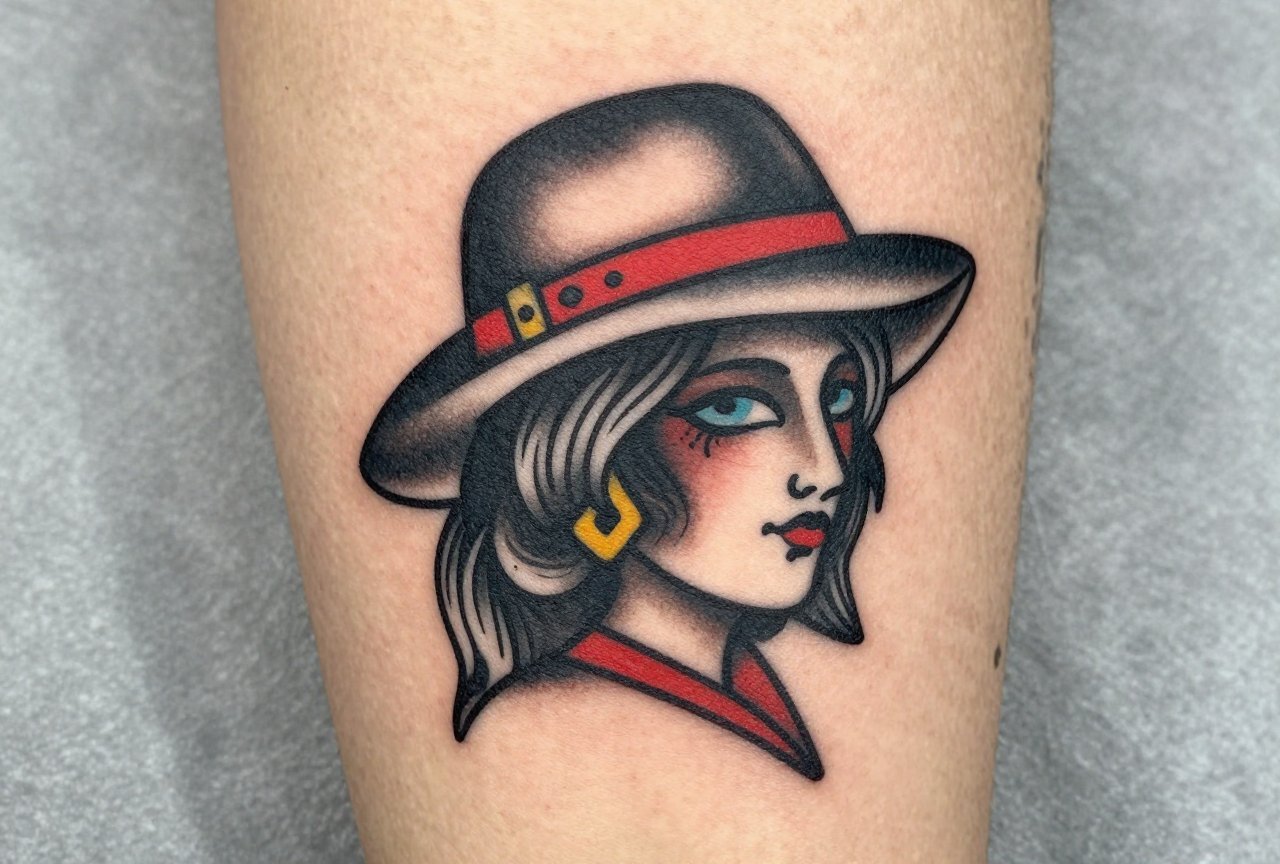
Traditional Americana flash has rules. Break them and you’re doing something else, not necessarily worse, just different. The lines are bold, typically 7 to 14 needle groupings, built to last through sun and time. Shading is minimal, usually achieved through whip-shading or simple black gradients rather than smooth gray washes. Color is flat and saturated: sailor red, navy blue, mustard yellow, pitch black, and skin-tone green for foliage.
The imagery is instantly recognizable. Not abstract, not interpretive. You see it, you know it. Here’s what you’ll find on any respectable flash sheet:
- Eagles: Spread wings, fierce expression, often clutching banners or arrows. Symbolizes freedom, military service, American identity
- Roses and daggers: Beauty and pain, love and betrayal. The dagger through the rose is practically a cliché because it works
- Swallows and sparrows: Originally marked nautical miles traveled; now general good luck and return-home safeness
- Pin-ups and hula girls: Sailor Jerry’s specialty. Cheeky, nostalgic, always with that 1940s aesthetic
- Snakes, panthers, tigers: Aggressive, coiled, usually crawling through something or biting something
- Ships and lighthouses: Nautical roots, guidance, the journey
- Skulls and coffins: Memento mori, but never too grim. There’s usually a rose or banner softening the blow
The banners matter. “Mom,” “Hold Fast,” “Death Before Dishonor.” The lettering is part of the design, not an afterthought. Script is bold, slightly curved, designed to flow with the image beneath it.
Color vs Black and Grey
Purists will tell you traditional Americana flash lives in color. They’re mostly right. The limited palette, five, maybe six colors maximum, is part of the discipline. But black and grey traditional has its place, and some of the best work I’ve seen lately goes this direction.
Color traditional ages with character. That sailor red fades to a dusty rose, blue goes slightly greenish, yellow often disappears entirely. A good artist accounts for this, packing color dense enough that the fade looks intentional rather than washed-out. Black and grey skips the color fade problem entirely, but you lose the immediate punch. A black panther hits different than a purple one. Both valid. Both require different maintenance conversations.
Here’s the honest truth: color traditional needs more touch-ups over decades. Black and grey is lower maintenance. If you’re sunscreen-averse or work outdoors, factor that in. I’ve seen twenty-year-old color traditional that looks like a watercolor experiment gone wrong. I’ve also seen black and grey traditional that reads perfectly at thirty years because the lines were bold enough to survive.
Best Placements
Traditional Americana flash was designed for specific body real estate. The designs have gravity, they want to sit flat, read clearly, not twist around too much anatomy.
- Upper arm/shoulder cap: The classic. Eagle spread across the deltoid, banner wrapping the front. This is where the style was born to live
- Forearm: Perfect for vertical designs, daggers, snakes, clipper ships. Easy to show, easy to hide with a long sleeve
- Chest panel: The centerpiece. Often an eagle, sometimes a ship, occasionally a full pin-up. Demands commitment and pain tolerance
- Thigh: Modern placement, but excellent for larger flash pieces. Flat canvas, good for detailed work that still needs to read from distance
- Hands and knuckles: Traditional loves the hands. HOLD FAST across the knuckles. Small symbols on the fingers. High visibility, high commitment
What doesn’t work as well: ribs, where the twisting distorts those bold lines; neck, unless you’re fully committed to the aesthetic head-to-toe; anywhere the skin stretches dramatically, because traditional relies on stable geometry.
Who It Suits
Not everyone. That’s fine. Traditional Americana flash carries a certain attitude, unapologetic, slightly nostalgic, working-class in its bones even when worn by millionaires. It suits people who want their tattoos readable, not mysterious. People who appreciate craft over concept. I’ve tattooed lawyers and mechanics in this style, and both wore it well because both understood what they were choosing.
It also suits collectors building cohesive bodies. Traditional plays well with other traditional. A sleeve of mixed flash, unified by line weight and color palette, looks intentional in a way random tattoos rarely achieve. Start with a forearm eagle, add a ship above, a snake below, a banner somewhere. Five years later you’ve got a story that makes visual sense.
Modern Variations
Neo-Traditional
The obvious evolution. Keeps the bold lines, adds more detail, more color gradients, more realistic shading. Think traditional composition with illustrative technique. Artists like Emily Rose Murray pushed this hard. The subject matter expands too, animals, portraits, pop culture references rendered in traditional-adjacent language. Still readable from distance, but with more going on up close.
Japanese-American Fusion
Some artists, particularly on the West Coast, blend traditional Americana flash structure with Japanese imagery and color sensibility. Waves rendered in traditional line weight. Koi fish with sailor Jerry composition. It shouldn’t work, but in the right hands, it absolutely does. The shared emphasis on bold outline and flat color makes the marriage possible.
Contemporary Flash Revival
Younger artists are painting flash again, not just designing on iPad. There’s a market for hand-painted sheets, for limited edition flash drops, for the aesthetic of the sheet itself. Shops host flash days where designs are pre-drawn, priced to move, executed fast and clean. No consultations, no revisions. Point and shoot. Returns tattooing to its social, spontaneous roots.
Choosing an Artist
Look at their healed work. Fresh traditional photographs beautifully, those bold lines and saturated colors pop on Instagram. Healed work tells the truth. Ask to see something a year old, five years old. Good traditional artists keep these photos because they’re proud of how their work ages.
Check their line weight consistency. Traditional lives or dies on clean, confident outlines. Wobbly lines, inconsistent thickness, blown-out edges, these are death for this style. A traditional specialist can pull a seven-inch line in one pass without hesitation. That confidence comes from repetition, from painting flash, from understanding how skin takes ink differently on bone versus muscle versus fat.
Ask about their palette. Traditional artists often mix their own tones, have preferences, can explain why they use this red instead of that one. If they can’t talk color with specificity, they might not be living in this style deeply enough.
And honestly? Trust the shop vibe. Traditional Americana flash comes from a specific culture. The artist should respect that culture, not just borrow its visual language. Look for flash on the walls. Listen for the right music. The aesthetic is holistic.
Final Thoughts
Traditional Americana tattoo flash isn’t going anywhere. It survived the realism boom, the tribal wave, the fineline explosion. It’ll survive whatever comes next because it works. Bold lines last. Readable imagery satisfies. The cultural weight, sailors and sideshows, Jerry and Hardy, the whole romantic American tattoo mythology, gives it depth beyond mere fashion.
Get it because you love how it looks, not because it’s trending. Wear it where it belongs. Find an artist who sleeps and breathes this stuff. And maybe, if you’re lucky, hang a flash sheet on your wall too. The art deserves to live off skin as well as on it.
Related Style Guides
- Free Tattoo Designs That Actually Work
- Classic Tattoo Designs That Never Go Out of Style
- Realistic Wolf Tattoos: Complete Style Guide
- Explore more
Frequently Asked Questions
What makes a tattoo ‘Traditional Americana’ versus just traditional?
Traditional Americana specifically refers to the bold, graphic style pioneered by artists like Sailor Jerry and Norman Collins in the early to mid-20th century. It is characterized by heavy black outlines, a limited color palette of red, yellow, green, and blue, and iconic imagery such as anchors, roses, eagles, and pin-up girls that reflected American military and working-class culture.
Why do flash tattoos use such a restricted color palette?
The limited palette originated from practical constraints of early tattooing, as artists worked with fewer pigment options and needed colors that would hold up reliably in skin over time. These boundaries became a defining aesthetic of the style, forcing artists to create maximum visual impact through design rather than color complexity.
Can I get a custom design in Traditional Americana style, or does it have to be flash?
You can absolutely get custom work in this style, though many collectors specifically seek classic flash designs for their historical authenticity. A skilled artist can create original pieces that honor the traditional rules of bold lines, simple shading, and limited colors while incorporating personal imagery that fits the aesthetic.
How do I find an artist who specializes in authentic Traditional Americana flash?
Look for artists who display solid, consistent line work in their portfolio and who may actually paint and sell traditional flash sheets. Many specialists work at shops with historical ties to the style, and reputable artists will be transparent about their training influences and whether they apprenticed under established traditional tattooers.