Funny traditional tattoos take the bold linework, limited color palettes, and iconic imagery of American traditional tattooing and twist it toward comedy. Think crying clowns with exaggerated tears, animals in human predicaments, classic pin-up poses subverted with unexpected subjects, or reaper motifs where Death itself looks inconvenienced. The style demands the same technical discipline as serious traditional work: thick black outlines, saturated color fills, minimal shading. But the subject matter winks at the viewer. The humor works because the craftsmanship refuses to play for laughs.
What Makes the Joke Work
The visual grammar of funny traditional borrows directly from the mid-century flash sheets that defined the style, work often linked to Sailor Jerry, Bert Grimm, and their contemporaries. Bold black outlines create the graphic readability that makes these jokes work from across a room. Colors stay classic: vermillion red, cobalt blue, golden yellow, forest green, and cream. The comedy emerges from juxtaposition. Sacred heart imagery wrapped in a banner reading “Pizza Forever.” A dagger through a heart where the heart has a face and looks annoyed. Traditional panthers weeping melodramatically.
Comedic Subversions of Classic Flash
Common motif twists include:
- Animals in human roles: bears in business suits, penguins smoking pipes, dogs looking disappointed in you specifically
- Literal interpretations of phrases: “love hurts” rendered as a heart with a visible bruise, “time flies” as a melting clock with wings and a frantic expression
- Reversal of power dynamics: tiny mice threatening cats, flowers eating bees, the moon looking frightened of the wolf
- Anachronistic objects in period settings: a traditional clipper ship with a Wi-Fi symbol, a Victorian portrait subject holding a smartphone
How the Punchline Reads on Skin
Unlike text-based joke tattoos, funny traditional relies on visual storytelling compressed into a single image. The composition must read instantly. No fine print required. This is why the traditional format suits comedy so well. Its graphic boldness functions like a well-timed punchline. The humor typically lands through facial expression (exaggerated on animals and objects), situational absurdity, or the collision of sacred traditional imagery with profane or mundane subject matter.
Linework and Technique
Technical execution determines whether a funny traditional tattoo succeeds or becomes a regrettable joke. The linework cannot be sloppy and call it loose. This style demands precision. Outlines run consistently bold, usually achieved with round liners for main lines, stepping down to smaller groupings for interior details. Line weight variation creates depth: thicker contours on outer edges, slightly thinner lines defining interior forms. Funny traditional often pushes toward cartoonish expression, but the tattooing itself must be disciplined.
Color Packing for Comedic Impact
Saturation separates professional work from amateur attempts. Color fills in funny traditional need to be flat, even, and dense. Patchy color kills the graphic punch. Artists typically work in small sections, wiping frequently to check consistency. Whip shading, when used, stays minimal and purposeful: a surprised eyebrow, a blush on a cheek, the shadow under a floating object. The limited palette actually assists the comedy. Too many colors diffuse the graphic impact. Two or three well-saturated colors against black and skin tone carry more visual weight than a rainbow approach.
Needle Selection and Healing Considerations
Black outlines heal darkest and most consistently. This is why traditional tattoos age well. For funny traditional, the bold black structure preserves the joke even as color fades slightly over decades. Color packing benefits from magnum needles for solid fills, but small comedic details (teeth, eyes, tiny accessories) often require single-needle precision. These fine details are the first to blur with age and sun exposure, so placement matters. Areas with thinner skin or more movement (inner bicep, ribs, feet) will degrade fine comedic expressions faster than stable placements like outer forearms or calves.
Common Mistakes to Avoid
Plenty of funny traditional tattoos fail on execution, not concept. The most frequent error is underdrawing the comedy, assuming the joke is obvious when the image lacks the graphic clarity to communicate it. A confused expression on a snake requires specific eyebrow placement, eye shape, and head tilt. Without these, you have a snake that looks vaguely wrong, not deliberately funny.
Conceptual Pitfalls
- Overexplaining the joke: if the tattoo needs a caption to land, the image has failed
- Choosing humor that relies on current slang or memes: traditional format implies longevity; the joke should survive five, ten, twenty years
- Confusing randomness with absurdity: deliberate visual logic separates comedy from nonsense
- Neglecting negative space: cramming too much detail destroys the bold readability that makes traditional tattoos work
Technical Errors
Blown lines in funny traditional are particularly disastrous because the style’s graphic simplicity exposes every flaw. A wobbly outline on a realistic portrait might hide among textures. On a bold traditional piece, it reads as incompetence. Similarly, muddy color mixing, where adjacent colors bleed together during healing, destroys the clean separation that defines the style. Green and red should not become brown at their border. Saturation shortcuts, like diluting ink to stretch supply, result in colors that heal to a dusty version of their intended brightness, draining the comedic vitality.
Modern Variations
Contemporary artists have expanded funny traditional in several directions while maintaining core technical requirements. Neo-traditional funny work introduces slightly more complex shading, illustrative detail, and expanded color palettes (muted teals, dusty roses, ochres) while keeping the bold outline structure. The comedy in neo-traditional tends toward narrative scenes: a full tableau of animals at a poker table, a Victorian séance with bored ghosts checking phones.
Japanese Fusion and Other Hybrids
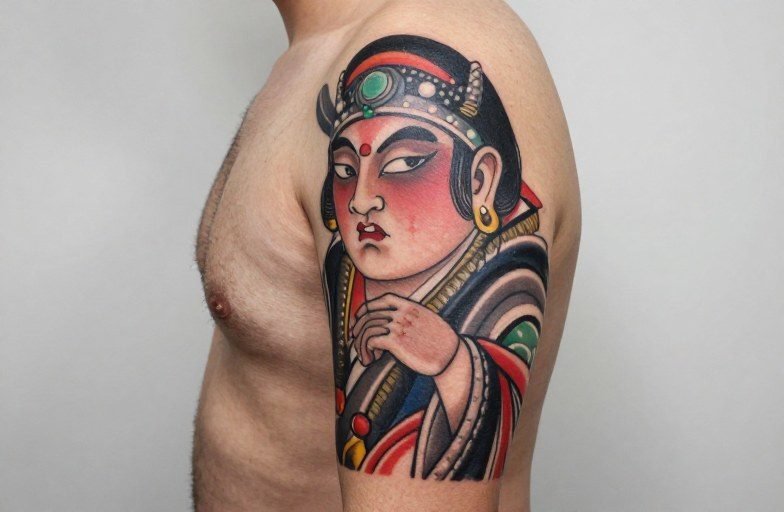
Some artists merge traditional American boldness with Japanese iconography, creating funny tattoos of kirin looking embarrassed, or koi fish with human expressions of determination. These hybrids require understanding of both visual languages. The humor must respect the source material enough to subvert it effectively. Other fusions include traditional format with Chicano black-and-gray influence, producing funny tattoos with softer shading transitions but still graphic readability.
Text Integration and Lettering
Modern funny traditional sometimes incorporates period-appropriate lettering (thick serif banners, ribbon scrolls, tombstone inscriptions) as part of the comedic mechanism. The text itself becomes the joke, or contradicts the image. This demands lettering skill from the artist. Poorly executed text in an otherwise solid tattoo reads as an afterthought. Best practice keeps lettering large enough to age legibly, with adequate spacing between letters and words.
Choosing the Right Artist
Not every traditional tattooer can execute funny work effectively. Technical proficiency with bold lines and color packing is necessary but insufficient. The artist needs comedic timing in visual form. Review portfolios for evidence of humor that lands: expressive faces, clever juxtapositions, work that makes you laugh before you read any caption.
Portfolio Red Flags and Green Lights
- Green light: consistent bold outlines across all work, healed photos showing color retention, variety in subject matter including humorous pieces
- Red flag: portfolios with only serious traditional work and no evidence of comedic sensibility; artists who dismiss your concept as silly rather than engaging with the technical challenge
- Green light: artists who ask questions about the specific expression, posture, or situation you want depicted
- Red flag: artists who suggest “we’ll figure it out at the appointment” for a concept that requires precise visual planning
Consultation Dynamics
A productive consultation for funny traditional involves the artist sketching variations, testing how the joke reads at different scales and compositions. Be wary of artists who want to add their own punchline without understanding yours. The collaboration should sharpen your concept, not replace it. Ask to see healed examples of their humorous work. Fresh tattoos always look more saturated and crisp than they will in six months. Healed photos reveal whether the comedic expression still reads clearly or has blurred into ambiguity.
Placement and Scale Decisions
Funny traditional tattoos need room to breathe. Too small, and the facial expressions that carry the joke become indecipherable dots. Too large without sufficient compositional weight, and the humor feels stretched thin. Most successful funny traditional pieces work best at palm-sized or larger, with the main comedic element given clear priority in the design. Consider your own body movement, too. A tattoo on a frequently flexing area may distort the expression unpredictably, turning a knowing smirk into an accidental grimace.
What to Remember
Funny traditional tattoos occupy a difficult middle ground. They must be technically impeccable to honor the style’s history, yet conceptually loose enough to let the joke breathe. The best pieces achieve this balance through restraint: one clear comedic idea, executed with the same gravity as a ship or a swallow. You are not asking the tattoo to do less work than a serious piece. You are asking it to do the same work, plus make someone laugh.
Choose your concept with an eye toward longevity. The funniest traditional tattoos remain funny because their humor operates on visual logic rather than reference. A dog looking disappointed in you requires no cultural context. A heart with a bruise needs no explanation. These images work in 2024 and will work in 2044 because the comedy lives in the image itself, not in what the image points to outside itself.
Find an artist who takes the humor seriously. That sounds contradictory, but it is the whole point. The joke is in the subject. The tattooing is in the craft. When both land together, you have something that lasts: a permanent smile, earned through skill.
Frequently Asked Questions
How small can a funny traditional tattoo be while still reading clearly?
Palm-sized is generally the minimum for most funny traditional pieces. The facial expressions and graphic boldness that carry the joke need sufficient space to remain legible after healing. Very small pieces (under 2 inches) often lose their comedic clarity as fine details blur over time.
Will a funny traditional tattoo age worse than a serious traditional tattoo?
Not if executed properly. The bold black outlines that define traditional style preserve the structure regardless of subject matter. However, funny traditional often relies on fine details (expressive eyes, small accessories) that do degrade faster than large solid fields. Stable placement and sun protection matter more for humorous pieces because the joke depends on those details remaining readable.
Can I add text to make sure people get the joke?
You can, but you should not need to. If the image requires a caption to land, the concept has failed at the visual level. Text can complement the humor (contradicting the image, adding a second layer), but the core joke must read without it. Poorly integrated text also ages badly if too small or densely packed.
How do I know if my concept is funny-random versus actually funny?
Test it against time. Will the joke still make sense in ten years without explanation? Does it rely on a specific reference that will date it? True absurdity in funny traditional has internal visual logic: the mouse threatens the cat with a specific expression, posture, and prop. Randomness lacks that coherence. Show your concept to someone unfamiliar with the reference; if they laugh at the image alone, it works.
Do all traditional tattooers do funny versions, or do I need a specialist?
Not all traditional tattooers handle comedy well. Technical skill with bold lines and color packing is necessary but not sufficient. Look specifically for healed examples of humorous work in their portfolio. An artist who only executes serious traditional imagery may lack the comedic sensibility to sharpen your concept, even if their linework is flawless.