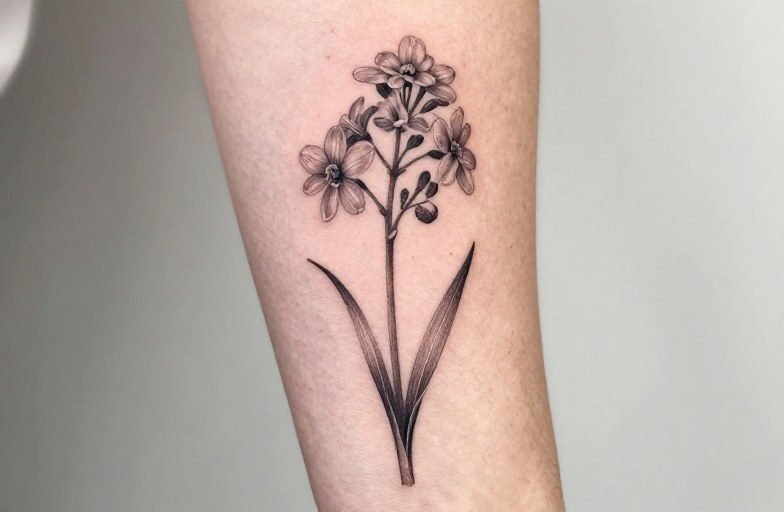
A larkspur tattoo most commonly signals an open heart, lighthearted love, and the bonds of July birthdays. The flower’s tall, delicate spikes carry a dual nature, graceful yet resilient, which draws people who want something botanical without the overdone rose or lotus. Different colors shift the message slightly: purple for first love, pink for fickle or changing affection, white for pure intentions, and blue for dignity and grace.
Color vs Black and Grey
Color larkspur tattoos capture what makes this flower distinctive. The natural gradient from deep indigo to pale violet at the petal edges, or the soft pink-to-white transitions, give tattooers something technically interesting to work with. Watercolor styles lean into this, letting the bloom bleed outward without heavy outlines. Traditional or neo-traditional approaches use saturated magentas and cobalt blues with bold black stems.
Black and Grey Realism
Stripped of color, larkspur becomes about structure. The negative space between petals, the fine hairs on the stem, the way the flower clusters terminate in a single spur, these details become the entire point. Black and grey works well for smaller pieces where color might muddy at a distance. The downside: without hue, larkspur loses its immediate recognizability. Someone unfamiliar with botany might read it as generic wildflower unless the spur (the backward-pointing nectar tube) gets emphasized.
Color Saturation and Skin Tone
Cool purples and blues sit well on lighter skin but can ash out or look bruised on deeper tones unless the artist warms the base with magenta or red undertones. Yellow and white larkspur varieties exist but yellow ink fades fastest and white alone rarely holds crisp definition long-term. For darker skin, rich jewel-toned purples with solid black backing tend to age most gracefully.
How It Ages on Skin
Larkspur’s fine petals and thin stems present genuine aging challenges. Lines under a millimeter thick spread and blur over five to ten years. What reads as delicate linework fresh out of the shop often becomes indistinct grey smear later. The spur, that hooked extension behind the bloom, is particularly prone to this, it’s a small detail that disappears early if not built with enough pigment density.
Shading Strategy for Longevity
- Build petal depth with layered greywash or color packing rather than single-pass fine lines
- Leave strategic highlights (skin breaks) rather than trying to tattoo white over everything
- Anchor the composition with darker stems and leaves that won’t vanish as the flower head softens
- Avoid tiny scattered buds; they blob together within a few years
Placement matters equally. Inner forearms and calves see moderate sun and friction, larkspur here holds better than on fingers, ribs, or feet where constant rubbing and moisture attack the ink. Upper arms and thighs offer the best compromise: enough flat surface for detail, enough protection from daily wear.
History & Cultural Roots
The name “larkspur” comes from the spur’s resemblance to a lark’s claw, though the flower itself is often linked to Greek mythology, specifically the figure of Ajax and the blood that supposedly transformed into these blooms. Some trace it to medieval England, where the plant was used in protective charms and hung in stables to ward off ghosts. The Victorian language of flowers codified its meanings most directly: purple for haughtiness (later softened to first love), pink for fickleness, and white for happy nature.
Native American Associations
Indigenous peoples of the Plains used larkspur (often called “delphinium” in broader botanical terms) for dye and sometimes in ceremony, though the plant’s toxicity limited medicinal use. Tattoo imagery rarely draws from these specific practices directly, but the flower’s North American presence adds regional resonance for those with prairie or mountain connections.
Design Tips & Pairings
Single-stem larkspur reads elegant and minimal. Multiple stems in a loose bundle suggest abundance and layered meaning. The natural vertical growth makes it ideal for forearm runs, rib-to-hip placements, or trailing down the back of an arm.
Complementary Elements
- July birth month pairings: ruby gemstones, cancer or leo constellation lines, other July flowers like water lily
- Memorial contexts: names or dates woven through the stem, sometimes with a single fallen petal
- Botanical accuracy: pairing with native grasses or pollinators (hummingbirds, sphinx moths) that actually visit the flower
- Negative space: letting the stem break and resume, or ghosting secondary blooms behind the main cluster
Butterflies and larkspur together are common to the point of cliché. If you want insects, consider the less obvious: the hummingbird hawkmoth, or simply the geometric pattern of seed pods after flowering. Larkspur seed pods look like small purses or pouches, an underused visual that extends the life cycle narrative without defaulting to caterpillar-to-butterfly imagery.
Personal & Modern Meanings
Beyond birth month, people choose larkspur for its structural qualities. The flower stands tall but sways, there’s a specific metaphor in that combination of backbone and flexibility. Some connect it to recovery or resilience, not because of any traditional meaning but because the plant itself reseeds aggressively after disturbance.
Contemporary Interpretations
Minimalist single-line larkspur designs have gained traction, reducing the bloom to its essential spur-and-petal silhouette. These work for people who want the reference without the full botanical illustration. Others use larkspur as a secondary element in larger garden compositions, where its height provides vertical contrast to low-growing roses or peonies.
Gender associations with this flower remain relatively neutral compared to more loaded blooms like lilies or orchids. That flexibility appeals to people seeking floral imagery without stereotypical feminine or masculine coding.
Best Placements
The vertical habit of larkspur dictates most successful placements. Horizontal orientations fight the flower’s natural form and usually look awkward unless heavily stylized.
- Forearm, back of arm: the stem runs with the bone, most natural reading
- Rib cage, floating: allows for true-to-life height, though pain factor is significant
- Outer thigh: flat canvas, good for multi-stem clusters with full leaf detail
- Ankle to foot: the stem trails downward; historically associated with travel and movement
- Behind the ear: single small bloom, intimate scale, limited detail possible
Hand and finger placements generally fail with larkspur. The detail required doesn’t survive in those high-wear zones, and the stem’s length doesn’t suit the available space. Neck placements work only if the design is bold enough to read at a distance, fine larkspur there disappears into skin texture.
What to Remember
Larkspur offers a specific, underused botanical choice with genuine symbolic depth, but it demands technical respect. The very delicacy that makes it appealing is what fights aging. If you want this flower, commit to enough size to let the details breathe, choose an artist who understands botanical structure versus just pretty pictures, and place it where your daily life won’t grind it away within a few years. The meaning is solid, July birth, open heart, light love, but the execution determines whether anyone, including you, can still read that meaning a decade later.
Frequently Asked Questions
Does larkspur have different meanings based on color?
Yes, traditional floriography assigns purple to first love, pink to fickleness or changeable affection, white to pure joy, and blue to dignity. Most contemporary tattoos draw on purple or blue for general positive associations rather than strict color-coded messaging.
How big should a larkspur tattoo be to age well?
At minimum, allow two to three inches for a single bloom with visible spur detail. Smaller than that, the fine lines between petals blur together within five years. Multi-stem pieces need significantly more real estate to avoid crowding.
Is larkspur toxic, and does that matter for tattoo symbolism?
The plant is genuinely poisonous if ingested, containing alkaloids that affect the nervous system. Some people lean into this as part of the meaning, beauty with an edge, or protection through deterrence. Most simply choose it for the visual and birth-month connection without engaging the toxicity aspect.
What’s the difference between larkspur and delphinium in tattoo designs?
Botanically they’re closely related and visually similar, with delphinium generally referring to perennial garden cultivars and larkspur to annual wild types. For tattoo purposes, the terms often get used interchangeably, though “larkspur” specifically carries the July birth flower designation.
Related Tattoo Meanings
- Leafless Tree Tattoo Meaning: Bare Branches, Deep Roots
- Lighter Tattoo Meaning: Flame, Rebellion Renewal
- Lion of Judah Tattoo Meaning: Roots, Symbolism Design
- Explore more