
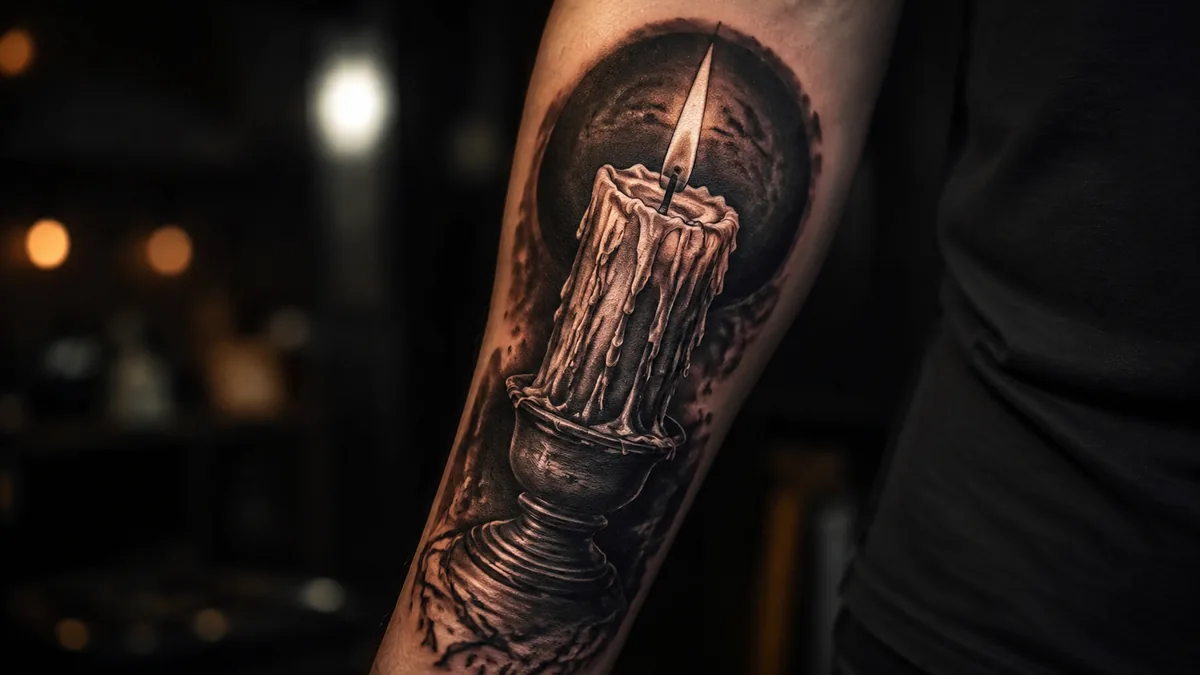
A candle tattoo is one of those designs that hits hard without being loud. It carries real weight, real meaning, and it reads clean on skin from across the room. People get it for all kinds of reasons, but the thread running through almost all of them is the same: light in the dark.
The symbolism is honest and layered. A candle gives off light while it burns itself down. That tension between life, sacrifice, and hope is exactly why this tattoo keeps showing up in studios. It’s not a trend piece. It’s a choice people sit with.
Core Meaning: Light, Hope, and Mortality
The candle is one of the oldest symbols humans have used to represent life. The flame burns, it gives warmth, it guides, and it goes out. That duality is the core of the candle tattoo. Most clients want it to represent hope in a dark period, or the idea that even a small light matters in a big darkness.
Mortality sits right next to that hope. A burning candle melts. It’s a reminder that time moves and life is finite, but the light is still worth something while it lasts. A lot of people pair this with dates or names to make that meaning personal and specific to their experience.
Memory and Grief: Honoring Someone Lost
Even a small flame holds back the whole dark.
One of the most common reasons people walk into a shop asking for a candle is grief. A candle lit for someone who’s gone is a universal gesture. Vigils, memorials, religious services, almost every culture uses a lit candle to honor the dead. The tattoo carries that same weight permanently.
It’s a clean way to memorialize someone without going full portrait. You can work in initials, a birth and death date, or a small meaningful object tucked into the composition. It’s quieter than a portrait but just as sincere, and for a lot of people that restraint is exactly the point.
Religious and Spiritual Roots
Candles are embedded in religious practice across the board. In Catholicism, votive candles are lit as prayers. In Judaism, the Shabbat candles and the menorah carry deep spiritual meaning. In Vodou and Santeria, candle color and flame are central to ritual. These traditions are real, and clients who come from those backgrounds often bring that context directly into the tattoo.
This is where you want to ask your client what their relationship to the symbol actually is. A simple flame for one person is a devotional image for another. Understanding that shapes everything from composition to whether you add iconography like a cross, a rosary, or a specific saint’s image in the background.
Popular Design Variations
The melting pillar candle is the most classic read. Wax dripping down the sides, a steady flame, maybe a candlestick holder. It photographs well, ages predictably, and works in both fine line and traditional bold styles. A blown-out candle with a curl of smoke reads as loss or the end of something, which some clients specifically want over a burning flame.
Candelabras and three-wick candles show up for people who want something more ornate or gothic. Skull candles, where the wax takes the shape of a skull, are popular in dark traditional and illustrative work. Some clients go for an hourglass integrated with a candle to double down on the time and mortality angle. All of these are solid executions that hold up on skin long term.
Black and Grey vs. Color
Black and grey is the dominant choice for candle tattoos, and it makes sense for the subject matter. The symbol is about shadow and light, and a skilled artist using whip shading and solid blacks captures that contrast beautifully. It also heals reliably and holds its detail well over years, especially in the mid-range sizes that candle tattoos tend to run.
Color opens things up. A yellow-orange flame with a warm glow effect works great in illustrative and neo-traditional styles. Red candles read as passion or danger. Black candles have their own meaning in certain occult and witchcraft contexts, representing protection, banishment, or mourning. If your client is coming in with a specific color in mind, ask what it means to them, because it’s usually deliberate.
Placement and How It Ages
The candle shape is naturally vertical, which makes it a strong choice for the forearm, shin, and sternum. The proportions are forgiving and the composition flows with the body rather than against it. Inner forearm placements look sharp, heal nice, and are low-wear enough to keep the linework crispy for years. Upper arm and thigh are solid bets for larger, more detailed pieces.
Avoid high-wear zones like the inner wrist crease, the side of the hand, or between the fingers if you want this to last with any detail. Fine line candle tattoos on the fingers look great fresh and fade fast. A bolder execution in a lower-wear zone will hold and still read clearly a decade out. Talk to your artist about sizing up slightly if you want fine internal details to survive the years without blurring.
Who Gets Candle Tattoos and How to Make Yours Personal
This tattoo draws a wide crowd. People in recovery get it as a symbol of finding light again. Caregivers and nurses get it for guidance and service. Readers and writers lean into the classic image of a candle next to a book. Grieving people get it as a permanent memorial. Religious clients get it as devotion. The symbol is flexible enough to hold all of those readings without losing its identity.
Making it yours usually comes down to the details you add around the main image. A specific flower, a meaningful object, a phrase, a date, a moth drawn to the flame. The moth drawn to candle light is a strong pairing with its own symbolism around obsession and fatal attraction. Bring references, talk through what the candle means to you personally, and let that conversation shape the final design.









