
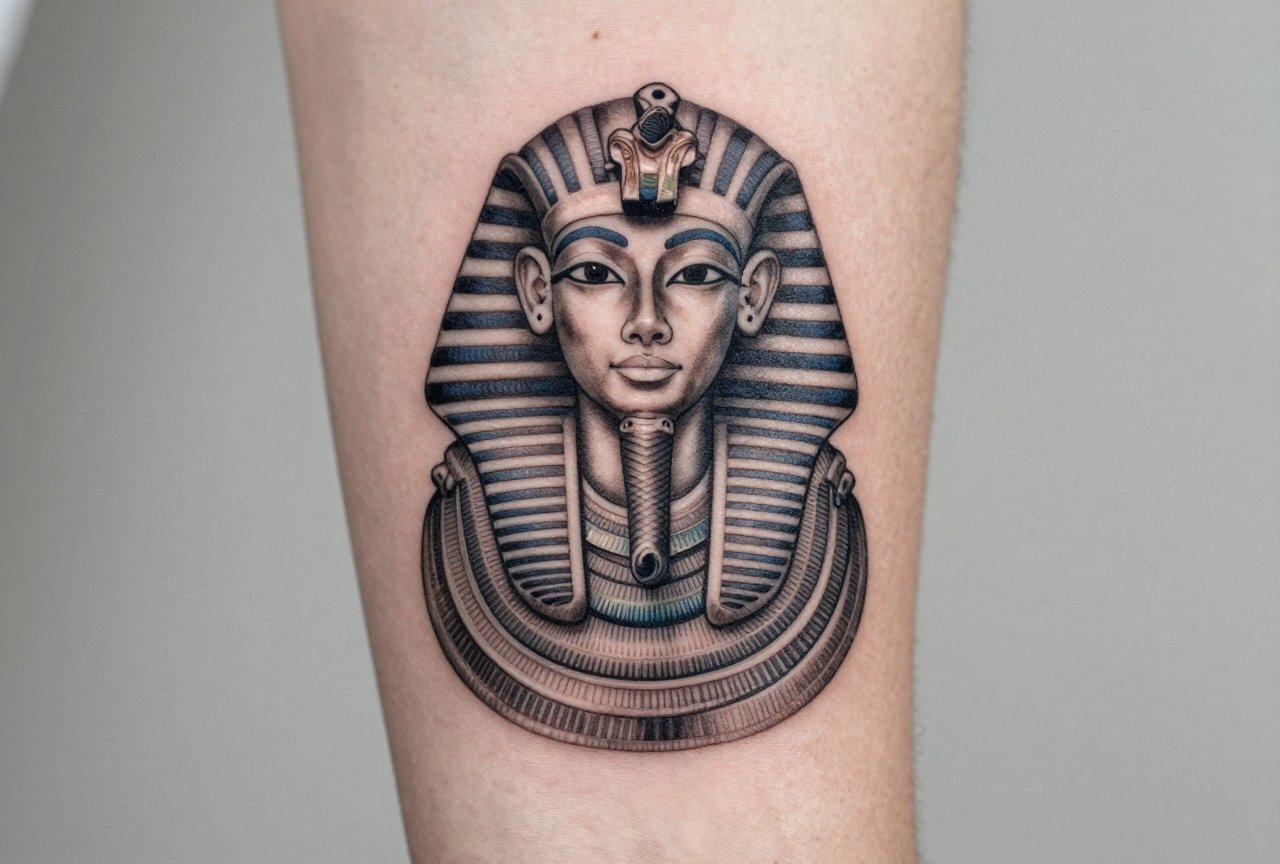
A pharaoh tattoo means power, legacy, and the eternal soul. It draws from ancient Egyptian kings who were seen as living gods, bridging the human and divine. Most people who sit in my chair for this design aren’t Egyptian historians, they’re drawn to something primal: the idea of ruling your own life, leaving a mark that outlasts you, or carrying protection from something older than yourself.
Symbolism & History
The pharaoh wasn’t just a king. He was Horus in human form, the son of Osiris, the guarantor that the sun would rise and the Nile would flood. That weight of meaning is why this image hits so hard as a tattoo, it carries millennia of belief about order, death, and rebirth.
Divine Authority & Leadership
I’ve tattooed pharaohs on forearms of guys who just made manager for the first time, on chest pieces for veterans, on calves for a woman who started her own law firm. The thread is the same: they want a visual reminder that authority is theirs to claim. The nemes headdress, the crook and flail, the false beard, even stylized, these elements read instantly as “I decide.”
Death, Afterlife & The Ka
The ancient Egyptians believed every person had a ka, a life force that needed a body to return to. Pharaohs built pyramids and took treasures into death to sustain theirs. A pharaoh tattoo can channel that same desire: not fear of death, but preparation for it. I’ve had clients who survived cancer or lost parents choose this image as a way of saying “I’m still here, and what I am continues.”
- Protection: The pharaoh’s image was magical, wearing it was believed to ward off chaos
- Legacy: The obsession with monuments, names carved in stone, memory that outlasts flesh
- Transformation: The journey through death to rebirth, Osiris’s own story
- Order over chaos: Ma’at, the concept of balance, was the pharaoh’s sacred duty
Common Variations & Styles
Not every pharaoh tattoo looks like Tutankhamun’s gold mask. In my shop, we see three main approaches, and they age differently on skin.
Realistic/Portrait Style
Full color, gold tones, lapis blue, carnelian red. Stunning when fresh. Here’s the reality: those light yellows and bright blues fade fastest. I’ve watched a gorgeous full-color pharaoh mask go muddy in five years without touch-ups. If you want this route, commit to sunscreen and plan for a refresh. Black and grey realism ages cleaner, especially on the contrast of the striped nemes against skin.
Neo-Traditional & Graphic
Bold lines, limited palette, stylized features. These hold. The thick outlines fight blur, and the simplified color blocks don’t muddy the same way. A neo-trad pharaoh with a dagger or snake reads immediately from across a room. We do a lot of these on upper arms and thighs where the flat planes let the graphic style sing.
Minimalist & Linework
Single needle, profile silhouette, maybe just the headdress. Risky. Fine lines spread. I’ve seen delicate pharaoh profiles blow out to fuzzy suggestions in two years on high-movement spots like wrists. If you want minimal, go bigger than you think, and place it somewhere stable, inner bicep, upper back, somewhere the skin doesn’t twist much.
- Mask only: Focus on the iconic gold face, stripped of context
- Full figure: Seated pharaoh, crook and flail crossed, often with hieroglyphic borders
- Pharaoh with deities: Anubis, Horus, or Isis flanking or merging
- Modern fusion: Pharaoh imagery with geometric patterns, mandala backgrounds, or graffiti elements
Best Placements
Where you put it changes what it says and how it lives.
Forearm: Visible, declarative. The pharaoh faces outward, addressing the world. Good for the “I claim my power” message. Easy to show, easy to cover with a sleeve. Line work stays crisp here if you avoid the inner wrist crease.
Chest: The heart’s territory. When someone wants the afterlife meaning, the protection angle, they often feel it here. Centered over the sternum, a pharaoh mask becomes almost devotional. I’ve done chest pieces where the client wanted the eyes to line up with their own nipples, unsettling when you first hear it, but the effect is arresting.
Thigh: Canvas space. You can get the full seated figure, hieroglyphic border, real detail. Thigh skin is forgiving for healing, less sun exposure if you don’t live in shorts. The trade-off: fewer people see it, but it’s yours.
Back: Between the shoulder blades, a pharaoh becomes something watching your back. Literally. I’ve heard that from clients more than once. The upper back holds detail well, but lower back, tramp stamp territory, distorts with movement and age. I’d steer you higher.
Hand or neck: We do these, but I always pause. These are job-stoppers in most of America, and the skin there sheds and suns aggressively. A pharaoh on a hand is a statement you can’t take back. Make sure it’s the statement you want.
Who Chooses This Tattoo / Personal Meanings
After fifteen years, I can tell you there’s no single pharaoh client. The meaning bends to the person.
Leadership & Ambition
Young men, mostly, in their twenties and thirties, getting their first or second serious piece. They want the icon of command without the cliché of a lion or wolf. The pharaoh feels historical, earned, less aggressive than a predator but still potent. I had a client, construction foreman, who said he wanted his crew to see it when he rolled his sleeves. Not the pharaoh’s face, his own arms, but the image reminded him to be fair, decisive, unshaken.
Heritage & Reclamation
Some Black clients choose pharaoh imagery to connect with pre-colonial African civilization, to claim a history beyond slavery. This is deeply personal, and I listen more than I speak when someone brings this in. The meaning isn’t mine to define. My job is to render it with respect and technical skill.
Survival & Continuity
People who’ve faced death, illness, combat, overdose, violence, sometimes gravitate here. The pharaoh’s entire culture was organized around not dying, around persisting. That speaks. A woman I tattooed had the mask placed over her mastectomy scar. She called it “putting my own face back on.”
Similar Symbols
If the pharaoh appeals but doesn’t quite fit, these live in the same neighborhood:
- Eye of Horus / Ra: Protection, royal power, the sun’s journey. More compact, less narrative.
- Anubis: The guardian of death, mummification, the threshold. Darker, more somber.
- Scarab: Rebirth, the sun’s cycle, transformation. Often paired with pharaoh imagery.
- Pyramid: Monument, endurance, the achievement of many for one. Geometric, modern-friendly.
- Cleopatra: Female power, political cunning, tragic romance. Different energy, more seductive, less divine.
We see a lot of sleeves that combine these elements: pharaoh mask, pyramid background, Anubis lurking, Eye of Horus repeated as pattern. It works if the artist understands the scale, too small and it becomes visual noise, too scattered and the meaning dissolves.
Final Thoughts
A pharaoh tattoo isn’t a trend. It’s been coming through shops steady for decades, and it’ll keep coming because the questions it answers are permanent: Who am I? What do I leave? What outlasts me? The image is heavy with history, but what matters is what you load it with. Get it for power, for protection, for heritage, for the sheer visual punch of gold and lapis on skin. Just get it done well, bold enough to age, placed to live, and honest to who you are right now, not who you think you should be. The pharaohs built for eternity. Your skin deserves the same respect.
Frequently Asked Questions
Does a pharaoh tattoo need to be in color to look authentic?
Not at all. Black and grey pharaohs age better and read more sculptural. Color is striking fresh, but golds and blues fade fast without maintenance. Some of the most powerful pharaoh work I’ve done has been charcoal tones on pale skin.
Is it culturally appropriative to get a pharaoh tattoo if I’m not Egyptian?
Ancient Egypt is a global cultural touchstone, but intention matters. If you’re drawn to the imagery, learn the history. Don’t treat it as mere aesthetic. I’ve had respectful clients of every background, and thoughtless ones too. The difference is curiosity and humility.
How much detail can fit in a small pharaoh tattoo?
Less than you think. The nemes stripes, facial features, and headdress elements need space to breathe. Under three inches, you lose the distinction that makes it read as pharaoh. I’d rather do a clean small silhouette than a cramped portrait that blurs to mush.
What should I avoid combining with pharaoh imagery?
Be careful with sacred symbols you don’t understand, specific hieroglyphs, the ankh in certain orientations, deity names. I’ve had to gently redirect clients from tattooing random hieroglyphic strings that turned out to be gibberish or unintentionally comic. Research or ask your artist.
Related Tattoo Meanings
- Cleopatra Tattoo Meaning: Power, Beauty Legacy
- Ank Symbol Tattoo Meaning: Ancient Egyptian Power Protection
- Cheetah Tattoo Meaning
- Explore more









