
Realistic Werewolf Tattoos: A Working Artist’s Guide
Realistic werewolf tattoos occupy a fascinating space between horror iconography and deeply personal symbolism. The challenge lies in rendering a creature that exists only in imagination with the anatomical conviction of something alive. For collectors and artists alike, this demands technical precision and thoughtful design choices at every stage.
Symbolism & Core Meaning
At its foundation, the werewolf represents duality: the civilized self and the untamed instinct coexisting in uneasy tension. This resonates across cultures and centuries, making it one of the most psychologically layered figures in tattoo art.
Transformation and Identity
The metamorphosis from human to wolf speaks to moments of profound personal change. Many collectors choose this imagery during transitions: recovery, career shifts, parenthood, or the shedding of past versions of themselves. Unlike static symbols, the werewolf captures process rather than outcome, the becoming rather than the being.
Instinct and Social Constraint
There’s also a liberating quality to the werewolf as symbol. The full moon, often incorporated into these designs, functions as an external force that strips away pretense. For those who feel constrained by social expectations, the wolf-man offers a visceral fantasy of authentic expression, however destructive that might appear.
History & Cultural Roots
The werewolf’s visual vocabulary draws from multiple streams, which informed tattoo interpretation significantly.
European lycanthropy trials of the 16th and 17th centuries produced lurid courtroom descriptions that still influence how artists render the transformation: elongated limbs, bristling fur erupting from human skin, the jaw distending impossibly. These accounts, often linked to actual medical conditions like hypertrichosis, created a template for horror illustration that persists in tattoo realism today.
Earlier still, Norse berserker warriors wearing wolf pelts and Germanic skin-changer legends contributed the association with battle frenzy and liminal spiritual states. Slavic vlkodlak traditions, meanwhile, emphasized the curse aspect, the tragic figure unable to control his own violence. Each tradition offers different emotional temperatures for tattoo design: the noble warrior, the cursed victim, the ravenous predator.
Hollywood cemented the modern visual standard. Lon Chaney’s 1941 makeup design, with its rounded snout and sorrowful brow, differs sharply from the more lupine, elongated forms of An American Werewolf in London (1981) or the muscular hulking variants of later films. A collector’s preferred cinematic reference often predicts their desired emotional register.
Similar & Related Symbols
Several adjacent motifs share thematic territory and frequently appear alongside werewolf imagery.
- Skinwalkers and Naguals: Southwestern Indigenous and Mesoamerican traditions feature human-animal shapeshifters, though these carry specific cultural weight that requires sensitive handling. Direct appropriation should be avoided; thematic conversation is possible with proper research and respect.
- Van Helsing and monster hunters: The adversarial relationship creates narrative tension in multi-session pieces or companion tattoos.
- Full moons and lunar phases: Nearly universal accompaniment, the moon’s cycle reinforces themes of periodic change and uncontrollable external forces.
- Wolves (non-lycanthropic): Naturalistic wolf portraits offer a related but distinct symbolism: pack loyalty, wilderness, survival without the human duality element.
- Other Universal Monsters: Dracula, Frankenstein’s creature, and the Mummy share the vintage horror aesthetic and work well in themed collections or sleeves.
Common Variations & Styles
Realistic werewolf tattooing encompasses several sub-approaches, each demanding different technical execution.
Transformation Stages
The mid-transformation pose, human features dissolving into lupine structure, offers maximum visual drama. This requires mastery of skin texture transitions: smooth human dermis giving way to follicle density, pore structure shifting, the cartilage of ears lengthening and folding. Reference material becomes crucial here; artists frequently study medical texts on skin conditions, animal anatomy, and prosthetic makeup documentation to build convincing intermediate states.
Full Wolf-Man Portraits
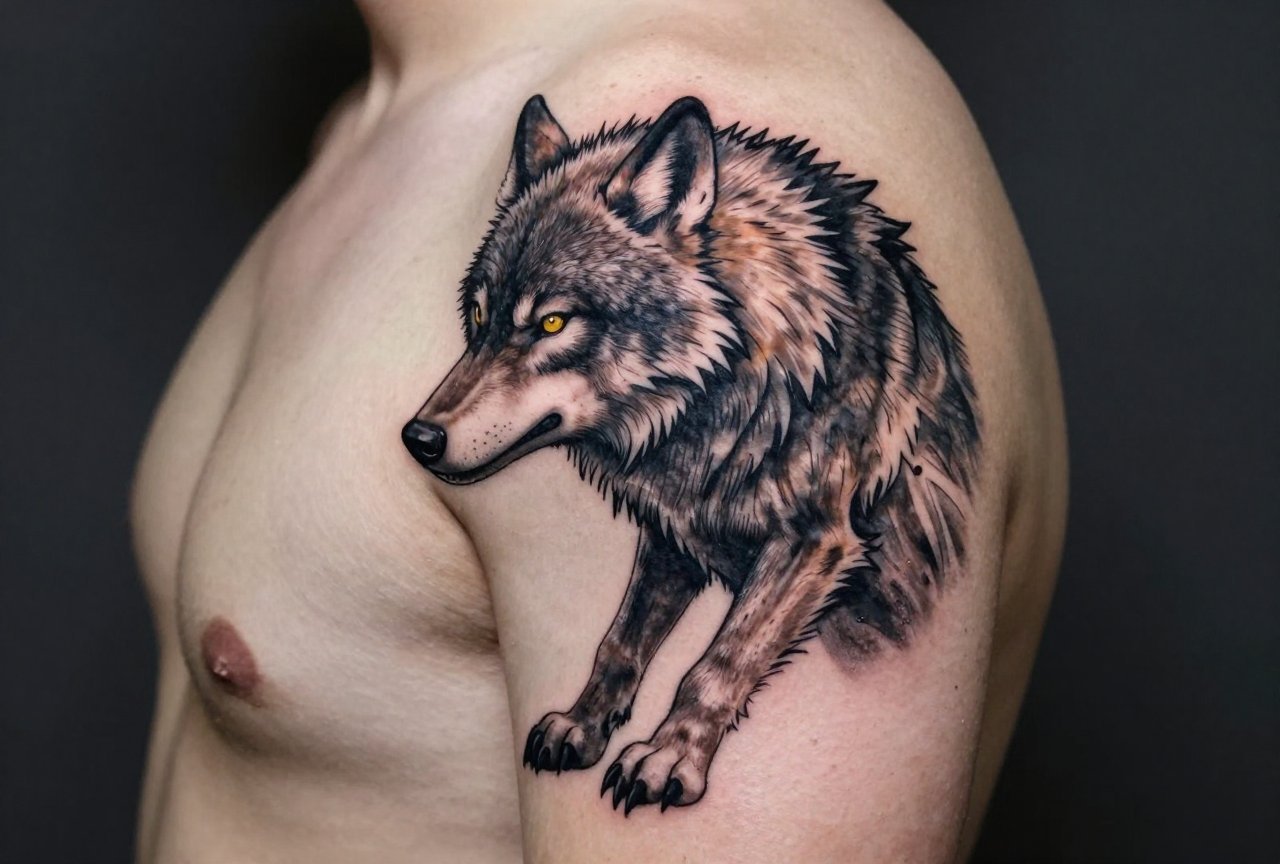
The completed form, whether bipedal or quadrupedal, allows for more stable composition. Bipedal variants emphasize the retained human posture and proportions, creating uncanny recognition in the viewer. Quadrupedal forms read more as monstrous wolf than hybrid, which some collectors prefer for its primal directness. Both require solving the fur problem: tattooed fur must suggest individual strand direction, density variation, and underlying musculature without the actual dimensional depth of real pelts.
Black and grey realism dominates this subject, though selective color appears in eye pigmentation, blood, or moonlight. Some artists explore neo-traditional structures with realistic rendering, using bold outlines to contain the chaotic subject matter. Others work in pure photorealism, competing with cinematic concept art for detail fidelity.
Design Tips & Pairings
Successful placement and composition require anticipating how the form will move and age.
Anatomical Considerations
The werewolf’s elongated proportions suit certain body areas exceptionally. Forearms and calves accommodate the stretched limb structure naturally. The torso, particularly the ribs and side, allows for the curled, dynamic poses that suggest mid-hunt or mid-transformation. Thighs offer substantial real estate for seated or crouching compositions.
Fur texture presents particular aging challenges. Extremely fine stippling and single-needle work can blur over time; slightly bolder approaches to texture, with clear value separation between highlight and shadow areas, maintain readability longer. Discuss this explicitly with your chosen artist during consultation.
Complementary Elements
- Architectural ruins or gothic environments: Ground the creature in atmosphere without competing for attention.
- Negative space moonlight: Strategic un-tattooed skin can read as luminous source, a sophisticated solution to the moon element.
- Human hands or faces in partial transformation: Mirror the main figure and create narrative depth.
- Botanical decay: Thorned roses, dead trees, or autumn leaves reinforce themes of beautiful corruption.
Text integration proves difficult with this subject; the visual complexity of realistic werewolf rendering rarely benefits from additional lettering. If quotes or names matter to the collector, consider separate adjacent pieces rather than overlay.
Personal & Modern Meanings
Contemporary collectors infuse werewolf imagery with meanings far removed from folklore origins.
Mental health recovery narratives appear frequently: the werewolf as controlled condition rather than curse, the management of cycles that cannot be eliminated. Neurodivergent collectors sometimes identify with the sensory intensity and social misalignment the figure suggests. The monster as misunderstood rather than evil, a reading enabled by decades of sympathetic pop culture portrayals.
Gender transition finds expression here too; the body’s betrayal and subsequent reclamation, the social navigation of visible change. The werewolf’s involuntary monthly cycle carries obvious resonance that many collectors explore with intentional, reclaimed symbolism.
Fandom and literary attachment matter as well. Specific portrayals, from The Wolf Man to Teen Wolf to The Witcher, carry personal significance that shapes desired aesthetic. The responsible artist listens for these attachments without assuming them.
Key Takeaways
Realistic werewolf tattooing rewards preparation and specificity. The subject demands technical excellence in texture transition, anatomical knowledge, and value control. Its symbolism operates on multiple registers: ancient folklore, cinematic nostalgia, and intensely personal narrative. Successful pieces result from honest consultation about reference material, aging expectations, and the emotional temperature the collector seeks. Whether approached as horror celebration, psychological metaphor, or both, the werewolf remains one of tattooing’s most technically demanding and symbolically rich subjects.
Frequently Asked Questions
How long does a realistic werewolf tattoo typically take?
Time varies dramatically based on size, placement, and detail level. A small portrait might require 6-8 hours, while a full sleeve or back piece with environmental elements can extend across 30-50 hours or more. The fur texture and transformation details that define quality work cannot be rushed. Most artists schedule these as multiple sessions to preserve skin integrity and maintain precision.
What makes werewolf tattoos particularly challenging for artists?
The core difficulty lies in rendering something that does not exist in nature with convincing realism. Artists must synthesize human anatomy, wolf anatomy, and often prosthetic or cinematic reference into a coherent form. Fur texture in tattoo medium lacks the dimensional depth of actual pelts, requiring sophisticated value manipulation to suggest density and direction. The transformation stages add the further challenge of believable intermediate anatomies.
Should I choose black and grey or color for my werewolf tattoo?
Black and grey dominates this subject for good reason: it emphasizes form and texture, ages more predictably, and carries the gothic atmospheric associations most collectors seek. Selective color, limited to eyes or blood, can punctuate without overwhelming. Full color approaches work better for comic or illustrative styles; in realism, they often distract from the sculptural qualities that make these pieces successful. Discuss specific intentions with your artist.
How do I find an artist qualified for this specific subject?
Seek portfolios demonstrating three specific competencies: accomplished fur or hair texture rendering, successful hybrid or monstrous creature work, and strong value control in black and grey. Horror subject matter alone is insufficient; the technical demands of realistic transformation exceed stylized approaches. Schedule consultations with artists whose healed work, not just fresh photography, shows sustained clarity. Ask specifically about their reference process and how they approach texture aging.









