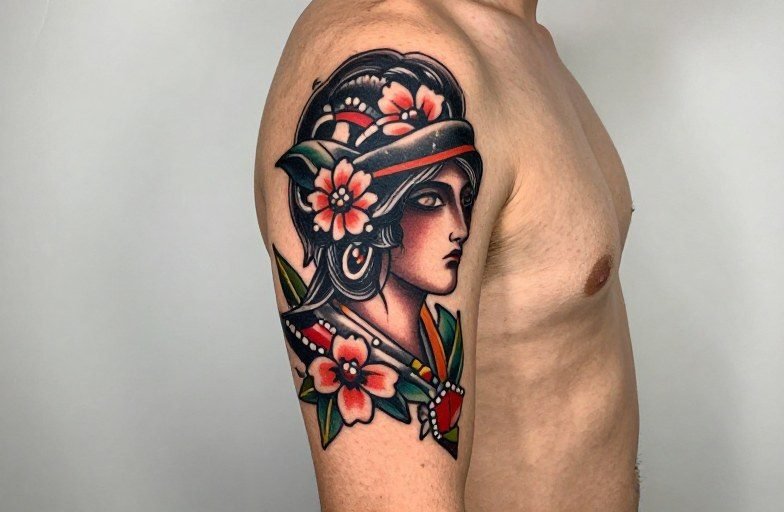
American Traditional tattoos, sometimes called Old School, are built on a visual language that has remained remarkably consistent for nearly a century. Thick black outlines, saturated color fields, and instantly readable imagery: anchors, eagles, roses, pin-up figures, sailing ships, and predatory animals. For men, this style offers something rare in contemporary tattooing: a design that reads clearly from across a room and holds its structure for decades. The aesthetic emerged from specific circumstances, naval culture, limited technology, and the need for tattoos that healed fast and stayed legible. Understanding those constraints explains why the style looks the way it does, and why it still works.
Origins & History
The style is often linked to the early 1900s, when electric tattoo machines became reliable enough for consistent linework. Sailors and servicemen were the primary clientele, which shaped both the subject matter and the technical approach. Designs needed to be completed quickly, heal under rough conditions, and remain identifiable even as skin aged and sun-damaged. This practical necessity produced the hallmarks we recognize today: bold outlines, minimal shading, and a restricted palette that could be mixed from a few basic pigments.
The Sailor Connection
Naval tradition heavily influenced the imagery. Swallows marked miles sailed, one for every 5,000 nautical miles, according to some accounts, though specific numbers vary by source. Anchors signified stability or maritime service. Nautical stars served as navigational symbols. These weren’t arbitrary choices; they communicated membership in a specific culture. The style spread through port cities and military bases, carried by artists who learned from each other through apprenticeship rather than formal training.
Mid-Century Shop Culture
By the 1940s and 1950s, American Traditional had codified into something approaching a standard curriculum. Flash sheets, pre-drawn designs displayed on shop walls, allowed artists to work efficiently and clients to choose quickly. The aesthetic became associated with working-class masculinity, motorcycle culture, and later, rebellious identity. This association persists, though the client base has broadened considerably.
Key Characteristics & Motifs
Recognizing genuine American Traditional work requires attention to specific technical choices, not just subject matter. The style is defined by how it’s built, not merely what it depicts.
- Line weight: Heavy black outlines, typically 7-14RL needles, creating borders that remain visible even as color fades
- Color palette: Red, yellow, green, and blue as primaries; black for shading; limited use of purple or brown
- Shading approach: “Whip shading” or sparse black fill, never smooth gradients
- Imagery conventions: Eagles with spread wings, roses with dagger stems, clipper ships, pin-up women, panthers, snakes, skulls, hearts with banners
- Composition: Designs meant to stand alone, not blend into larger scenes; each element reads as a complete image
The banner with text remains a distinctive feature, curved ribbons bearing names, dates, or short phrases, integrated into the design rather than floating above it. This requires planning; the text must follow the banner’s curve legibly, which constrains word choice and letter count.
Color vs Black and Grey
Traditional American work is fundamentally a color style, but black and grey adaptations have become common, particularly for men who prefer subdued visibility or need to coordinate with existing monochrome pieces. The tradeoffs are real and worth understanding.
Color Traditional
Saturated pigments, especially the classic vermillion red and cadmium yellow, create immediate visual impact. These colors age predictably: reds warm toward orange-brown, blues gray slightly, greens can muddy. The black outline preserves the design’s structure through these changes. Color demands more sessions for larger pieces and requires stricter sun protection during healing and long-term.
Black and Grey Adaptations
Some artists specialize in “black traditional”, the same imagery and linework, rendered with black fill and grey shading instead of color. This reads more starkly and can integrate with other black and grey work more easily. The risk is losing the cheerful, graphic quality that defines the style; the reward is timelessness and easier maintenance. Ask to see healed examples of any artist’s black traditional work, as fresh tattoos look darker than they settle.
Best Placements
American Traditional designs were originally sized for arms, chests, and backs, areas accessible with the limited needle configurations of early machines. Modern equipment allows more flexibility, but certain placements remain particularly effective for men.
- Upper arm/shoulder: The classic canvas. Rounds and rectangles fit the muscle contour; eagles and ships read powerfully here
- Forearm: Excellent for vertical designs, daggers, snakes, pin-up figures. Visibility is high; consider professional implications
- Chest, centered: Anchors, hearts with banners, or symmetrical animal heads. The sternum provides natural framing
- Thigh: Increasingly popular for larger single pieces. Good pain tolerance, easy concealment, ages well with muscle mass
- Hand and knuckles: Traditional territory, but requires commitment. These placements don’t suit first tattoos for most men
Back pieces exist in traditional style but tend toward Japanese-influenced arrangements unless strictly composed as separate panels. The style’s graphic, isolated nature makes it less suited to full back sleeves that flow continuously.
Who It Suits
Not every aesthetic matches every person. American Traditional tends to complement men with certain preferences and constraints.
Those who work in environments where visible tattoos are accepted or irrelevant will find the style’s bold visibility an asset rather than liability. The graphic clarity suits larger body types well, the heavy lines don’t get lost on bigger frames the way fine detail can. Men building extensive collections often use traditional pieces as anchors, literally and figuratively; the style’s self-contained nature means it doesn’t require surrounding work to feel complete.
Skin tone affects color choices. Darker skin can carry black traditional beautifully; saturated color requires more deliberate pigment selection and sometimes adjusted design emphasis. Experienced artists in this style will have specific approaches and portfolios demonstrating range.
Modern Variations
Contemporary artists have expanded the vocabulary without abandoning the grammar. “Neo-traditional” maintains the bold outlines but introduces more complex shading, expanded color palettes, and varied subject matter, animals rendered more realistically, portraits with traditional framing, ornamental elements integrated with classic motifs. This isn’t better or worse, but different; the original style’s restraint is precisely what gives it longevity.
Some practitioners specialize in “tough traditional”, deliberately rougher application, slightly blown lines, a weathered aesthetic that references the style’s historical execution. Others pursue hyper-clean precision, every line uniform and every color field perfectly saturated. Both are valid; neither is more authentic. The question is what you want to live with.
Choosing an Artist
Specialization matters more than reputation in other styles. A brilliant realism artist may execute poor traditional work; the muscle memory and design instincts differ significantly. Evaluate artists specifically on their traditional portfolios, not their overall skill.
- Request to see healed photos, not just fresh work. Color saturation drops 20-30% during healing; lines settle and soften
- Look for consistent line weight throughout the design, not just in prominent areas
- Check that color fields are packed solid without patchiness or visible needle marks
- Ask about their apprenticeship lineage; traditional tattooing historically transmitted through direct mentorship
- Discuss their pigment choices for your specific skin tone; experienced artists adjust palettes based on melanin content
Consultations should involve design discussion, not just scheduling. The best traditional artists will modify flash or custom designs to fit your specific anatomy while preserving the style’s essential character.
Final Thoughts
American Traditional endures because it solved real problems, legibility, longevity, efficient execution, and those solutions created a visual language with cultural weight. For men considering this style, the practical advantages align with aesthetic appeal: these tattoos stay readable, age gracefully relative to more delicate approaches, and carry historical resonance without requiring personal narrative justification. The commitment is to the style itself, to its conventions and constraints, which paradoxically offers freedom within a defined framework. Choose an artist who respects those constraints, and you’ll have work that looks as intentional in thirty years as it does today.
Frequently Asked Questions
How long does an American Traditional sleeve typically take?
A full traditional sleeve usually requires 15-25 hours across multiple sessions, depending on design density and whether it includes hand or inner arm work. The style’s bold fill allows faster progress than realism, but proper healing between sessions, typically 3-4 weeks, extends the overall timeline to several months.
Can American Traditional cover up existing tattoos?
Yes, the heavy black outlines and saturated color make it excellent for cover-ups, though the existing tattoo’s darkness and location constrain design options. Darker original work may require a black panther, ship with heavy sails, or similarly dense imagery. Consultation is essential; not everything can be covered effectively.
Why do some traditional tattoos look blurry after healing?
Blowout, ink spreading beyond the intended line, occurs when needle depth is inconsistent or skin is overworked. In traditional work, this destroys the crisp structure that defines the style. Proper artist technique prevents it; sun exposure and poor aftercare accelerate aging blur in healed pieces.
Is it acceptable to mix American Traditional with other styles in a collection?
Absolutely. Many men combine traditional pieces with Japanese work, black and grey realism, or ornamental designs. The key is thoughtful placement and spacing, traditional pieces function as visual punctuation, creating rest areas between more complex work. A skilled artist can advise on transitional elements.
Related Style Guides
- Realistic Compass Tattoos: Complete Style Guide
- Realistic Deer Skull Tattoos: Complete Style Guide
- Realistic Jewelry Tattoos: Complete Style Guide
- Explore more