
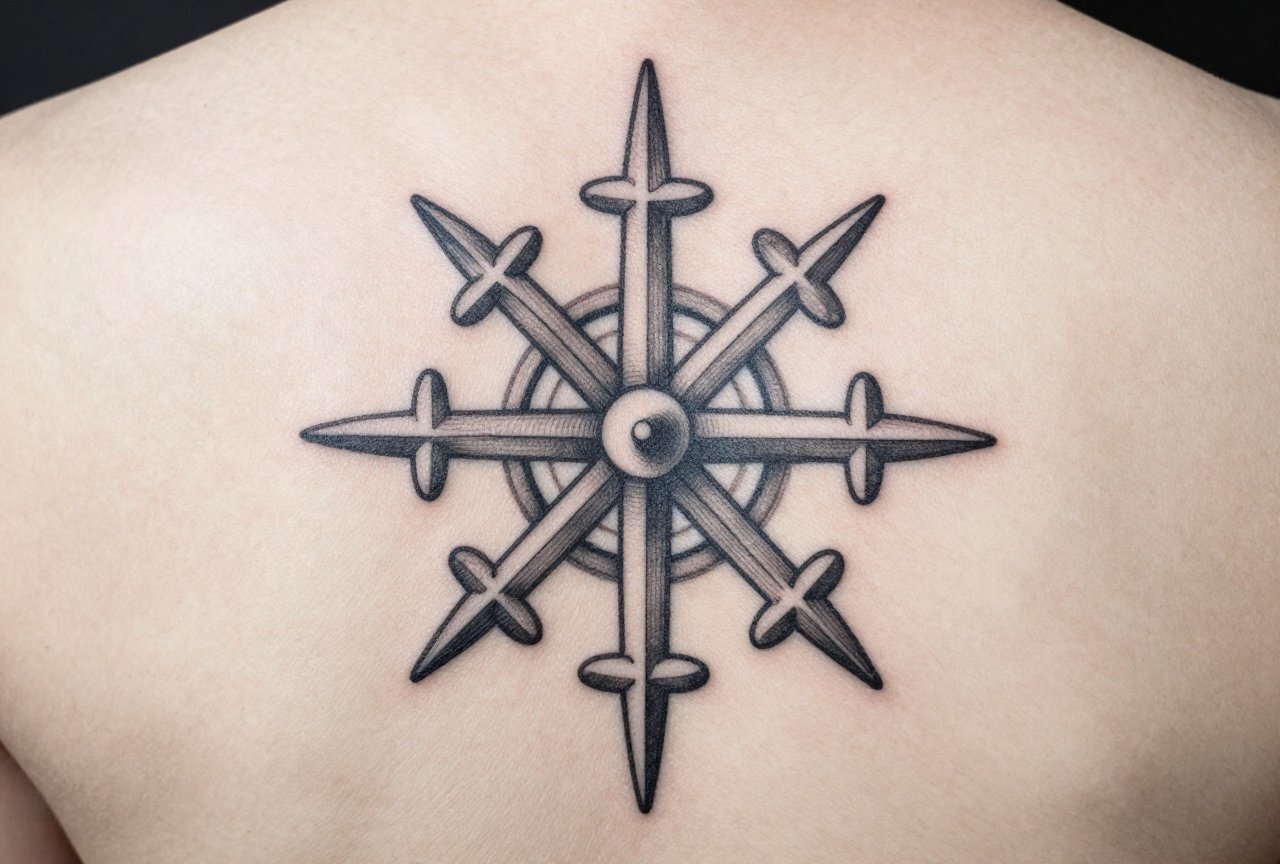
The Vegvisir is an Icelandic magical stave, think of it as a Norse compass, that traditionally helped travelers find their way through rough weather. In tattoo form, it’s become one of the most requested symbols in my shop, though most people who sit in my chair want it less for literal navigation and more as a personal reminder that they’ll figure things out even when life gets disorienting.
Symbolism & History
What the Symbol Actually Represents
The Vegvisir’s eight arms radiate outward, each ending in a distinctive rune-like point. In the Huld Manuscript from 1860, where it first appears in documented form, the description is plain: “if this sign is carried, one will never lose one’s way in storms or bad weather, even when the way is not known.” That’s it. No epic saga, no Thor connection, just a practical magical tool from Icelandic folk tradition.
I’ve tattooed this symbol on maybe forty people over the years, and the conversations always split two ways. Some come in thinking it’s ancient Viking warrior stuff. Others have done their reading and know it’s actually from the 19th century, part of a collection of Icelandic galdrastafir (magical staves). I tell clients both things can be true: the symbol isn’t millennia-old, but the cultural longing it represents, that human need for direction when you’re lost, absolutely is.
The Rune Controversy
Here’s where shop talk gets interesting. The Vegvisir isn’t technically a rune. Runes are characters from alphabets like Elder Futhark. The Vegvisir borrows rune-adjacent visual language, but it’s a stave, a constructed magical symbol. I’ve had clients get frustrated when I mention this, like I’m devaluing their choice. I’m not. The symbol’s power was always in intention, not academic pedigree. But as someone who does this for a living, I want people walking out with truth on their skin, not myth.
Common Variations & Styles
Line Work vs. Ornamental Approaches
The cleanest Vegvisir tattoos are pure black line work, single needle or tight three-round, letting the geometry speak. These age beautifully. The arms stay readable, the negative space stays crisp. I’ve seen them ten years old still looking like they were drawn yesterday.
Then there’s the ornamental route: knotwork filling the negative spaces, dotwork shading in the quadrants, sometimes runic bands circling the whole thing. These look stunning fresh. But I warn clients, fine dotwork in small spaces tends to soften and blur over time. The symbol’s already busy; adding density can turn it into a black blob if you’re not careful with scale.
- Minimalist blackwork: Fast, affordable, holds up. Best for first tattoos or people who want the meaning without the spectacle.
- Woodcut style: Heavier lines, deliberate texture. Looks like it was carved into something. Popular with guys who want something that reads masculine without being aggressive.
- With surrounding runes: Often personal names or concepts in Elder Futhark. I always double-check spelling with clients. Nothing worse than a permanent typo in a dead language.
- Compass rose fusion: Blending the Vegvisir with traditional nautical compass imagery. Works conceptually, but visually tricky, the two symbols fight for dominance if the artist isn’t careful.
Color vs. Black and Grey
Almost every Vegvisir I do is black. Occasionally someone wants red accents for protection symbolism, or blue for water/travel connection. It works, but sparingly. This symbol’s identity is in its line structure. Color doesn’t add meaning; it risks distracting from it.
Best Placements
Forearms dominate. The circular or radial nature of the Vegvisir fits the cylindrical shape of an arm perfectly. Inner forearm for personal visibility, you see it when you need reminding. Outer forearm for public statement. Both work.
Chest pieces happen, usually central, sometimes with the arms extending toward the collarbones. The sternum’s flat plane suits the geometry, though healing’s rougher there. I’ve done them on calves, thighs, ribs, behind ears. The behind-ear ones are tiny, maybe an inch, and I always warn: detail that small bleeds together eventually. The symbol becomes a suggestion rather than a readable image.
Shoulder caps work well for larger ornamental versions. The curve of the deltoid gives the radiating arms natural flow. One client, a commercial fisherman, got his on the back of his hand, visible, practical, connected to his actual navigation through actual storms. That placement made sense in a way most hand tattoos don’t.
Who Chooses This Tattoo / Personal Meanings
The Practical Seekers
These are my favorite consultations. They come in knowing the historical limitations, not caring. One woman, recently divorced, wanted it as a “reminder that I can find my own way now.” A guy in his fifties, career change, said he’d spent thirty years letting other people chart his course. The symbol’s meaning is always personal projection, and that’s valid. Every tattoo is autobiography in some form.
The Heritage Connection
Icelandic descendants, Scandinavian Americans, people with DNA test results and new curiosity. Some bring family stories. Others bring vague northern European vibes and a Pinterest board. I don’t gatekeep the symbol, it’s not closed practice material, but I do ask what it means to them specifically. “I like Vikings” gets a different conversation than “my grandmother spoke Icelandic.”
The Spiritual But Not Religious
We see this a lot. People who’ve left organized faith but want something that feels like protection, guidance, intention. The Vegvisir slots in neatly: culturally specific enough to feel grounded, symbolically flexible enough to accommodate individual belief. I’ve had atheists get it as pure metaphor, pagans as actual working magic, Christians who see parallels to divine guidance. The symbol holds all of it without contradiction.
Similar Symbols
Clients often confuse the Vegvisir with the Ægishjálmur (Helm of Awe), another Icelandic stave. The Helm has eight arms too, but they’re trident-shaped, radiating from a central point with protective rather than navigational intent. Visually distinct once you know, but easy to mix up in online image searches. I’ve had people come in wanting one, show me a picture of the other. We sort it out.
The actual Norse sun compass is different too, historical artifact, not magical symbol. Found on a wooden disc in Greenland, used for determining latitude by shadow. Some tattoo artists combine it with the Vegvisir, which is historically inaccurate but visually compelling. I mention the anachronism; clients usually don’t care.
Compass roses, Celtic knotwork, even mandalas get compared. The Vegvisir’s specific geometry, those alternating long and short arm terminals, the way the points don’t quite touch the circle, gives it identity. Good artists recognize it instantly. Bad ones trace something close enough and hope nobody notices.
Final Thoughts
I’ve watched the Vegvisir surge in popularity over fifteen years of tattooing. It rode the wave of Nordic interest, survived the peak of Viking TV show aesthetics, and settled into something more durable: a genuinely useful symbol for people who feel unmoored. Not everyone who gets it knows the Huld Manuscript. Not everyone needs to. The meaning lives in the wearing.
What I respect is the sincerity. When someone sits in my chair and explains why this particular arrangement of lines matters to them, I’m reminded that tattooing isn’t really about history or accuracy. It’s about marking a moment of decision, a commitment to direction. The Vegvisir does that job exceptionally well. Storms come. We all need something that helps us believe we’ll find through.
If you’re considering one, do your reading, find an artist who understands the geometry, and know why it’s yours. The rest is just ink and time.
Frequently Asked Questions
Is the Vegvisir actually a Viking symbol?
Not exactly. It first appears in the Huld Manuscript from 1860, long after the Viking Age ended. It’s an Icelandic magical stave, not an ancient rune, though it draws on Norse cultural traditions.
Does the Vegvisir need to be a certain size to work as a tattoo?
I recommend at least two inches in diameter for clean line work. Smaller than that, and the fine details blur together within a few years. Ornamental versions need even more room to breathe.
Can I add runes around my Vegvisir?
Absolutely, but verify your spelling carefully. Elder Futhark has no standardized dictionary, and transcription errors are common. Work with someone who knows the runes, not just the alphabet.
Will a Vegvisir tattoo look dated in ten years?
The minimalist blackwork versions age gracefully. Trendy ornamental styles or heavy dotwork may feel period-specific. Stick to clean geometry if you want longevity over current fashion.









