
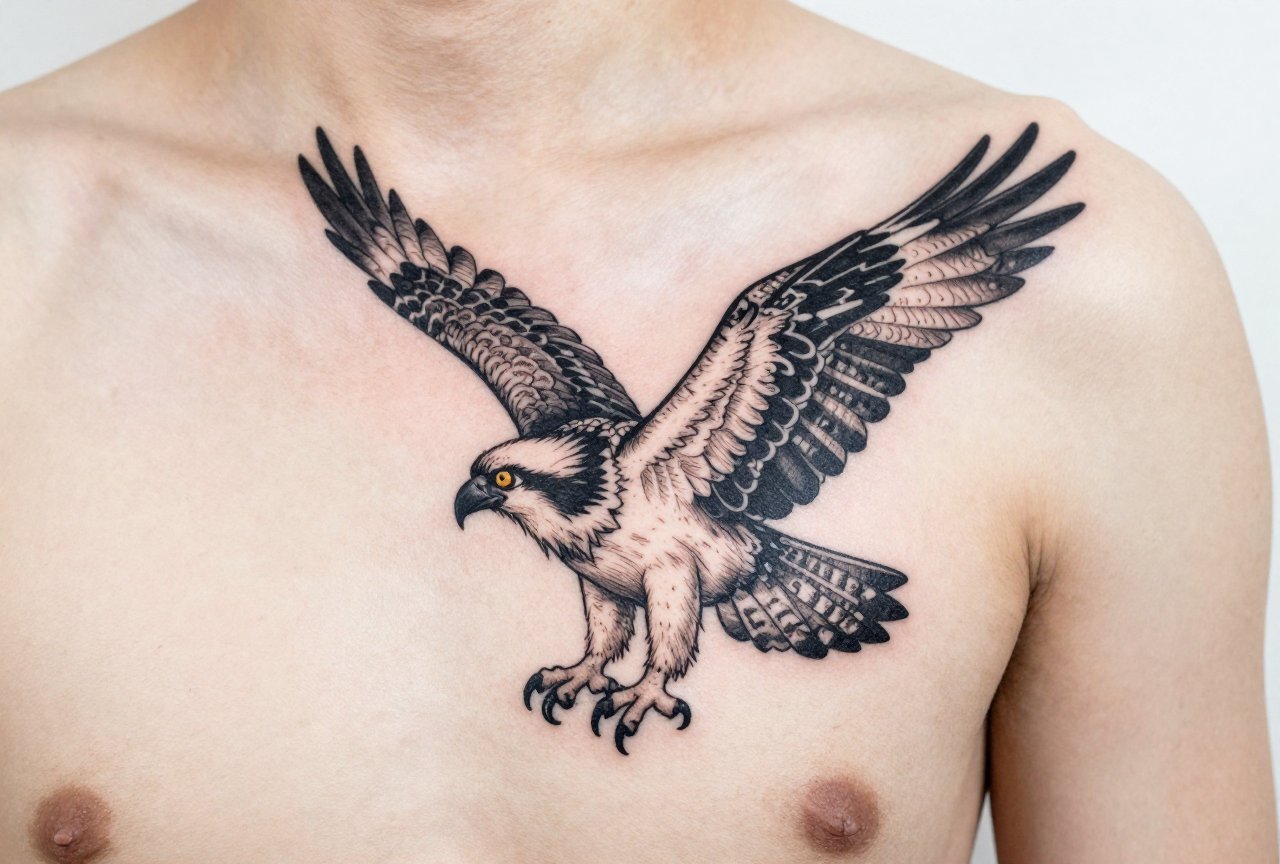
Osprey Bird Spirit Tattoo Meaning: Power, Focus, Freedom
The osprey commands attention without demanding it. Alone among raptors, this bird survives almost entirely on live fish, plunging feet-first into water with a precision that seems almost impossible. For anyone drawn to this tattoo, the appeal usually begins with that singular image: wings folded, eyes locked on target, disappearing beneath the surface and emerging with what it came for. The meaning layers from there.
Key Characteristics
Visually, the osprey offers tattoo artists remarkable material. Its wingspan creates dramatic horizontal compositions; the head, with its dark eye stripe against white crown, reads clearly even at smaller scales. The reversible outer toe, unique among birds of prey, lets ospreys grip fish with two toes forward and two back. Artists sometimes emphasize this anatomical oddity, though most focus on the broader silhouette of the dive.
What Distinguishes It from Eagles and Hawks
Confusion with the bald eagle happens constantly, and understandably so. Both share white heads, dark bodies, and fishing habits. Yet the osprey carries distinct markers worth knowing before you commit to design. The wings show a pronounced crook at the wrist in flight, creating an M-shape against the sky. The plumage underneath appears largely white, not mottled. These details matter for accuracy, but they also affect composition. An osprey tattoo tends to read as more angular, more kinetic, than the broad-chested stillness of an eagle.
Color palettes range from full realism to stark blackwork. The natural contrast of dark brown against white lends itself to bold graphic treatments, while the iridescent quality of the upperwing feathers rewards careful color work. Some artists push the fish-grasping talons forward, turning the bird’s hunting method into the central visual event.
History & Cultural Roots
Recognition of the osprey stretches across remarkably disconnected cultures, though specific attributions vary significantly. In ancient Rome, the bird was often linked to auspicious signs and divine favor, appearing in texts concerned with omens and natural prophecy. Medieval European falconry treatises sometimes grouped the osprey with fish hawks, noting its training difficulties but respecting its specialized skill.
Indigenous North American Associations
Among several Pacific Northwest Coast peoples, the osprey appears in crest art and oral traditions, though less prominently than the thunderbird or raven. Its role tends to emphasize keen sight and successful pursuit rather than the cosmic power of more mythologically central birds. This relative modesty can actually suit tattoo wearers who want spiritual resonance without claiming grandiose symbolism.
Certain Southeast Asian traditions also recognize fish-eating raptors in protective or boundary-guarding contexts. The exact species in these references remains uncertain in many cases, scholars note, since regional terminology often grouped similar birds together. What persists is the association between aerial mastery, water penetration, and the successful crossing of elemental boundaries.
Common Variations & Styles
The dive remains the most requested composition, and for sound reason. The folded-wing posture generates immediate visual tension, the body becoming a projectile rather than a glider. Artists handle this differently by tradition: Japanese-influenced work might elongate the body and exaggerate the talon spread; neo-traditional approaches favor bold outlines and limited but saturated color fields; blackwork specialists exploit the strong value contrast between the osprey’s dark back and pale underside.
Alternative Compositions
- Perched with prey: The bird on a branch or post, fish still writhing, captures aftermath rather than action. This suits placement where horizontal spread is limited.
- Skull integration: Some designs merge the osprey with fish skulls or skeletal elements, playing on the predator’s complete dependence on aquatic prey. The effect can read as memento mori or ecological commentary.
- Geometric abstraction: Breaking the wing structure into angular planes or sacred geometry patterns has gained traction, though this risks losing the bird’s essential recognizability.
- Nest and young: Rare but emotionally potent, showing the osprey’s substantial stick constructions with chicks visible below.
Water rendering varies enormously. Some artists treat the splash as negative space, others as detailed foreground element. The moment of entry, with water surface tension just breaking, offers particular sculptural challenge and reward.
How It Ages on Skin
The osprey’s graphic strengths translate well to longevity, with important caveats. The strong dark-and-light pattern holds definition better than subtler avian subjects. The eye stripe, in particular, tends to remain readable even as finer details soften. Problems emerge when designs overreach on scale or complexity.
What Holds and What Fades
Small osprey tattoos, especially those attempting detailed feather texture, suffer predictable degradation. Individual barbs blur together; the bird’s distinctive shape becomes generic raptor. Conversely, the bold silhouette of a diving osprey, even at moderate size, maintains impact through years of sun exposure and skin change.
Color work on the yellow iris and ceres (the fleshy base of the beak) demands careful pigment selection. These warm accents sit against cool water backgrounds in many designs, and cheaper yellows can shift muddy. The white head feathers, rendered as negative space or very light gray, sometimes discolor toward skin tone over time, reducing the head’s striking contrast.
Placement on frequently flexed areas, the inner bicep or ribs, can distort the diving posture in ways that undermine its aerodynamic logic. The bird’s power comes from its streamlined form; warping that form through anatomical movement weakens the design’s essential impact.
Best Placements
The horizontal dive naturally suits the chest, upper back, and outer forearm. On the chest, the bird can descend toward the sternum, fish emerging toward the solar plexus. The upper back allows full wingspan display, though this requires substantial space to avoid crowding. Forearm placement works best when the dive angle follows the natural taper of the limb, wrist to elbow.
- Thigh: Ample space for water splash detail below, the dive reading as downward into the leg’s mass.
- Side torso: The body’s curve can echo the wing fold, though this demands careful custom drawing rather than stencil application.
- Calf: Less common but effective for perched compositions, the vertical muscle structure supporting upright posture.
Hand and finger placements generally fail this subject. The osprey’s impact depends on scale and context; reducing it to knuckle size sacrifices everything distinctive. Neck placement can work for experienced collectors with established coverage, but the bird’s fishing association may read unexpectedly in professional contexts.
Similar & Related Symbols
Understanding adjacent symbols helps clarify whether the osprey specifically serves your intention, or whether related imagery might communicate more precisely.
Birds of Prey Comparisons
The bald eagle carries heavier national and patriotic loading, especially in American contexts. Its symbolism tends toward dominion and authority rather than the osprey’s specialized competence. The peregrine falcon shares the dive association but emphasizes speed over calculated water entry. Hawks and harriers, more generalized hunters, lack the osprey’s elemental boundary-crossing, its movement between air and water.
Among non-raptors, the kingfisher offers interesting parallel: similar fishing method, smaller scale, different cultural associations, often linked to patience and domestic tranquility rather than power and focus. The cormorant, another fish-diver, carries more ambiguous symbolism across cultures, sometimes associated with servitude or deception.
Marine imagery frequently accompanies osprey tattoos: waves, specific fish species, coastal landscapes. The combination can specify geography, personal history, or ecological commitment. Some wearers pair the bird with fishing implements, creating personal narrative about pursuit and provision. Others keep the bird isolated, letting its self-sufficiency speak without elaboration.
Final Word
The osprey tattoo rewards those who respect its essential nature: a bird that does one thing spectacularly well, that cannot survive through generalization or compromise. Its meaning of power, focus, and freedom emerges not from mythology’s grandest claims but from observable behavior, the daily demonstration of precision under pressure. Whether rendered in meticulous realism or stripped to essential silhouette, the design succeeds when it preserves that core identity, the bird that enters water as confidently as air and returns with what it sought.
Frequently Asked Questions
What does an osprey tattoo symbolize?
The osprey primarily symbolizes focused power, hunting precision, and the freedom to move between elements, air and water. Its meaning centers on the bird’s unique survival strategy: complete specialization rather than general capability. For many wearers, this translates to personal commitment, the discipline of pursuing one thing with total dedication.
How do I make sure my osprey tattoo doesn’t look like an eagle?
Request specific anatomical markers from your artist: the pronounced wrist crook creating an M-shaped wing silhouette in flight, the largely white underwing rather than mottled pattern, and the dark eye stripe against the white crown. The reversible toe structure, with two talons forward and two back when gripping fish, also distinguishes the osprey if your design includes prey.
Does an osprey tattoo need color to work?
Black and gray handles this subject exceptionally well due to the bird’s natural high contrast. The dark back against white head and underparts reads clearly without color. If you do add color, focus on the yellow eye and ceres, but ensure your artist uses stable pigments, as warm accents against cool backgrounds are prone to shifting over time.
What size works best for an osprey tattoo?
The diving posture requires enough space to show the folded-wing aerodynamics without distortion. As a general guideline, the body alone should be at least palm-sized for basic silhouette recognition, with additional space for water splash or prey elements. Smaller designs tend to lose the distinctive wrist crook and read as generic birds of prey.









