Similar & Related Symbols
The equal sign stands within a broader family of marks that communicate balance, fairness, and connection. Understanding these neighbors helps clarify what the equal sign does, and does not, represent.
Mathematical and Logical Kin
The tilde (~), meaning “approximately equal,” carries a softer, more flexible energy. The equivalence sign (≡) suggests identity rather than mere equality, two concepts that diverge in philosophy but converge in tattoo culture. The plus-minus sign (±) embraces contradiction, something the equal sign refuses. For those drawn to mathematical precision, these alternatives offer nuance without abandoning the clean visual language of symbols.
Social Movement Marks
The raised fist, the rainbow flag, the peace sign, and the interlocking male-female symbols all occupy adjacent territory. Each carries heavier historical baggage than the equal sign, which often reads as quieter, more personal. The Human Rights Campaign’s yellow equal sign on blue remains one of the most recognizable adaptations, though many choose stripped-down versions precisely to avoid organizational affiliation. The ampersand (&), meaning “and,” functions as a gentler connector, less about equivalence than accompaniment.
- The infinity symbol (∞) suggests endlessness rather than balance
- The balance scale evokes justice systems specifically
- The yin-yang embodies dynamic opposition, not sameness
What to Expect
Getting an equal sign tattoo typically involves less time under the needle than most designs, but this brevity deserves respect, not underestimation.
Session Dynamics
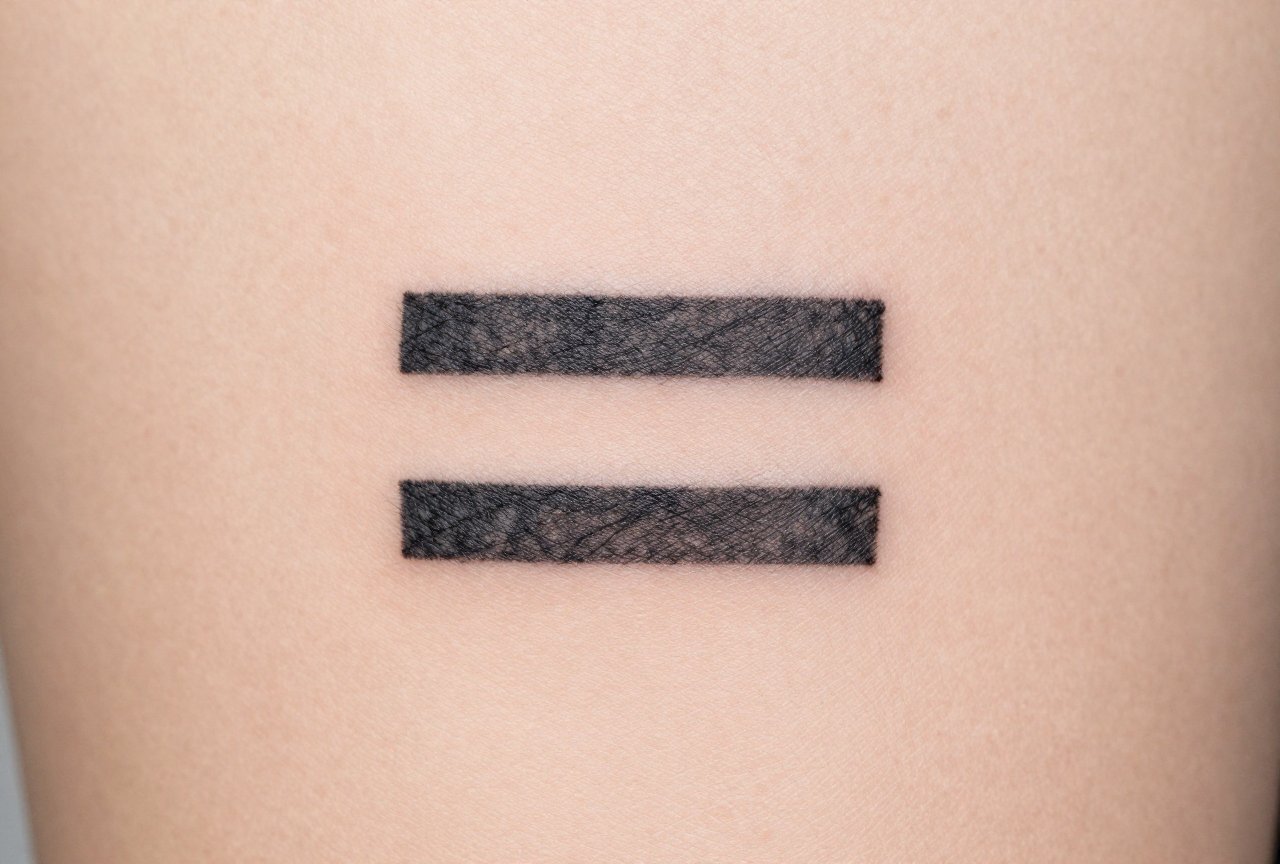
Two parallel lines, whether horizontal or vertical, require steady handwork. The artist must maintain consistent spacing and clean edges; there is nowhere to hide a wobble. Most pieces finish in under an hour, sometimes twenty minutes. The sensation concentrates in a small area, which some find more intense than dispersed work. Numbing cream remains an option, though many artists prefer working on unmedicated skin for fine lines.
Healing Considerations
Simple geometry heals straightforwardly. The equal sign lacks the color saturation that complicates recovery, and its small scale reduces scabbing surface area. Expect the lines to settle over four to six weeks. During this window, the tattoo may appear slightly raised or shiny; this normalizes. Sun exposure poses the primary long-term threat to crisp edges, making sunscreen application non-negotiable for placement on exposed skin.
Choosing the Right Artist
Minimalist work demands maximal skill. The equal sign’s simplicity functions as a trap for inexperienced hands; without ornamentation, every imperfection broadcasts clearly.
Seek portfolios heavy in linework, geometric precision, and single-needle technique. Look for healed photos specifically, not just fresh work. Crisp edges in a one-year-old tattoo indicate an artist who understands depth, ink saturation, and skin type variation. Ask directly about their experience with mathematical or symbolic tattoos; this niche requires different concentration than illustrative pieces.
Consultation matters even for small designs. Discuss line weight preferences, whether you want hairline delicacy or bolder presence. The gap between the two lines, usually one to three line-widths, dramatically affects visual weight. A skilled artist will propose adjustments based on your skin’s undertone and the specific placement’s movement patterns.
- Request to see healed examples of parallel-line work
- Discuss how the design will age with skin changes
- Confirm the artist’s comfort with your stated meaning
Common Variations & Styles
The basic structure invites modification without losing recognizability. These adaptations allow personal expression while maintaining the core symbol’s immediate readability.
Structural Modifications
Vertical orientation transforms the equal sign into a pause or parallel path, less common but increasingly chosen for wrist or finger placement. Adding a third line creates the “identical to” symbol (≡), shifting meaning toward sameness rather than equivalence. Breaking one line, or adding subtle curvature, introduces imperfection as a deliberate aesthetic. Some choose to embed the equal sign within larger compositions, its lines forming part of a word, a heartbeat, or abstract geometry.
Stylistic Approaches
Traditional tattooing renders the equal sign with slight weight variation, giving it vintage authority. Dotwork or stippling softens the edges, creating a glow rather than a hard boundary. Watercolor backgrounds behind crisp equal lines juxtapose chaos and order. Negative space versions, where the lines remain skin-colored within a dark field, invert expectations dramatically. Blackwork saturation makes the symbol monumental; single-needle execution whispers it.
Mythology & Folklore
The equal sign lacks ancient mythological roots, its invention credited to Welsh mathematician Robert Recorde in 1557. Yet symbols outgrow their origins, and this one has accumulated cultural resonance that functions similarly to folklore.
Historical Emergence
Recorde chose two parallel lines because “no two things can be more equal.” The symbol spread slowly, competing with other equality notations for centuries before standardizing. This gradual adoption mirrors how tattoo meanings layer: mathematical origin, then social application, then personal significance. The symbol’s relatively recent birth means it carries less colonial or religious baggage than many alternatives, a neutrality some find liberating.
Contemporary Mythmaking
In tattoo culture, the equal sign has become associated with specific communities and moments: marriage equality campaigns, gender rights movements, personal recovery narratives. These associations function as modern folklore, stories passed between wearers and observers without formal documentation. The symbol’s adoption by celebrities and activists accelerated this mythologization, though individual tattoos always exist apart from public figures. What persists is the symbol’s chameleon quality, its ability to mean partnership, mathematical truth, social justice, or self-acceptance depending on context.
Best Placements
The equal sign’s compact geometry suits numerous locations, each carrying different visibility and intimacy implications.
Visible Declarations
Wrist placement dominates, particularly the inner wrist where the symbol faces the wearer. Finger tattoos, especially along the side of a finger or between knuckles, read as quiet but constant presence. Behind the ear offers partial concealment, the symbol revealed only with certain hairstyles. The forearm, particularly the inner surface, provides enough space for slightly larger scale without becoming aggressive.
Private Locations
Ribcage placement protects the symbol under clothing, shared only by choice. The ankle or foot, while technically visible, often escapes notice in daily interaction. Some choose the chest, near the heart, for romantic or identity-based meanings. The back of the neck, covered by hair or collar, offers similar selective revelation. Consider how aging affects each area: wrist skin thins and moves constantly; ribcage skin stretches with breathing and body changes.
- Inner bicep: personal visibility, easy to conceal
- Collarbone area: elegant horizontal alignment with the symbol
- Alongside existing tattoos: integration into larger narrative
Before You Decide
Living with a symbol of equality requires examining your relationship to that concept. The tattoo will prompt questions, assumptions, and conversations you do not control. Some will interpret it as political statement regardless of your intent; others will assume personal narrative you may not wish to share. The symbol’s very clarity, its resistance to decorative distraction, means it speaks before you do.
Consider timing. Getting this tattoo during or immediately after significant life events, whether joyful or traumatic, can layer meanings that complicate later reflection. The equal sign’s simplicity tempts impulsive decision-making; its permanence demands otherwise. Spend time with the symbol drawn on your skin in marker, observing how it feels across different days and social contexts.
Meaning need not be fixed. The equal sign can honor a relationship today, a principle tomorrow, a remembered self in years to come. What matters is choosing it with full awareness of this fluidity, not despite it. The best equal sign tattoos belong to people who have made peace with ambiguity, who wear the symbol not as explanation but as invitation, to conversation, to reflection, to continued becoming.
Frequently Asked Questions
Does an equal sign tattoo always mean LGBTQ+ pride?
Not necessarily. While the symbol is widely recognized from marriage equality and human rights campaigns, many wearers choose it for mathematical appreciation, relationship partnership, or broader philosophical meanings around balance and fairness. Context and placement often suggest intent, but the symbol’s meaning ultimately depends on the individual.
How much does an equal sign tattoo typically cost?
Small, simple equal sign tattoos usually fall at the lower end of studio minimums, often because they require minimal time. However, pricing varies significantly by location, artist reputation, and specific technique. Highly skilled artists specializing in precise linework may charge more for the expertise required to execute clean, lasting parallel lines.
Will an equal sign tattoo blur or fade quickly?
Like all fine-line tattoos, the equal sign is vulnerable to spreading over time, particularly if placed on high-movement areas or executed with insufficient depth. Choosing an experienced artist, protecting the tattoo from sun exposure, and maintaining healthy skin all extend crispness. Bold lines generally age better than hairline versions.
Can I combine an equal sign with other symbols or text?
Absolutely. Common integrations include incorporating the equal sign into longer words, pairing it with dates or initials, or embedding it within geometric patterns. The symbol’s clean geometry makes it adaptable, though overcomplication can dilute its immediate recognizability. Discuss compositional balance with your artist during consultation.