
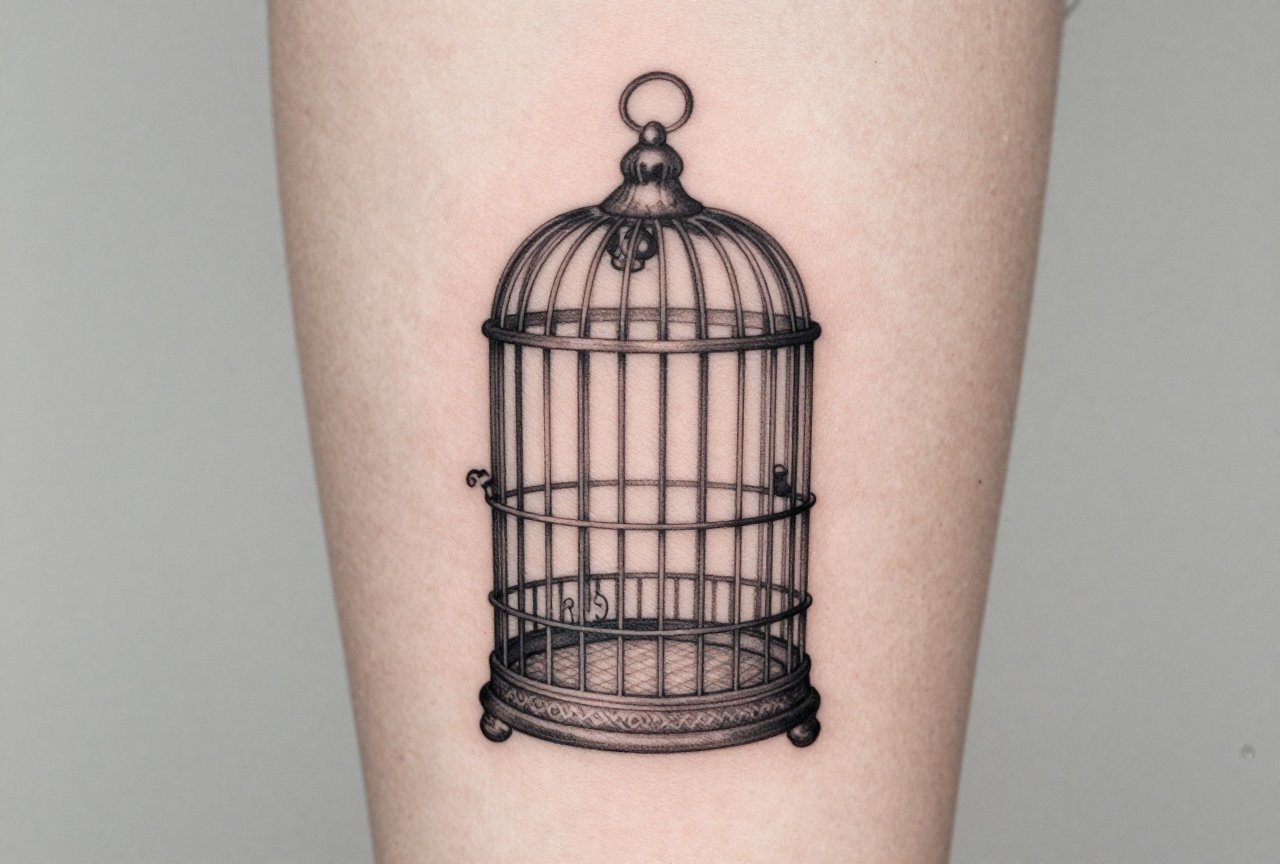
A bird cage tattoo carries layered meaning: the cage itself speaks to confinement, while the bird, inside, escaping, or absent entirely, changes the story. I’ve tattooed this design on ribs, forearms, and behind ears, and every client brings a different reading. Some see liberation. Others mourn what they’ve lost. The image is old, flexible, and deeply personal.
Symbolism & History
The bird cage has been a visual symbol for centuries, showing up in Victorian mourning jewelry, political cartoons, and religious art. In tattooing, it gained traction during the early 2000s alongside the rise of “neo-traditional” and illustrative styles, though I’ve seen flash versions dating back to the 1970s in old shop collections.
Freedom vs. Captivity
This is the core tension. A bird flying from an open cage reads as liberation, breaking free from addiction, a relationship, a job, a self. I’ve done this on clients leaving prison, leaving marriages, leaving hometowns. The cage door matters: open suggests possibility, closed suggests ongoing struggle. A bird still inside the cage can mean resilience, patience, or the feeling of being watched and contained. One client told me, “I’m still in it, but I know what outside looks like now.” That stuck with me.
Absence and Loss
An empty cage hits different. No bird at all. I’ve tattooed this for parents who’ve lost children, for people after breakups where the other person was the one who “got away.” The negative space does the emotional work. It’s quieter than a memorial portrait, less explicit. Some clients add a single feather falling, or a perch with claw marks. Those details aren’t decorative, they’re the actual story.
Common Variations & Styles
The design adapts across tattoo languages. Here’s what works and what I’ve seen age poorly.
- Neo-traditional: Bold lines, limited color palette, decorative filigree on the cage bars. Holds up well. The heavy line weight prevents blurring over time.
- Blackwork/dotwork: Fine stippled shading, geometric cage structures. Stunning fresh, but I’ve seen the dots spread and soften after five years on high-movement areas like wrists. Placement matters.
- Watercolor: Bird in color, cage in black and grey. The contrast is striking. I warn clients: watercolor fades faster, and the bird, the emotional focal point, can become muddy if not reinforced with line.
- Minimalist/line: Single needle, delicate. Popular on collarbones and ankles. Ages poorly if too small. I’ve had to thicken lines on touch-ups where the cage bars disappeared into skin texture.
- Realistic: Photographic bird, ornate Victorian cage. Heavy detail, longer sessions. The bird’s eye is everything, if it looks alive, the whole piece works.
Adding elements changes meaning: a key (who holds it?), a lock (broken or intact?), flowers growing through the bars (beauty in confinement, or nature reclaiming?). I once tattooed a cage with a clock face for the base, time as the prison. The client was a nurse, burnt out. She didn’t need to explain.
Best Placements
Where this goes on the body affects how the story reads.
Visible vs. Hidden
Forearm or wrist: the cage is a statement, a conversation starter. I’ve had clients who want it seen, survivors of domestic violence who want the visible proof of leaving. Ribs or hip: private, intimate. Often for grief that doesn’t need explaining to strangers. Behind the ear: small, personal. The bird escaping upward toward the hairline is a common request; it reads as thoughts getting free.
How Placement Ages
Cage bars are parallel lines. On skin that stretches and moves, inner bicep, stomach, thighs, those lines can warp. I’ve seen perfectly straight bars become wobbly after weight fluctuation. For cage designs, I prefer flatter, more stable areas: outer forearm, calf, upper back. If someone insists on ribs, I simplify the bar structure so minor spreading doesn’t ruin the geometry.
Skin type matters too. On darker skin, I often recommend heavier black in the cage and strategic negative space for the bird rather than relying on light colors that can heal ashy. It’s not about limitation, it’s about making the symbol readable for decades.
Who Chooses This Tattoo / Personal Meanings
After fifteen years in shops, I can tell you the “type” doesn’t exist. I’ve tattooed bird cages on a 19-year-old leaving a religious household and a 67-year-old widower. On a former prisoner and a corporate lawyer. The meaning is in the specifics they bring.
- Addiction recovery: The cage is the substance, the bird is the self re-emerging. Often paired with dates or “one day at a time.”
- Relationship endings: Sometimes the cage was the relationship; sometimes the bird was the partner who left. The same image holds opposite griefs.
- Mental health: Anxiety as cage, or depression as the bird that stopped singing. I’ve had clients who couldn’t articulate it until they saw the sketch.
- Creative blocks: Writers and musicians who feel their voice trapped. The open door is permission to make something again.
What I tell clients: the meaning doesn’t need to be legible to anyone else. I’ve seen couples get matching cage tattoos where one has the bird inside, one has it escaping, both true to their experience of the same marriage. That’s the power of the symbol. It holds contradiction.
Similar Symbols
Clients often arrive considering related imagery. Here’s how I talk them through the differences.
- Single bird (no cage): Pure freedom, less complexity. Good for straightforward narratives. Loses the tension that makes the cage design resonate.
- Anchor: Stability, holding ground. Opposite energy. I’ve had people combine cage and anchor, stuck but not drifting, which is its own kind of truth.
- Key: Solution, access, secrecy. Pairs with cage as “finding the way out” or “who locked it?”
- Feather: Lightness, spirit, often memorial. A fallen feather near a cage can mean the bird didn’t survive the escape, or that freedom has a cost.
- Barbed wire: More aggressive confinement, less poetic. I steer people toward cage imagery when the struggle has an internal or emotional quality rather than purely physical.
Some clients mash these together: cage with feather, key with bird. It works when the elements are in visual balance. I usually sketch three versions, minimal, moderate, maximal detail, and let them feel which one carries their weight.
Final Thoughts
The bird cage tattoo endures because it’s a frame, not a fixed statement. It asks the question rather than answering it. Are you trapped? Have you escaped? Did you leave something behind? In my chair, I’ve watched people cry looking at the stencil, relief or grief or both. The tattoo doesn’t create the meaning, they bring it. The image just gives it shape.
If you’re considering this design, bring reference but also bring your own specifics. What kind of bird? What state is the door in? Is the cage rusted, ornate, broken? Those choices aren’t aesthetic preferences. They’re the story. A good artist will listen and translate. The best ones will ask what you haven’t said yet.
Frequently Asked Questions
Does it matter what kind of bird I choose for the design?
Yes, different birds carry different weight. A sparrow or swallow traditionally connects to sailors and return; a raven suggests darker themes; a songbird might represent voice or creativity. I ask clients what bird they actually see, not what they think should be there. The personal association matters more than textbook symbolism.
Will a bird cage tattoo look blurry or spread over time?
Fine parallel lines can soften, especially on high-movement areas. I recommend slightly thicker line weight than you might want initially, and stable placements like outer forearm or calf. Touch-ups every few years keep the bars crisp. Black and grey ages more predictably than heavy color.
Is an empty cage too depressing for a tattoo?
Not in my experience. Clients who choose empty cages usually want to honor absence without spectacle. It’s quieter than a name or date. The feeling is more contemplative than tragic. I’ve never had someone regret it, they tend to be the most certain clients in my chair.
Can I combine a bird cage with other elements without making it cluttered?
Absolutely, but restraint matters. I usually suggest one or two additional elements maximum, placed so they interact with the cage rather than float nearby. A key hanging from the door latch works. A key, a banner, flowers, and a clock don’t. Negative space is your friend here.
Related Tattoo Meanings
- Bluebird Tattoo Meaning: Hope, Happiness Home
- Hydrangea Tattoo Meaning: Emotion, Gratitude Change
- Meaningful Moon Stars Tattoo Meaning: Symbolism What It Means
- Explore more









