
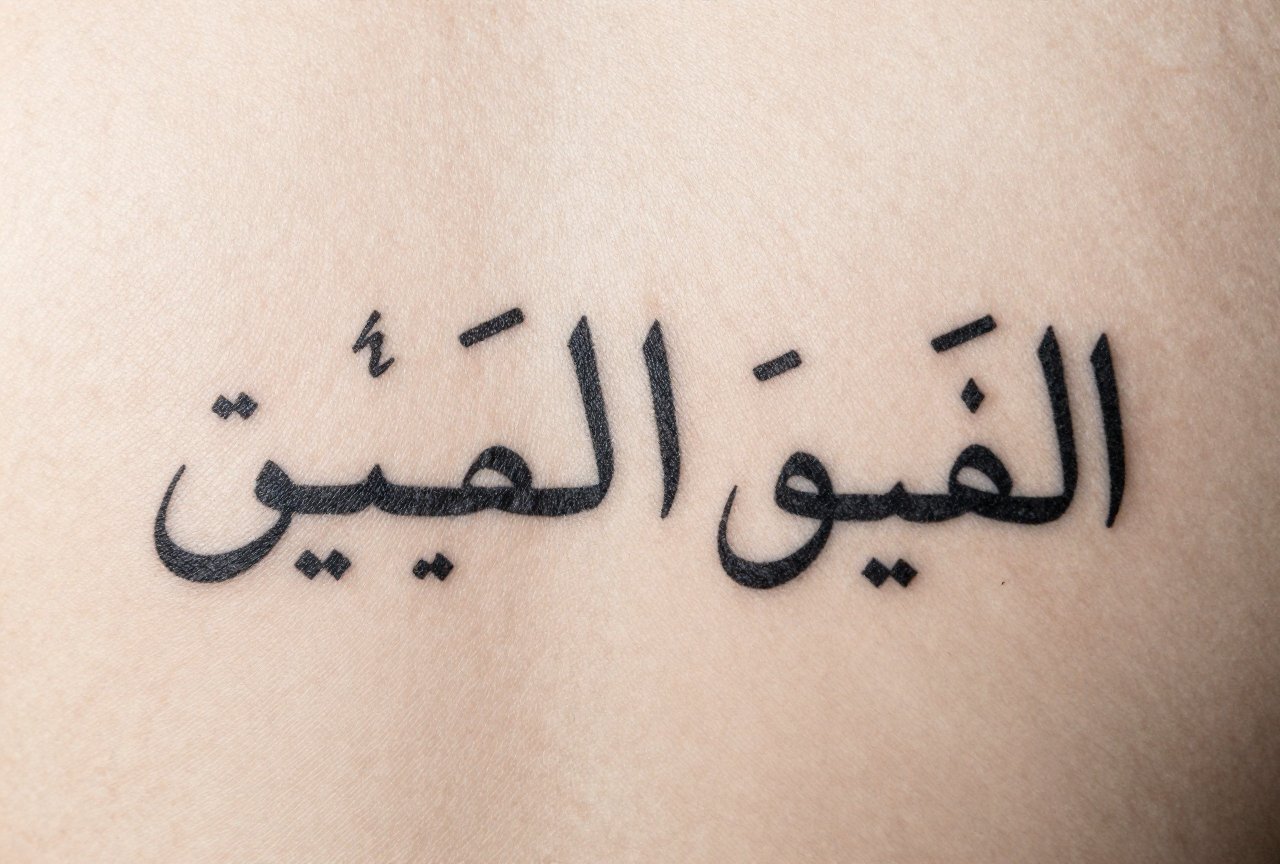
Arabic word tattoos are inscriptions in the Arabic script that hold personal, spiritual, or philosophical significance for the wearer. The flowing, connected letters create visually striking designs that wrap around limbs or sit quietly on skin like whispered secrets. You will see these on converts to Islam who want their shahada visible, and on people simply drawn to the script’s beauty.
Symbolism and History
The Arabic script itself carries weight beyond whatever word you choose. Its development from Nabataean and related scripts is often linked to the 4th through 6th centuries CE, and it became inseparable from the Quran’s transmission. That religious association lingers in every curve, even when the word is secular.
Religious and Spiritual Weight
Allah, Muhammad, al-salam (peace), sabr (patience), tawakkul (trust in God): these dominate requests in most shops. The letters often flow upward by request, like aspiration. The script becomes a compass, a reminder that lives on skin longer than phone lock screens.
Non-Muslims sometimes want these too, and that is where shop conversations get real. You should ask yourself: do you understand what you are carrying? The script is not mere decoration. It is loaded history.
Calligraphic Traditions
Arabic calligraphy has several classical styles. Thuluth’s tall verticals work well for forearms. Naskh’s readability suits smaller pieces. Diwani’s dense loops are beautiful but risky at small sizes; they blur after a few years. That Instagram photo of intricate Diwani was fresh. Consider how it will look at year five.
Common Variations and Styles
Not all Arabic word tattoos look alike. The style changes the meaning’s feel.
- Classical calligraphy: Formal, respectful, often religious. Think mosque walls on skin. Clean lines, deliberate spacing.
- Modern minimalist: Single words, thin lines, sometimes disconnected letters for aesthetic effect. A word for love in hairline script on a collarbone. Fragile, intimate.
- Integrated designs: Words woven into geometric patterns, flowers, or abstract shapes. A word for mother inside a rose stem, the thorns becoming letter strokes.
- Blackwork versus stipple: Solid filled letters versus dot shading. Stipple softens the script, makes it feel ancient, archaeological.
Some clients bring their grandmother’s handwriting. Others bring Google Translate, and any experienced artist will suggest verification with a native speaker. There are stories of “salad” instead of “peace” because of one dot misplaced. Good shops keep an Arabic-speaking artist on referral for this reason.
Best Placements
Arabic script flows right-to-left, which affects how it sits on the body.
Vertical and Curved Spaces
The spine reads beautifully, words descending like a prayer. Inner forearm: you see it when writing, when reaching. That is active placement. Rib pieces follow the bone’s curve naturally, though the ribs compress and expand, so artists warn clients: breathing moves the tattoo during healing. Be careful with tight wraps.
Size and Aging Reality
Arabic’s dots and diacritical marks are detail work. Below two inches, they disappear into skin blur within five years. A tiny “sabr” on a wrist looks beautiful at month one. At year three, the dots may merge into a smudge. Most experienced artists now say: go bigger than you think, or lose the dots and accept ambiguity. Some clients prefer that; mystery becomes part of the meaning.
Neck and hand placements are bold. Visible Arabic script in Western countries carries assumptions, especially post-2001. Most artists will not discourage, but will ask: are you ready for conversations? For misreadings?
Who Chooses This Tattoo and Why
Three broad groups typically seek this work.
- Heritage reclaimers: Second or third-generation immigrants who never learned Arabic properly. The tattoo becomes education, defiance, reconnection. A word for roots for a Lebanese-American woman who was mocked for her accent as a child. The chair becomes emotional space.
- Spiritual seekers: Converts, those curious about Sufism, people who found peace in Islamic practice. They often want protection, reminders, commitments made visible.
- Aesthetic choosers: Drawn to the script’s beauty, sometimes ignorant of context. The conversation matters. Sometimes they learn and still want it. Sometimes they pivot. Either way, informed consent matters.
Personal meanings witnessed in shops: a father’s name after his death, a child’s name in a new parent’s handwriting, a divorce date in numerals as reclamation, the word “enough” after leaving abuse. The script holds whatever you pour into it.
Similar Symbols to Consider
Clients considering Arabic words often look at related options.
- Hebrew script tattoos: Similar religious weight, similar calligraphic beauty, different cultural reception. Hebrew’s revival as a spoken language adds political complexity some wearers do not anticipate.
- Sanskrit or Devanagari: Om, mantras, names of deities. Often chosen for yoga or spiritual connection. Same script-beauty appeal, same risk of mistranslation.
- Chinese or Japanese characters: The classic cautionary tale. Too many “strength” tattoos that actually say “soy sauce.” Arabic has better structural safeguards; connected script is harder to fake, but verification still matters.
- Geometric Islamic patterns: Girih tiles, arabesques. Avoids literal meaning while keeping cultural connection. Ages better, no translation needed.
Some clients switch from Arabic words to geometric patterns after realizing they cannot read what they would carry. The pattern still evokes the tradition without claiming fluency they do not have.
Before You Decide
Arabic word tattoos sit at a crossroads: aesthetic and ancestral, spiritual and political, permanent and evolving. The script carries more than dictionary definitions. It carries empire and resistance, prayer and poetry, colonization and reclamation. What you inscribe becomes part of that living history.
The best pieces are not the most technically perfect. They are the ones where the wearer knows exactly why those curves belong on their particular skin. Get it verified. Get it sized right. Get it for reasons that hold up at 3 AM when you cannot sleep and your tattoo is the only thing visible in the dark.
The meaning is not in the word alone. It is in the choosing, the carrying, the conversation between body and language that lasts until the ink fades or the skin does.
Frequently Asked Questions
How do I make sure my Arabic tattoo is spelled correctly?
Always verify with a native Arabic speaker, not just Google Translate. Many shops have referral artists or community connections. One misplaced dot changes the meaning entirely. Experienced artists have caught errors that would have been permanent embarrassments.
Will Arabic script tattoos blur or age badly over time?
The small dots and marks can spread and merge, especially below two inches or on high-movement areas like wrists and fingers. Go slightly larger than you think, or simplify by removing diacritical marks. Line work generally holds better than heavy shading.
Is it okay to get an Arabic tattoo if I’m not Muslim or Arab?
This is a personal and cultural question, not a rule. Some Arabic speakers appreciate respectful interest; others find non-Arabic wearers of religious script appropriative. Research the specific word’s significance and be prepared to explain your connection to it.
What’s the most painful placement for Arabic word tattoos?
Ribs and spine rank highest for most people because of bone proximity and thin skin. The script’s flowing nature means longer continuous sessions, which amplifies fatigue. Inner forearm and outer upper arm are more manageable starting points.









