
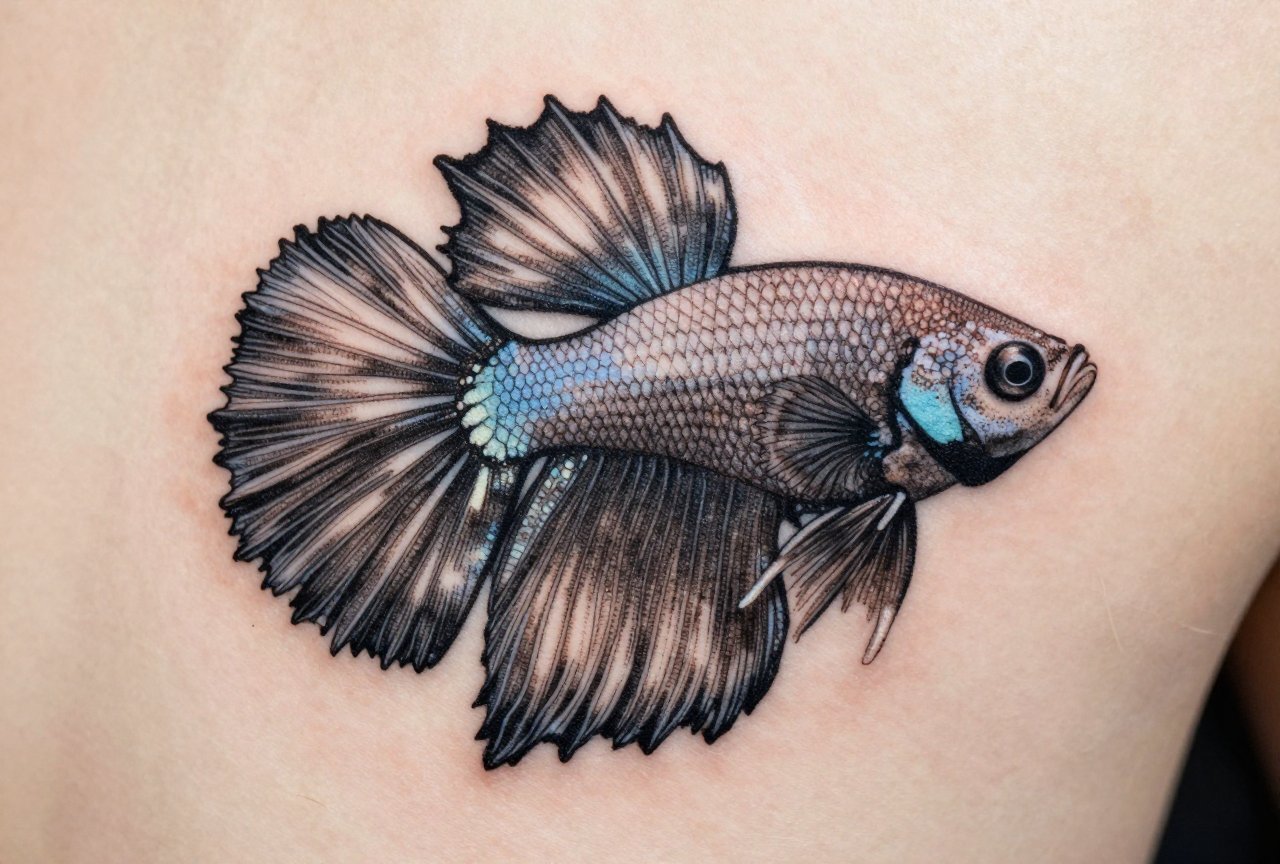
A betta fish tattoo carries layered meaning: resilience against odds, solitary strength, and beauty that demands respect. I’ve tattooed dozens of these over the years, and clients always arrive with a specific story, surviving something, choosing themselves, or honoring a period of necessary isolation. The betta doesn’t school with others; it fights its own battles. That speaks to people.
Symbolism & History
The betta’s reputation started in Southeast Asia, where villagers first noticed these fish fighting in rice paddies. Thai tradition gave them the name “pla kat,” or biting fish. By the 1800s, they were bred for combat, then gradually for spectacle. The meaning shifted from aggression to endurance, surviving confinement, thriving in small spaces, displaying brilliance despite limited territory.
What the Symbol Actually Represents
In my chair, I’ve heard clients connect bettas to divorce recovery, military deployment, chronic illness, or simply the choice to live alone and build something singular. The fish doesn’t apologize for its space requirements. It flares its gills and stands ground. That visual translates directly to skin.
- Resilience: Bettas survive in oxygen-poor water using a labyrinth organ, literal adaptation to impossible conditions.
- Solitary power: They cannot coexist with their own kind; the symbolism of chosen or necessary isolation resonates deeply.
- Veiled aggression: The flowing fins hide a fighter. Many clients identify with that duality, appearing gentle, possessing edge.
- Transformation: Dull in pet-store cups, they bloom in proper environments. Growth-through-circumstance symbolism.
Cultural Context Beyond the West
Thai culture still honors the betta as national aquatic heritage. In Vietnam, they’re associated with perseverance. Western tattoo culture adopted the symbol more recently, often stripped of origin context. I tell clients who want authenticity: research matters. A Thai-style betta paired with traditional sak yant elements carries different weight than a photorealistic pet portrait.
Common Variations & Styles
Shop floor reality: betta designs fall into distinct categories that age differently and attract different clients.
Style Breakdown
Photorealistic: Demands serious technical skill. The translucent fin edges, iridescent scaling, and color gradation separate good artists from Instagram filters. These work best at palm-size or larger. I’ve seen small photorealistic bettas blur into blue blobs after five years, skin doesn’t hold that level of detail below three inches.
Neo-traditional/Japanese-influenced: Bold outlines, limited color palette, exaggerated fin flow. These age cleaner. The black line gives the design structural integrity as skin changes. We see this a lot in walk-in shops, clients want the symbol without the maintenance anxiety.
Minimalist/line work: Single needle or fine line, often just the silhouette or negative-space suggestion. Popular with first-timers. Healing reality: fine lines can drop out or spread. Placement matters enormously, inner forearm holds; ribs or feet often don’t.
Abstract watercolor: The fin flow invites splash-style color bleeding. Looks stunning fresh. Five years later, the “water” often becomes muddy brown where colors mixed. I warn clients: yellow and purple bettas look gorgeous day one, but those complements muddy fastest.
Best Placements
Betta tattoos have natural movement, the fin flow wants space to unfurl. Cramping a betta into a two-inch ankle spot wastes the form.
- Outer forearm: Classic visibility, enough length for fin extension. Heals well, easy to show or cover.
- Thigh: Canvas size allows full tail spread. Pain tolerance manageable. We do a lot of these on clients who want the watercolor style with room for color to breathe.
- Ribcage/side: Follows the body’s natural curve, fin can trace the floating rib line. Hurts. Worth it for the flow, but clients need to commit to sitting still.
- Shoulder blade to upper back: The tail can extend toward the spine, creating movement. Sleep on your stomach during healing, I’ve had clients ruin ribcage work by rolling onto fresh ink.
- Behind the ear/small placements: Only for micro designs. The betta loses its symbolic impact when compressed to dime-size. Consider a single fin or abstract scale pattern instead.
Color longevity note: betta reds and blues are tattoo staples, but blue pigments historically fade faster to gray. Newer formulations have improved, but I still steer clients toward deeper crimsons and teals over bright primary blues if they want twenty-year vibrancy.
Who Chooses This Tattoo / Personal Meanings
After fifteen years, I can usually guess the story before it’s told. Betta clients aren’t random.
Patterns I’ve Observed
Survivors of abusive relationships often choose bettas, the “I finally have my own tank” narrative. People who’ve rebuilt after bankruptcy, addiction, or incarceration. The fish that lived in a cup and still displayed its fins. That metaphor lands hard.
Introverts who’ve stopped apologizing. The betta doesn’t need a school; it’s not defective for preferring solitude. I’ve tattooed this on software engineers, writers, night-shift workers, people whose social energy functions differently and who’ve made peace with that.
Pet memorials. Bettas live two to four years; their keepers often bond intensely because the relationship is entirely one-on-one. The tattoo becomes a tombstone with movement. I’ve done these with the fish’s actual color pattern, sometimes incorporating the tank’s silk plants or the gravel color from the client’s memory.
Competitive personalities. Fighters, athletes, entrepreneurs who respect the betta’s territorial refusal to back down. Usually rendered more aggressively, flared gills, confrontational angle.
Similar Symbols
Clients often arrive debating between a betta and something adjacent. Here’s how we talk through it in consultation.
- Koi: Shared perseverance symbolism, but koi are communal, swimming upstream in groups. The betta is singular. Choose based on whether your story is collective or individual.
- Phoenix: Also rebirth, but louder, more explosive. The betta’s resilience is quieter, daily survival rather than dramatic resurrection.
- Octopus: Intelligence, adaptability, but the octopus camouflages; the betta displays. Opposite strategies for surviving hostile environments.
- Lone wolf: Similar solitary symbolism, but mammalian, terrestrial, often masculine-coded. The betta offers fluid, gender-neutral alternative with visual softness that still carries edge.
- Lotus: Grows from mud, but rooted, stationary. The betta moves through its adversity. Consider whether your story is about blooming where planted or navigating while confined.
I had a client switch from koi to betta mid-consultation when she realized her divorce recovery wasn’t about “swimming upstream with others” but about “thriving alone in the small space I fought for.” The symbol matters. The right symbol fits like a key.
Final Thoughts
Betta fish tattoos work because the fish itself is contradictory, delicate and armored, solitary and visible, confined and magnificent. That complexity gives the design staying power beyond trend. I’ve watched clients cry during these sessions, not from pain, from the recognition that something small and overlooked could carry their story with dignity.
Choose an artist who understands fin flow as line weight, who knows that a betta’s eye placement changes its emotional register, who won’t just copy a pet-store photo but will build the design to move with your muscle. The meaning lives in the making, not just the motif. And when it heals, you’ll have something that flares its gills every time you roll up your sleeve.
Frequently Asked Questions
Do betta fish tattoos have to be colorful to carry meaning?
No. Black and grey bettas hold the same symbolism, and some clients prefer the starkness. I’ve done heavy blackwork bettas that read as armor rather than ornament. The meaning lives in the form, not the palette.
Is it disrespectful to get a betta tattoo if I’m not Thai or Southeast Asian?
The betta has crossed into global tattoo vocabulary, but context matters. Avoid pairing it with religious symbols you don’t understand. If you want to honor the origin, research Thai fighting fish history rather than treating it as generic “exotic” decoration.
How much should I expect to pay for a quality betta fish tattoo?
A palm-sized piece with proper color work runs $300-$600 in most US shops, more for large-scale or renowned artists. The fin detail takes time. Anyone quoting under $200 for a multi-color betta is either cutting corners or desperate, neither bodes well for your skin.
Can a betta tattoo be covered up or modified later if my life changes?
The flowing shape makes cover-ups challenging but not impossible. The tail’s curves can be extended into new forms, dragon fins, flame transitions, abstract waves. I always leave clients with that possibility in mind, building enough structural line to allow future adaptation.
Related Tattoo Meanings
- Birdcage Tattoo Meaning: Freedom, Captivity What Artists See
- Blacked Out Tattoo Meaning: Rebirth, Grief, and Starting Over
- Bleeding Heart Tattoo Meaning: Love, Loss Emotional Truth
- Explore more









