
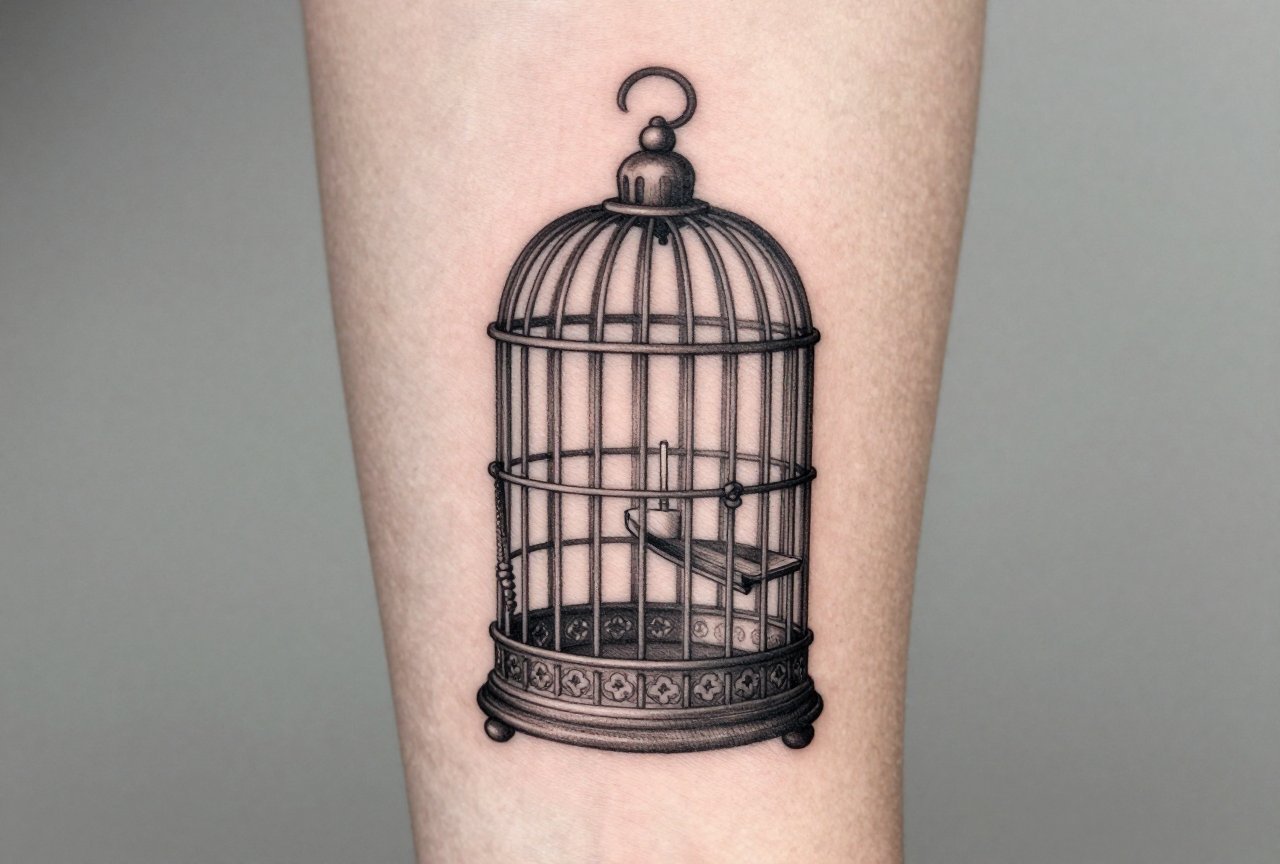
A birdcage tattoo is a visual paradox. It represents both imprisonment and liberation, depending on what’s inside, or whether the door hangs open. I’ve tattooed dozens of these over the years, and the story behind each one shifts dramatically based on a single detail: empty cage, bird inside, broken bars, or a tiny door swinging wide.
Symbolism & History
The birdcage carries weight across cultures that most clients don’t initially consider. In Victorian mourning jewelry, cages appeared alongside hairwork and weeping willows, symbols of loss, yes, but also of souls released. That duality still lives in the tattoo. I’ve had clients point to antique cage imagery and say “that’s my depression,” and others say “that’s my recovery.” Same visual, opposite read. The artist’s job is to nail the detail that tilts it toward their truth.
Freedom vs. Confinement
An open door changes everything. An empty cage with the door ajar reads as escape, as “I got out.” A bird still perched inside? That’s complicated, comfort in captivity, or choosing safety over the unknown. I’ve done one where the bird was halfway through the bars, wings spread, body still partially inside. The client called it “the year I almost left.” That ambiguity is the design’s power. It doesn’t resolve. It holds tension.
Protection & Nurturing
Not every cage is a prison. Some clients want the cage as sanctuary, keeping something precious safe from the world outside. Mothers get these sometimes, the cage holding a small bird representing a child. The bars become boundaries, not bars. The line between protection and control is thin, and good design makes that line visible. I tell clients: if you want nurturing, soften the cage. Round the bars. Add nesting material. Make it worn, loved, not stark.
Common Variations & Styles
Shop culture has its favorites. Certain cage variations come through the door repeatedly, and each carries distinct energy.
- Empty cage, open door: The classic freedom narrative. Clean, readable, works at small sizes. I’ve done these on wrists, behind ears, as first tattoos.
- Bird inside, door closed: Confinement, mental health struggles, feeling stuck. Often paired with muted color palettes or heavy black.
- Broken bars / cage falling apart: Active liberation, sometimes anger in the release. Bold lines, dynamic composition. These need space to read, forearm minimum, usually.
- Multiple birds, one cage: Family, chosen or blood. Who’s inside and who’s out tells the story.
- Floral growth overtaking cage: Nature reclaiming structure, healing over time. Popular with clients marking sobriety or post-divorce renewal.
Style matters. Fine line cages with delicate bars age poorly if too small, the lines blur, the bars merge into a dark blob. I’ve seen five-year-old finger-sized cages that read as abstract squares. For longevity, bars need negative space between them, or the artist must plan for spread. Traditional American styling solves this: bold outlines, limited palette, the cage simplified to its essential geometry. Neo-traditional allows more ornament, filigree tops, decorative bases, while keeping the structure readable long-term.
Best Placements
Where this goes changes how it functions. A cage behind the ear is private, almost secret. The same design on a forearm becomes conversation, declaration.
High-Visibility Spots
Forearms, calves, upper arms. These invite question. The client wants to talk about it, or at least wants the option. I did one on a client’s dominant forearm, a cage with the door broken off, bird long gone. She was a domestic violence survivor. The placement was strategic: she saw it when she reached, when she worked, when she extended her hand to new people. It was a reminder she chose to carry forward, not hide.
Intimate Placements
Ribs, sternum, upper thigh, back of neck. These stay closer to the body. The meaning becomes more interior, less performative. Sternum cages work beautifully with the body’s natural architecture, the cage echoing the ribcage beneath. I’ve tattooed these on clients processing body-related trauma, the cage literally over the heart. The pain of the placement becomes part of the ritual. They don’t talk about that in the articles, but in the chair, it’s real.
Small cages on wrists or ankles trend, but I warn clients: detail disappears. A cage the size of a quarter might look crisp fresh, but at ten years, those bars become a gray smudge. If you want small, simplify. Open door, single bar suggestion, maybe a bird silhouette escaping. Let the mind fill the cage in.
Who Chooses This Tattoo / Personal Meanings
After fifteen years, patterns emerge. Not stereotypes, patterns. Certain life moments push people toward this image.
- Post-incarceration: literal cages, literal freedom. Sometimes the bird is a phoenix, sometimes just a common sparrow. The ordinary bird matters here.
- Recovery from addiction: the cage as the substance, the open door as choice. These often include dates, small text, something grounding the timeline.
- Relationship endings: “I was caged” or “I caged someone else.” Guilt lives in these too. I’ve tattooed clients who were the cage, not the bird.
- Creative blocks: writers, musicians, artists who feel trapped by expectation. The cage becomes the industry, the audience, their own perfectionism.
- Chronic illness: the body as cage. These are heavy sits. We often pause, adjust, come back. The tattoo becomes collaboration, not just commission.
What unifies them is transition. Nobody gets a cage tattoo to say “I’m fine now.” They get it to say “I was somewhere, and now I’m somewhere else, and I need to mark the distance.”
Similar Symbols
Clients often arrive with reference images that aren’t quite right. I steer them toward or away from related imagery based on what they’re actually trying to say.
Butterflies emerging from chrysalises: transformation, yes, but natural, inevitable. The cage adds human-made structure, someone built it, someone holds the key. That’s crucial if the client’s story involves systems, institutions, other people.
Keys and locks: direct, less ambiguous. A key tattoo says “I found the way out” or “I hold the power.” The cage says “the way out existed, and I took it, or didn’t, or couldn’t.” More complicated. Some clients need that complication.
Barbed wire: purely negative, purely confinement. No bird, no door, no possible release. When clients bring barbed wire references, I ask: is there any version where you’re free? If yes, cage. If no, wire. The body knows which one fits.
Feathers alone: lightness, escape, but no structure to escape from. The cage gives the feather weight. Context. I’ve had clients add a single floating feather to cage designs, bird gone, only evidence remaining. That’s its own poetry.
Final Thoughts
The birdcage tattoo endures because it refuses easy reading. Every time I stencil one on, I watch the client settle into the chair differently, there’s weight to this choice, deliberation. It’s not flash art picked off a wall. It’s someone working through contradiction in permanent ink.
If you’re considering this design, know what your door is doing. Open, closed, broken, missing entirely. Know where your bird sits. The meaning lives in those specifics, not in the cage itself. Bring your artist the story, not just the image. The good ones will know how to build the bars, leave the space, make the metal look like it could actually hold something, or like it failed to.
And expect it to hurt more than you think. Ribs, sternum, anywhere bone lives close to skin. The cage form follows the body’s architecture, which means it often follows the body’s most sensitive terrain. Worth it, clients tell me after. But they don’t say it during.
Frequently Asked Questions
Does an empty birdcage always mean freedom?
Not necessarily. Some clients intend the empty cage as loss, something that was there and left. The open door usually signals freedom, but absence alone can read as grief. Context from the rest of the design matters more than the emptiness itself.
How small can a birdcage tattoo be before it blurs?
Anything under two inches risks the bars merging as the tattoo ages. If you want small, simplify to suggestion rather than full detail. A good artist will show you how much negative space the bars need to stay readable at five, ten, fifteen years.
Why do some artists refuse to do birdcages with birds inside?
Most don’t refuse outright, but they’ll push back if the design contradicts your stated meaning. A bird inside a closed cage with “freedom” as the intent? That’s a design problem, not a moral one. Artists want the image and intention to align.
Can a birdcage tattoo work with color, or should it stay black and gray?
Color works beautifully, muted teals and rusts for vintage cages, bright birds against gray metal for contrast. The risk is overcomplicating. In my experience, limit the palette to two or three colors max, or the cage structure gets lost in the visual noise.
Related Tattoo Meanings
- Hanger Tattoo Meaning: Symbolism, Styles Personal Stories
- Blacked Out Tattoo Meaning: Rebirth, Grief, and Starting Over
- Bleeding Heart Tattoo Meaning: Love, Loss Emotional Truth
- Explore more









