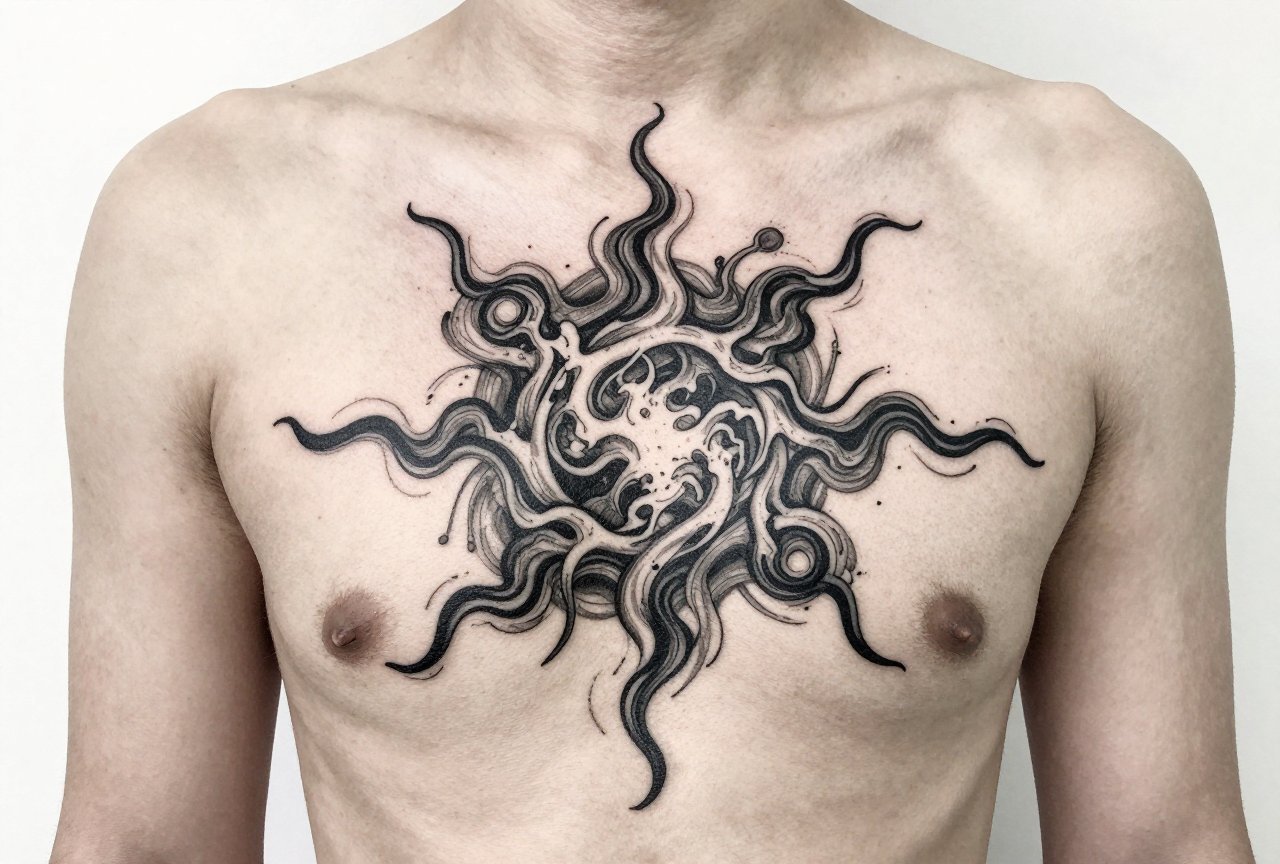
Some people want their tattoos to tell a clean story. Others want the story to explode, scatter, and reassemble somewhere unexpected. Chaos tattoos are for the second group. I’ve tattooed swirling geometric breakdowns, torn lettering, and biomechanical fragments that look like they crawled out of a crashed server. The best ones aren’t random, they’re controlled demolition. Here’s what actually works in the shop, what ages well, and where artists draw the line between beautiful disorder and just… messy.
Popular Styles That Nail Controlled Chaos
Not every scattered design reads as chaos. Some just look like the artist had a bad day. These styles have a proven visual language for disorder that tattooers can execute with intention.
Trash Polka and Its Offshoots
Red and black. Splatter, smear, photographic fragments, bold brushstrokes. I did a Trash Polka piece last year, raven’s head dissolving into clock gears and newspaper clippings across a guy’s ribs. The style was developed by German artists Simone Pfaff and Volko Merschky, and it still dominates when clients want “organized mess.” The high contrast helps it age. Those big black fields hold up. The fine red lines? They soften after five years, which actually improves the look, less graphic, more weathered.
- Best for: large pieces with negative space
- Avoid: tiny details that rely on red alone
- Reality check: needs a specialist; not every shop does this well
Biomechanical and Bio-Organic
H.R. Giger’s legacy lives in skin. I’ve seen clients sit for eight hours while we map piston rods and sinew across their shoulders, making it look like the tattoo is tearing through from underneath. The chaos here is structural, machinery and flesh in conflict. Shading is everything. Smooth gradients sell the illusion. Line work alone looks flat and cheap.
Abstract Expressionist and Splatter
Jackson Pollock on a body. I’ve tattooed pure paint-drip compositions, no recognizable imagery, just color fields and accidents. These are harder than they look. The artist has to fake randomness with total control. I tell clients: “I’m going to make this look like I spilled ink on you, but every drop is placed.” Healing can be tricky; saturated color patches sometimes settle unevenly.
Design Ideas That Actually Translate to Skin
Chaos lives in concept, but it dies in bad translation. Here are motifs I’ve seen work repeatedly.
- Shattered mirrors or glass: geometric fragments with distorted reflections inside. Great for forearms. The breaks hide muscle movement.
- Deconstructed portraits: a face coming apart into pixels, particles, or geometric shards. Requires a strong reference photo.
- Torn typography: words that fracture, overlap, or dissolve into abstract marks. I did “UNRAVEL” where the letters peeled into threads down someone’s calf.
- Cosmic collapse: nebulas, black holes, celestial bodies breaking apart. Color saturation is your friend here; muted palettes go muddy.
- Organic decay: flowers rotting into geometric patterns, trees splintering into circuitry. The contrast between natural and synthetic chaos hits hard.
One client brought me a sketch of a clock melting into a flock of birds, each bird fragmenting into smaller birds. We simplified it. Too many micro-elements and the whole thing becomes gray mush in three years. We kept the clock face readable, the first wave of birds distinct, and let the smallest fragments dissolve into suggestion. It healed clean. He came back for the other arm.
Best Placements for Chaos Tattoos
Chaos needs room to breathe. Or it needs to be compressed so aggressively that the density becomes the point. Middle ground is where chaos tattoos fail.
Large Canvas Areas
Back pieces, thighs, ribs, full sleeves. These let you establish rhythm, areas of density against real negative space. I did a full back of a city skyline dissolving into abstract storm clouds. The buildings were tight line work; the sky was pure atmospheric shading. The contrast only worked because I had eighteen inches of vertical space to let each section do its job.
Smaller Spots That Work
Wrists, behind the ear, hands. Here chaos becomes concentrated. A single screaming face fragmenting into three pieces on a wrist. A paint splatter that wraps from hand to forearm. The trick is accepting limitation. You can’t do a Trash Polka sleeve on a hand. You can do one bold smear with one hard edge. I tell clients: “Small chaos is about one strong move, not twenty weak ones.”
- Back: ideal for layered depth, multiple focal points
- Thigh: muscle stability helps detailed work age
- Forearm: high visibility, good for medium-scale fragmentation
- Hands/fingers: high chaos, high maintenance, frequent touch-ups
Color Choices: What Lasts vs. What Fades
Chaos tattoos often lean heavily on color to create disorientation. But disorientation becomes confusion when the color dies unevenly.
Black and gray is the safest chaos palette. It ages predictably. The contrast between solid black and washed gray can create all the visual noise you need. I’ve seen stunning chaotic pieces done entirely with black ink at three different dilutions.
Color demands strategy. Saturated reds, deep blues, and solid blacks hold. Pastels, neons, and soft gradients don’t. In my chair, I warn clients: “That mint green splatter will be pale gray in four years. Do you want that?” Sometimes they do, planned obsolescence as aesthetic. But most want the chaos to stay chaotic, not fade into murky suggestion.
- Longevity winners: black, crimson, cobalt, emerald, solid orange
- Fade risks: pastel pink, lavender, neon yellow, light teal
- Pro move: use color for focal points, black and gray for structure
One piece I still think about: a client wanted a tornado of color, every hue, pure saturation. We compromised. The tornado’s core was black and gray, the debris field was selective color. Three years later, the structure still reads. The color accents are softer but present. If we’d gone full rainbow, it would be a bruise-colored blur now.
Tips for Choosing Your Chaos Tattoo
I’ve watched people walk in with Pinterest boards titled “chaos tattoo” and walk out with something that doesn’t match their energy at all. Here’s how to avoid that.
Know Your Chaos Type
There’s mechanical chaos (gears, wires, structural collapse), organic chaos (nature, decay, growth run wild), and abstract chaos (pure form, color, motion). They don’t mix well. A sleeve that tries to do all three usually looks like three different artists fought on someone’s arm. Pick one language. Commit.
Find the Right Artist
Not every tattooer does chaos well. Look for healed photos, not fresh ones. Fresh chaos tattoos always look good, blood and plasma smooth the edges, swelling unifies the tones. Healed work shows whether the artist actually controlled the disorder or just got lucky. Ask directly: “How much of this style do you do?” If they hesitate, keep looking.
- Bring references but accept translation, your artist isn’t a printer
- Plan for multiple sessions; good chaos can’t be rushed
- Trust the process; the outline phase will look wrong before it looks right
- Consider how it fits existing tattoos; chaos doesn’t play well with traditional borders
We see this a lot in shops: someone with a clean traditional sleeve wants a chaos piece adjacent. The gap between structured and unstructured is hard to bridge. Sometimes we add transitional elements, geometric fragments that borrow from both languages. Sometimes we say no. A good artist will tell you when your vision creates a problem.
Final Thoughts
Chaos tattoos aren’t about lacking a plan. They’re about having a plan so tight it can contain explosion. The best ones I’ve done started with long conversations, not impulse. What kind of disorder speaks to you? Mechanical breakdown? Natural entropy? Pure abstract force? Once you know that, the design follows.
Healing will humble any chaos piece. That crisp splatter softens. Those razor-sharp fragments round at the edges. But chaos has an advantage: it doesn’t need to stay perfect to stay powerful. A traditional rose with blown lines looks like a mistake. A chaos tattoo with settled edges looks like it was always meant to be weathered. That’s the secret. You’re not fighting time. You’re inviting it in.
Frequently Asked Questions
Do chaos tattoos hurt more than other styles?
Not inherently, but they often cover larger areas and involve heavy saturation passes. I’ve had clients say the dense black fill in Trash Polka feels sharper than fine line work. Placement matters more than style for pain.
Can a chaos tattoo cover up an old tattoo?
Absolutely. Chaos is forgiving. I use fragmented elements to break up old outlines, and the visual noise hides previous work better than most traditional cover approaches. The new piece just needs to be darker and larger.
How do I keep a color-heavy chaos tattoo from going muddy?
Sunscreen, always. But also start with strategic color placement. I put long-term color in areas with less sun exposure and use black to frame it. Touch-ups every few years keep the chaos crisp, not murky.
Will a chaos tattoo look unprofessional in a conservative workplace?
Depends on placement and content. A forearm of abstract splatter reads as art to most people. A screaming face fragmenting into bones? Less so. I have clients who wear long sleeves for work and show full chaos on weekends. Plan for your actual life, not your ideal one.
More Tattoo Ideas
- Sonic Tattoo Ideas for Fans Artists
- Biomech Watercolor Tattoos: A Working Artist s Guide
- Watercolor Cat Tattoos: A Working Artist s Guide
- Explore more